2,000-Year-Old Greek Sling Bullet Found at Hippos Carries Ancient Battlefield Insult!
Archaeologists excavating the ancient city of Hippos have uncovered a remarkable military artefact dating back around 2,000 years: a small lead sling bullet engraved with a taunting message in Greek. The discovery was made during recent fieldwork near a riverbed beside the city’s necropolis, an area regularly surveyed with metal detectors as researchers continue to explore the remains of the former Hellenistic and Roman settlement.
Perched high above the Sea of Galilee, Hippos was once one of the important cities of the Decapolis, a network of urban centres shaped first by the successors of Alexander the Great and later influenced heavily by Roman rule. Its elevated position gave it strategic control over trade and military routes on the eastern side of the lake, making it a key stronghold throughout centuries of regional conflict.
The sling bullet itself is small but striking. Measuring just over three centimetres long and weighing approximately 45 grams, it was cast from lead using a mould, a common production method in the Hellenistic world. Its almond-shaped design matches many military projectiles used during the era. One side of the object appears heavily dented, suggesting it struck a target at considerable speed during battle.
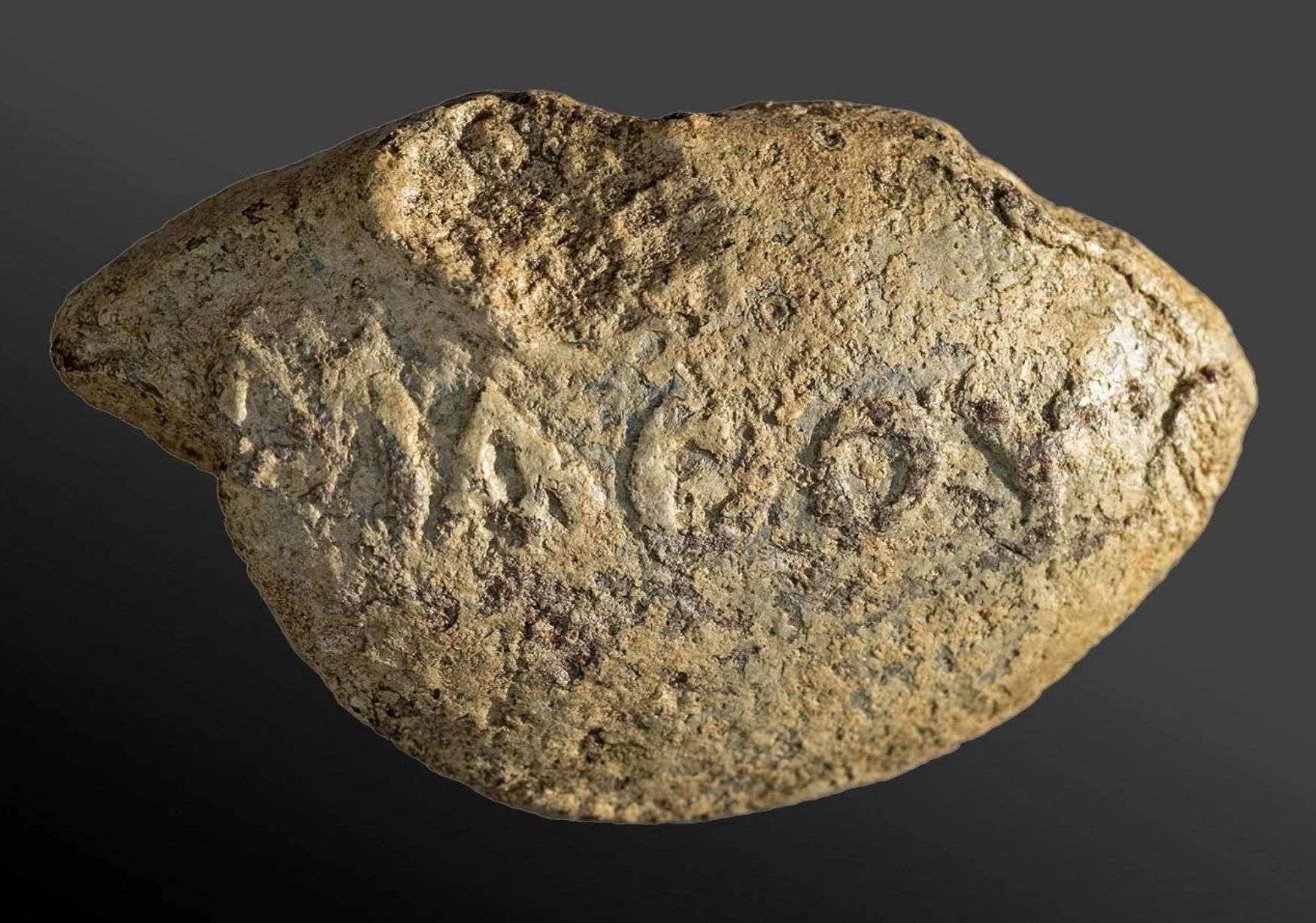
Photo Credit: Michael Eisenberg, University of Haifa
What makes the find especially unusual is the inscription engraved across its surface. Researchers identified the Greek word “ΜΑΘΟΥ”, derived from a verb meaning “to learn”. Scholars believe the phrase was intended as a command, roughly translating to “learn your lesson”. Rather than simply marking ownership or manufacture, the wording appears to have been deliberately provocative, the ancient equivalent of battlefield mockery aimed at enemy forces.
According to researchers from University of Haifa, the inscription reflects a broader tradition of psychological warfare in the ancient world. Similar sling bullets discovered across the Levant have carried short, aggressive phrases intended to intimidate opponents or humiliate them during combat. Others have featured symbols such as lightning bolts, scorpions, or references to gods and military leaders.
Excavations at Hippos over the past 26 years have uncovered dozens of lead sling bullets, many dating to the second century BCE. The city itself experienced repeated military upheaval during that period. Initially linked to Ptolemaic control, the settlement later fell to Seleucid forces following the Battle of Paneion around 199 BCE before eventually becoming part of the Roman sphere.
Although sling weapons may seem primitive by modern standards, they were highly effective tools of war in antiquity. Skilled slingers could launch projectiles across distances approaching 300 metres with surprising force and accuracy. Because lead ammunition could be mass-produced quickly and cheaply, sling bullets became a practical weapon during prolonged military campaigns.
Researchers also note that the wording on the Hippos bullet is linguistically unusual. The Greek grammar uses a middle-voice construction, blending action and consequence in a way that intensifies the insult directed at whoever stood on the receiving end. This subtle phrasing gives the object a surprisingly personal quality, offering a rare glimpse into the emotions and attitudes of ancient soldiers.