Archaeologists Uncover Second-Largest Roman Olive Oil Production Complex in Tunisia!
Archaeologists are shedding new light on one of the largest olive oil production centres ever identified from the Roman world, hidden for centuries among the steppes of western Tunisia’s Kasserine region. An international team from Tunisia, Spain, and Italy has been exploring the ancient landscape around Cillium, close to today’s Algerian border, and their discoveries reveal a remarkably well-organised agricultural system that once fuelled Rome’s appetite for olive oil.
Recent excavation seasons have centred on two vast olive-farming estates set within the Jebel Semmama massif. Despite its harsh climate, with limited rainfall and sharp temperature swings, the area proved ideal for olive cultivation. During the Roman period, North Africa rose to become the Empire’s main olive oil producer, with Tunisia emerging as Rome’s primary supplier.
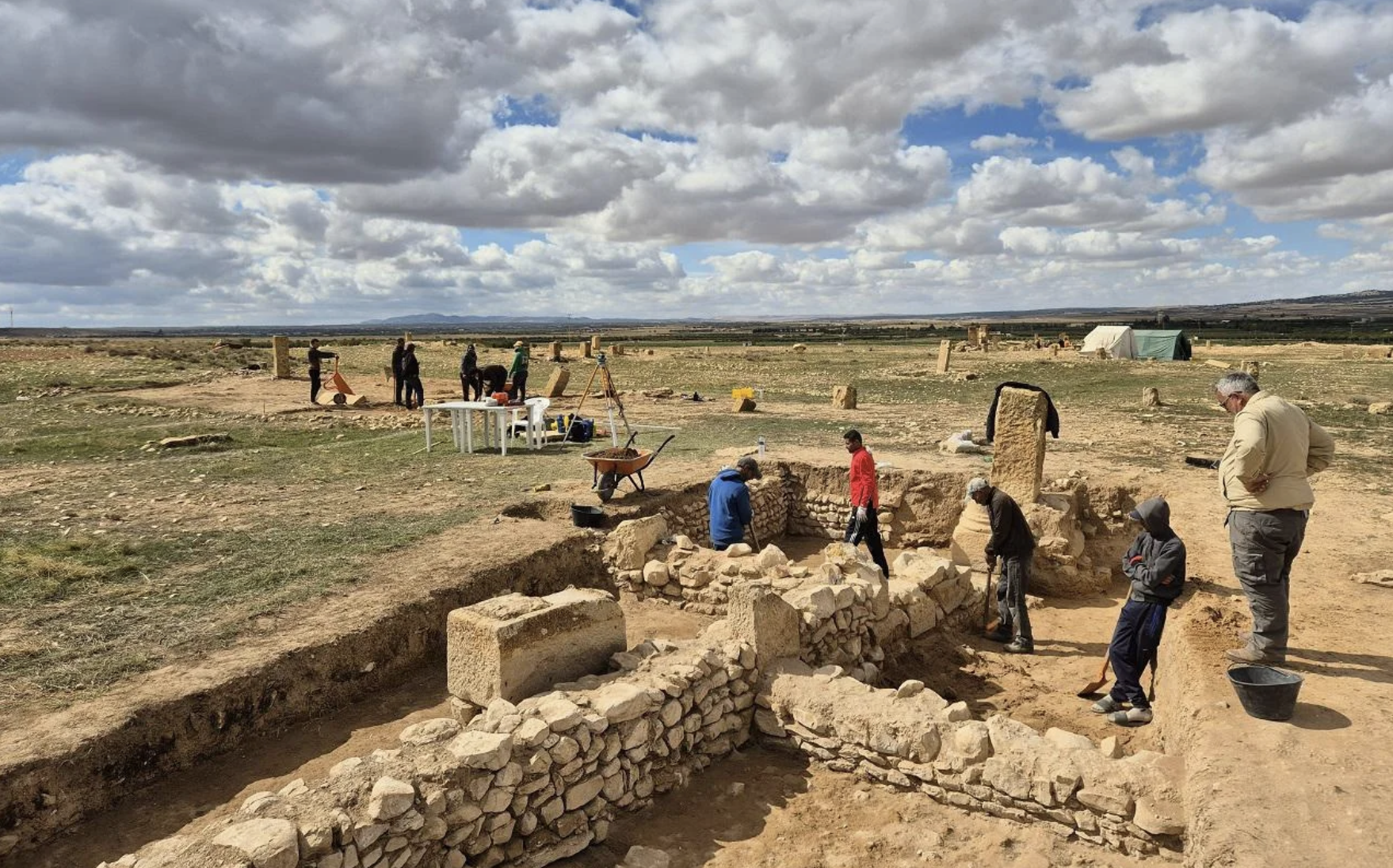
Photo Credit: Università Ca’ Foscari Venezia
At the heart of this research lies Henchir el Begar, thought to be the ancient Saltus Beguensis. A 2nd-century inscription records the estate’s right to hold a market every two months, hinting at its importance in regional trade. Spanning roughly 33 hectares, the settlement is divided into two main zones, Hr Begar 1 and Hr Begar 2, each equipped with pressing installations, rainwater-harvesting systems, and multiple cisterns. Together, they form one of the most advanced agricultural production hubs known in Roman Africa.
In the first sector, archaeologists uncovered a monumental torcularium containing twelve beam presses, the largest Roman oil-pressing facility ever found in Tunisia and second only to one other site across the entire Empire. The second sector houses another industrial-scale installation with eight presses. Evidence from excavations and stratigraphy shows that both complexes were active from the 3rd to the 6th centuries CE, a period of political change but steady economic continuity.
Around these imposing structures lay a rural vicus, home to colonists and possibly local families. The abundance of millstones and grinding stones scattered across the area points to a mixed agricultural economy involving both olive oil and grain production. Ground-penetrating radar surveys have recently revealed an extensive network of buried houses and pathways, overturning earlier assumptions that this frontier zone was sparsely occupied. Instead, it appears to have been a thriving, well-structured rural community.

Photo Credit: IPAR Project / Università Ca’ Foscari Venezia
This archaeological mission began in 2023 under the leadership of Professor Samira Sehili (University of La Manouba and the National Institute of Cultural Heritage of Tunisia) and Professor Fabiola Salcedo Garcés (Complutense University of Madrid). In 2025, the project expanded to include Professor Luigi Sperti of Ca’ Foscari University of Venice, with official backing from Italy’s Ministry of Foreign Affairs and International Cooperation. The partnership brings together researchers from across the Mediterranean and advances our understanding of ancient production economies, particularly the vast olive-oil networks that helped sustain Rome.
Beyond the Roman industrial remains, the team has uncovered objects dating from the Byzantine period and later centuries, including a decorated copper-and-brass bracelet, a limestone projectile, and architectural fragments such as a reused Roman press component. These finds reflect the long lifespan of the settlement and the enduring habit of reusing materials across generations.
As excavations continue, Henchir el Begar is emerging as a key site for understanding how North Africa supported the Roman Empire, not only with its abundant olive oil, but with complex rural communities whose organisation and productivity are only now coming into focus.