Beachy Head Woman DNA Study Reveals She Was a Local Woman of Roman Britain!
For more than ten years, a Roman-era skeleton discovered in southern England sparked debates about migration, identity, and the limits of archaeological science. Known as the Beachy Head Woman, she was long thought to be an immigrant to Britain. However, a new study suggests she was, in fact, a local woman from Roman Britain.
The remains, dating back roughly 2,000 years, were rediscovered in 2012 in a box at Eastbourne Town Hall. A handwritten label claimed the skeleton had been found near the cliffs of Beachy Head in the 1950s, though no excavation records exist. Radiocarbon dating later confirmed she lived between CE 129 and 311, during the Roman occupation of Britain.
Early scientific analyses, based on skeletal measurements, suggested a possible sub-Saharan African origin. This theory captured public imagination and even featured in museum displays, presenting her as one of the earliest known Africans in Britain. Later, unpublished DNA studies hinted at a potential Mediterranean link, possibly to Cyprus, but the evidence was incomplete and inconclusive.
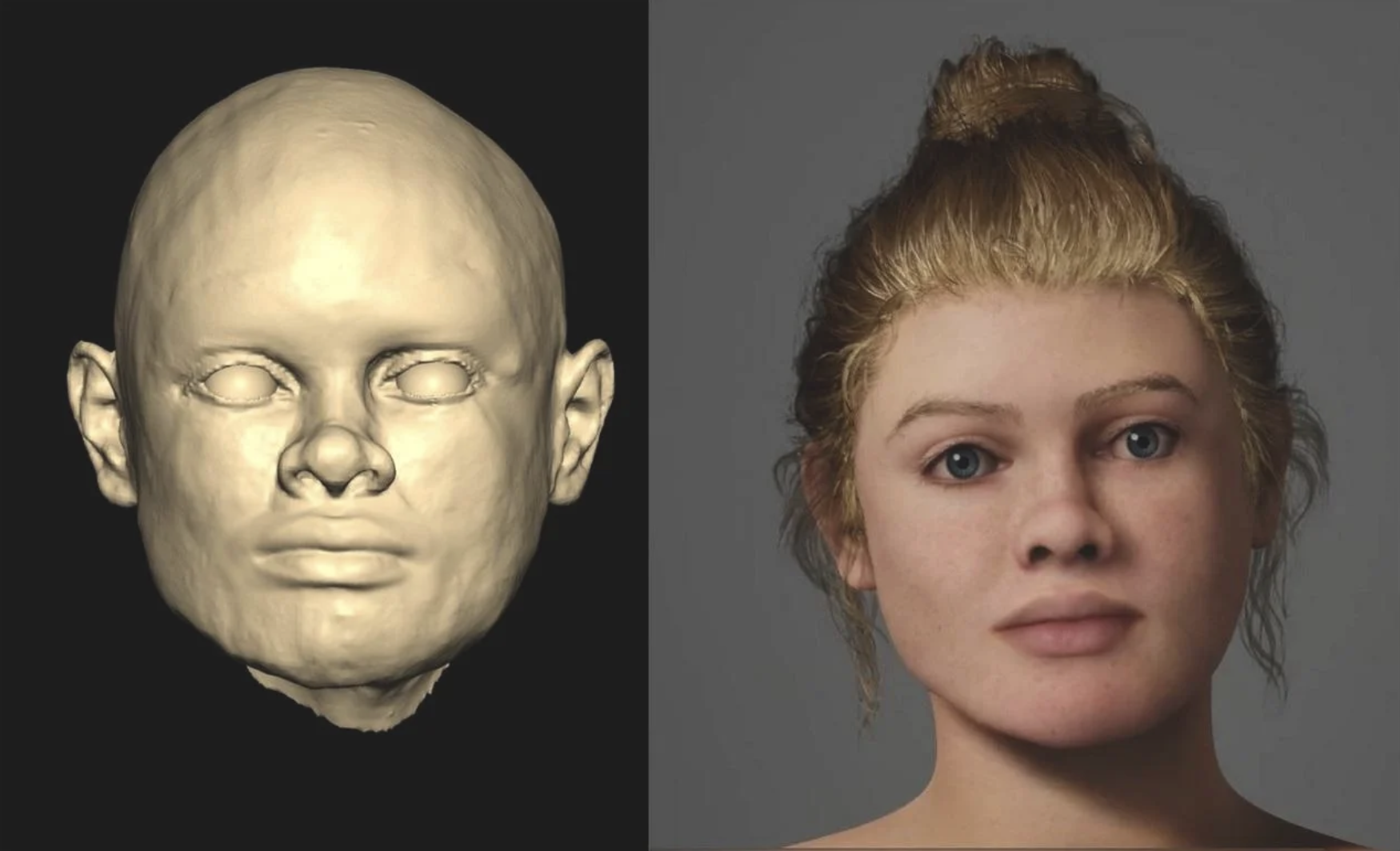
Photo Credit: Face Lab at Liverpool John Moores University, in A. Walton et al., Journal of Archaeological Science (2025)
The recent research, led by the Natural History Museum in London in collaboration with University College London, applied advanced ancient DNA sequencing techniques that were unavailable a decade ago. By analysing a far larger amount of high-quality DNA, researchers were able to place her ancestry within the broader genetic context of Roman Britain.
The findings reveal that her DNA most closely resembles that of people from rural southern Britain during the Roman period, as well as modern populations in England. There is no evidence of recent sub-Saharan African or Mediterranean ancestry. Isotope analysis of her teeth and bones further indicates she spent her early years on the south coast of Britain and moved around in ways typical of other local residents of the time.
Bioanthropological analysis offers additional glimpses into her life. She was aged between 18 and 25 at the time of death and stood just over 1.5 metres tall. A healed leg injury shows she survived a serious wound earlier in life, and chemical traces in her bones reveal a seafood-rich diet, consistent with coastal living.
Modern forensic techniques have also helped update her facial reconstruction. The latest work suggests she may have had blue eyes, light hair, and intermediate skin pigmentation. These details have been incorporated into a refreshed digital reconstruction, giving a more lifelike impression of her appearance.
The story of the Beachy Head Woman is more than a solved historical mystery; it demonstrates how scientific interpretations evolve as technology advances. What was once seen as the tale of a distant migrant is now understood as the story of a local woman, offering a clearer and more accurate picture of life in Roman Britain.