Archaeologists have identified what appear to be the first examples of stencilled rock art ever recorded in southern Africa. The unusual paintings were discovered at La Rochelle, a rock shelter near Carolina in Mpumalanga, South Africa, and consist of two small human-like figures created using a technique not previously documented in the region.
The discovery was reported by David Pearce of the University of the Witwatersrand and Kiah Johnson of the University of Cambridge in the South African Archaeological Bulletin. Although rock paintings are well known throughout southern Africa, these faint figures offer a new perspective on the techniques used by ancient artists.
Stencilling involves placing an object against a surface and applying pigment around it, leaving its outline visible once the object is removed. Unlike conventional paintings made using brushes or fingers, this technique produces a shape defined by the absence of paint.
Examples of stencilled art have been documented in numerous parts of the world, including European Ice Age caves, China, Indonesia, Papua New Guinea and Australia. Research has also revealed some surprising variations. In Egypt, miniature hand stencils once thought to represent the hands of infants were later identified as the forelimbs of lizards. At a site in northern Australia, researchers have also identified unusually small stencils that may have been produced using templates made from beeswax.
Despite these discoveries elsewhere, stencilling had not previously been identified in southern African rock art, making the La Rochelle figures particularly significant.
The rock shelter itself is relatively large compared with others in the surrounding Highlands region. Measuring approximately 30 metres in length and five metres in depth, it contains numerous paintings depicting animals and human-like figures. These include eland, hartebeest and smaller antelope, alongside other images produced using fine brushwork. However, rock art in the wider region is often sparse and poorly preserved, making unusual or faint markings particularly easy to overlook.
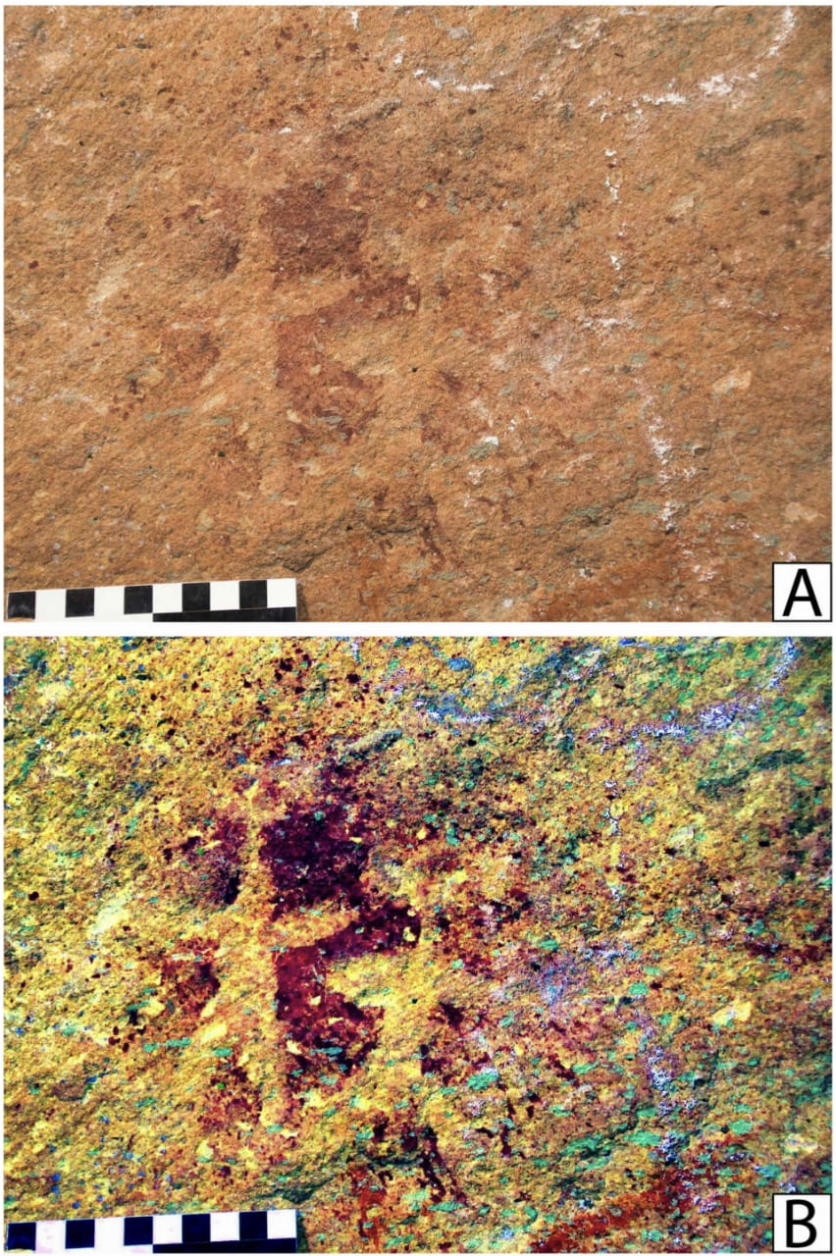
Photo Credit: David Pearce
La Rochelle had already been documented by researchers Anna Steyn in 1995 and Mduduzi Maseko in 2020, but neither recorded the two stencilled figures. Their subtle appearance may explain why they remained unidentified for so long.
Each figure measures approximately nine centimetres in height. Both have a simple, almost stick-like appearance, with indistinct heads and slender limbs extending from elongated torsos.
The surrounding pigment provides the clearest evidence that the images were created using a different method from the other paintings at the site. The figures appear as unpainted rock against a background of red pigment, rather than having the clearly defined outlines typically associated with brush or finger painting.
Researchers also observed that the pigment is concentrated most heavily between the two figures, becoming thinner further away. Tiny specks of paint surround the denser areas, suggesting that liquid pigment was sprayed or splashed against a template placed on the rock surface.
To make the faint markings easier to examine, Pearce and Johnson enhanced their photographs using D-Stretch, specialist software designed to bring out subtle details in rock art.
Although the researchers have identified the likely technique, the object used to produce the figures remains unknown. The shapes do not appear to correspond to any naturally occurring object, suggesting that the artists deliberately created or selected a template. Several materials could have served this purpose, including beeswax, clay, carved wood, bone, woven plant fibres or cut leather.
Beeswax is one possibility worth considering. Honey gathering was practised by San communities, and bees hold symbolic significance within San belief systems. However, there is currently no direct evidence that beeswax templates were used to create the La Rochelle figures.
Without further examples or supporting archaeological evidence, it is impossible to determine which material was involved. The discovery nevertheless raises interesting questions about how ancient artists produced their images and whether making the templates themselves carried any particular significance.
Establishing the age of the stencils presents another challenge. Neither figure overlaps with any of the other paintings in the shelter, meaning researchers cannot use their relative positions to establish which images were created first.
Direct dating of rock art at other southern African sites has shown that paintings within a single shelter can accumulate over hundreds of years, and sometimes across periods exceeding a millennium. Consequently, the stencils could be considerably older or younger than the surrounding artwork.
Their small size offers little help in narrowing down the date. Southern African rock paintings commonly depict figures much smaller than life size, so the nine-centimetre images do not stand out as unusual in this respect. For now, the researchers cannot establish when the figures were produced or how they relate to the wider artistic traditions represented at La Rochelle.
The shelter has undergone considerable changes over time, adding further complexity to the study of its paintings. The researchers also cannot yet confirm whether the stencils were made by hunter-gatherer communities.
If hunter-gatherers were responsible, the process of creating the templates may have held cultural or ritual significance. The researchers point to San traditions in which the preparation of paint itself could form part of ritual practices, although there is not enough evidence to establish whether anything similar occurred at La Rochelle.
The discovery highlights how much there is still to learn about the diversity of techniques used in southern African rock art. While the region is renowned for its painted depictions of people and animals, the two figures demonstrate that artists may also have experimented with methods that have so far received little archaeological attention.
Pearce and Johnson hope their findings will encourage further investigations of rock shelters in Mpumalanga and neighbouring regions. Identifying additional examples would help researchers establish whether stencilling was a widespread practice or a much rarer technique.
For now, the two faint figures at La Rochelle provide the first recorded evidence of stencilled rock art in southern Africa, opening up new questions about the materials, methods and possible cultural significance of ancient artistic expression.