Neolithic Axe Discovered in Steckborn Harbour After 5,000 Years!
What started as a fairly routine bit of maintenance work during the winter of 2025/26 soon turned into something far more exciting. Falling water levels and a build-up of sediment meant dredging was needed in Steckborn’s harbour, an area already known, since the 19th century, for its prehistoric pile-dwelling remains.
Rather than risk disturbing anything important, a specialist dive team from the Office of Archaeology of Thurgau stepped in during spring 2025 to carry out a careful underwater excavation. Working across an area of around 50 square metres, they uncovered layered deposits of lake marl and silt, along with remarkably well-preserved remains of a Neolithic settlement.
Among the usual finds (wooden house piles, animal bones, pottery fragments, and stone tools) one object stood out above the rest: an almost complete felling axe. Finds like this are incredibly rare, especially in such an intact condition.
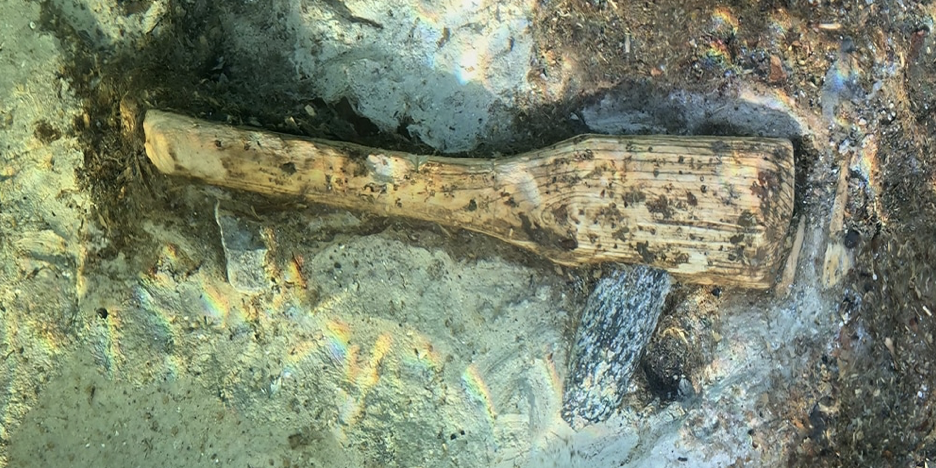
Photo Credit: ©Canton Thurgau
Radiocarbon dating revealed that the axe’s wooden handle dates back to around 2800 BCE, placing it firmly in the Late Neolithic period. What makes this discovery particularly special is the preservation of the wood itself. Organic materials like this don’t usually survive unless they’ve been protected in waterlogged, low-oxygen conditions, which is exactly what happened here.
The handle was made from ash, a wood prized for its strength and flexibility, ideal qualities for tool-making in prehistoric times. Its survival offers valuable insight into how people of the time selected and worked with natural materials.
The blade, on the other hand, was crafted from prasinit, a tough metamorphic rock linked to the Alpine region. Interestingly, researchers believe that the people of Steckborn didn’t transport this material over long distances. Instead, they likely gathered it locally from glacial deposits, showing a deep understanding of the landscape around them.
This discovery forms part of a much wider picture of prehistoric life around the Alps. The region is known for its pile dwellings, homes built on stilts along lakeshores and wetlands, dating from around 5000 to 500 BCE. These settlements are so significant that they’ve been recognised as a UNESCO World Heritage cultural phenomenon.
Waterlogged environments like these act almost like time capsules. They preserve organic materials such as wood, textiles, and plant remains that would normally decay on dry land. Because of this, discoveries like the Steckborn axe help archaeologists piece together not just tools, but entire ways of life.

Photo Credit: ©Canton Thurgau
Evidence from around Lake Constance suggests these communities lived in a balanced way, combining farming, animal husbandry, fishing, and foraging. Tools like this axe would have been essential, used for clearing woodland, building structures, and possibly even carrying social or symbolic meaning.
After being carefully recovered, the axe was taken to the Thurgau Office of Archaeology for conservation. Specialists worked to stabilise both the wooden handle and the stone blade, ensuring the object could be preserved for the future.
In an impressively short space of time, just a year after its discovery, the axe has now gone on public display at the Museum of Archaeology in Frauenfeld. Visitors can now see, up close, an object that once formed part of everyday life in a prehistoric lakeside community.
Although it’s not large or flashy, the Steckborn axe is an extraordinary find. Its level of preservation, combined with its clear context and craftsmanship, makes it something quite special. It brings us closer to the people who made and used it nearly 5,000 years ago along the shores of Lake Constance.
Perhaps just as importantly, it highlights something often overlooked: even ordinary construction work can uncover hidden chapters of human history. With the right precautions in place, these moments can turn into valuable opportunities to learn more about our distant past.