Lost Words of Empedocles Discovered in Cairo Papyrus Fragment!
Every so often, a discovery comes along that quietly reshapes what we thought we knew about the ancient world. This is one of those moments. Tucked away for years in a Cairo archive, a delicate fragment of papyrus has revealed something extraordinary: thirty previously unknown lines written by the pre-Socratic philosopher Empedocles.
Dating back to around the 1st century BCE, the manuscript offers a rare chance to hear directly from a thinker whose influence on Western philosophy has been immense, despite the fact that most of his original work has been lost for over 2,000 years.
What makes this discovery even more fascinating is where it happened. There was no dramatic excavation or buried treasure, just a careful re-examination of material already sitting on the shelves of the French Institute of Oriental Archaeology in Cairo.
It was here that Nathan Carlig, a papyrologist from the University of Liège, identified the fragment (catalogued as P. Fouad inv. 218) as part of Physica, a major philosophical poem by Empedocles.
Until now, Physica has only survived in fragments, quoted or paraphrased by later writers such as Plato, Aristotle, and Plutarch. That means we’ve largely been relying on second-hand interpretations rather than Empedocles’ own voice. This new fragment changes that in a big way.
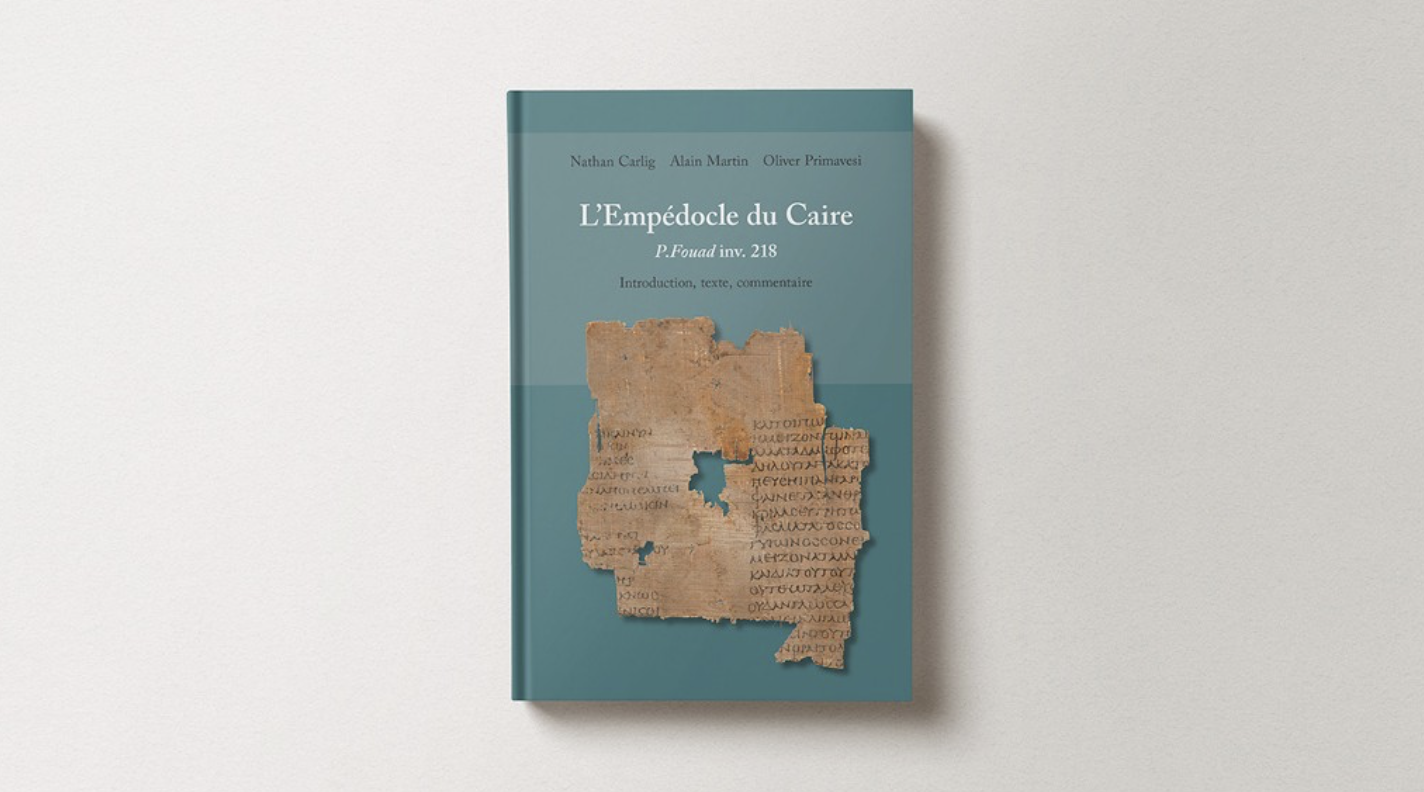
Photo Credit: University of Liège
The newly uncovered lines explore one of Empedocles’ most compelling ideas: how we perceive the world around us. At the heart of this is his theory of “effluvia”, tiny particles given off by objects that interact with our senses, especially sight. While it may sound unusual today, it’s actually an early attempt to explain perception in physical terms, bringing Empedocles surprisingly close to later scientific thinking.
What’s particularly interesting is how these lines connect with other ancient texts. Scholars have found links to writings by figures like Theophrastus, and even hints of influence in the works of Aristophanes and the Roman poet Lucretius.
All of this suggests that Empedocles’ ideas may have travelled further and lasted longer than we previously realised.
One of the most intriguing implications of this discovery is how it feeds into an ongoing debate: was Empedocles a precursor to atomism? Philosophers like Democritus are usually credited with developing atomic theory. However, Empedocles’ vision of the world, made up of interacting elements and governed by forces he called Love and Strife, shares some striking similarities.
He may not have proposed atoms in the strict sense, but his thinking seems to lay important groundwork. In that sense, he stands at a fascinating crossroads between myth and science.
Researchers have described this discovery in unusually vivid terms. To put it into perspective, imagine trying to reconstruct a major modern author from scattered quotes, only to suddenly uncover original pages of one of their greatest works. That’s the scale of what this papyrus represents.
Some scholars are even calling this period a kind of “second Renaissance”, as advances in papyrology continue to bring long-lost texts back into view.
Beyond the excitement of the find itself, this fragment helps reshape how we understand Empedocles’ place in history.
It strengthens the connections between him and other thinkers, clarifies his ideas, and gives us a clearer picture of how early Greek philosophy approached big questions about matter, perception, and reality.
At a time when fields like philosophy, physics, and cognitive science increasingly overlap, returning to these original sources feels more relevant than ever.
The newly discovered verses have been published and analysed in L’Empédocle du Caire, edited by Nathan Carlig, Alain Martin, and Olivier Primavesi.
And this is likely just the beginning. As research continues, there’s every chance that this small fragment will unlock even more insights, not just about Empedocles, but about how knowledge travelled and evolved across the ancient world.