1,600-Year-Old Phallic Roman Nail Cleaner Found Near Cheltenham!
A remarkably well-preserved personal grooming tool dating to the final centuries of Roman Britain has been discovered during archaeological excavations near Cheltenham, Gloucestershire.
The small copper-alloy object, believed to date from around AD 300–400, is shaped like a phallus and was designed as a nail cleaner. Archaeologists working on the M5 Junction 10 Improvements Scheme believe it could be one of the finest examples of this unusual type of Roman object ever discovered in Britain.
The artefact was recovered from one of several archaeological sites being investigated as part of the major road improvement project. Excavations are being undertaken by Archaeological Research Services Ltd on behalf of Galliford Try for Gloucestershire County Council.
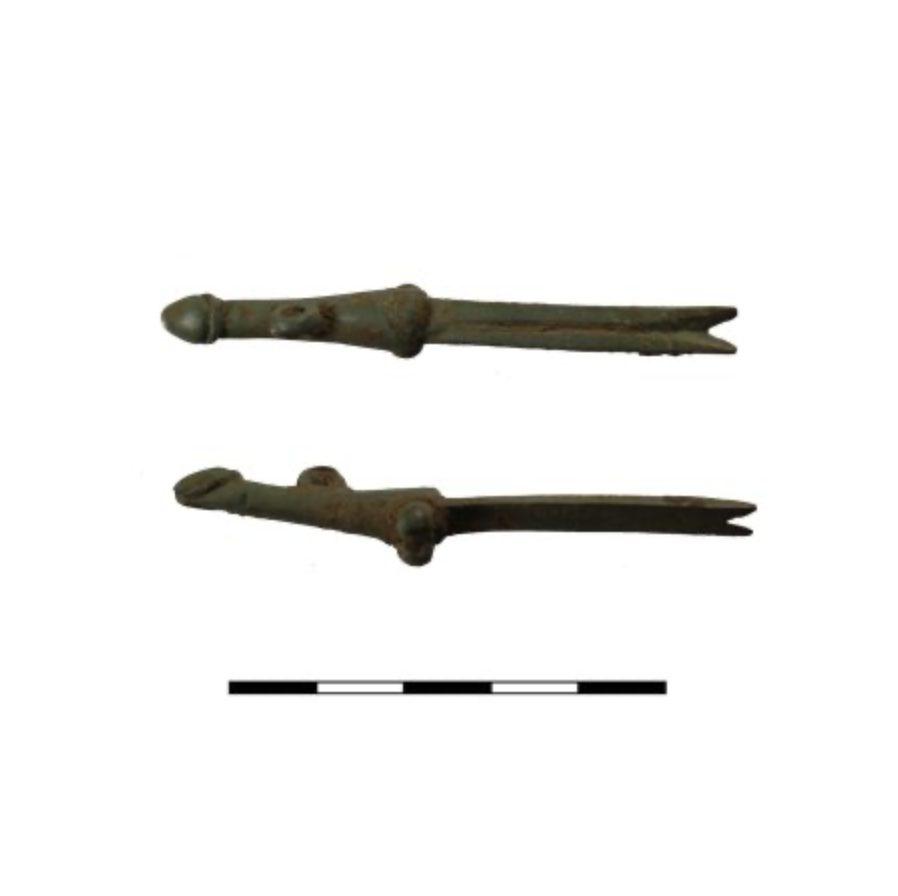
Photo Credit: Archaeological Research Services Ltd.
At first glance, the object appears to have been a simple item of personal hygiene. Roman nail cleaners were used to remove dirt from underneath the fingernails and were small enough to be carried around by their owners.
They were often part of collections of personal grooming equipment, alongside items such as tweezers and ear scoops. What makes the Cheltenham discovery particularly intriguing, however, is its distinctive shape. The nail cleaner was deliberately fashioned in the form of a phallus, combining an ordinary grooming implement with a symbol that held considerable significance in Roman society.
Phallic imagery was widespread throughout the Roman world and should not automatically be interpreted through a modern understanding of sexual symbolism. Instead, such representations were frequently associated with protection, fertility, prosperity and good fortune.
Phallic amulets were worn by people of different ages and genders, while similar imagery appeared on jewellery, household objects and military equipment. This means that the Cheltenham nail cleaner may have had a dual purpose. Its owner could use it as a practical grooming tool while simultaneously carrying an object believed to provide some form of protection or good fortune.
The nail cleaner was not the only discovery at the site to provide an insight into the appearance and personal possessions of people living during the later Roman period. Archaeologists also recovered a striking copper-alloy belt buckle and associated plate. The two components were produced from a single sheet of metal, which had been folded around a D-shaped buckle before being secured with rivets.
The design allowed the buckle to move freely as the belt was worn, while the attached plate had been given considerable decorative attention.
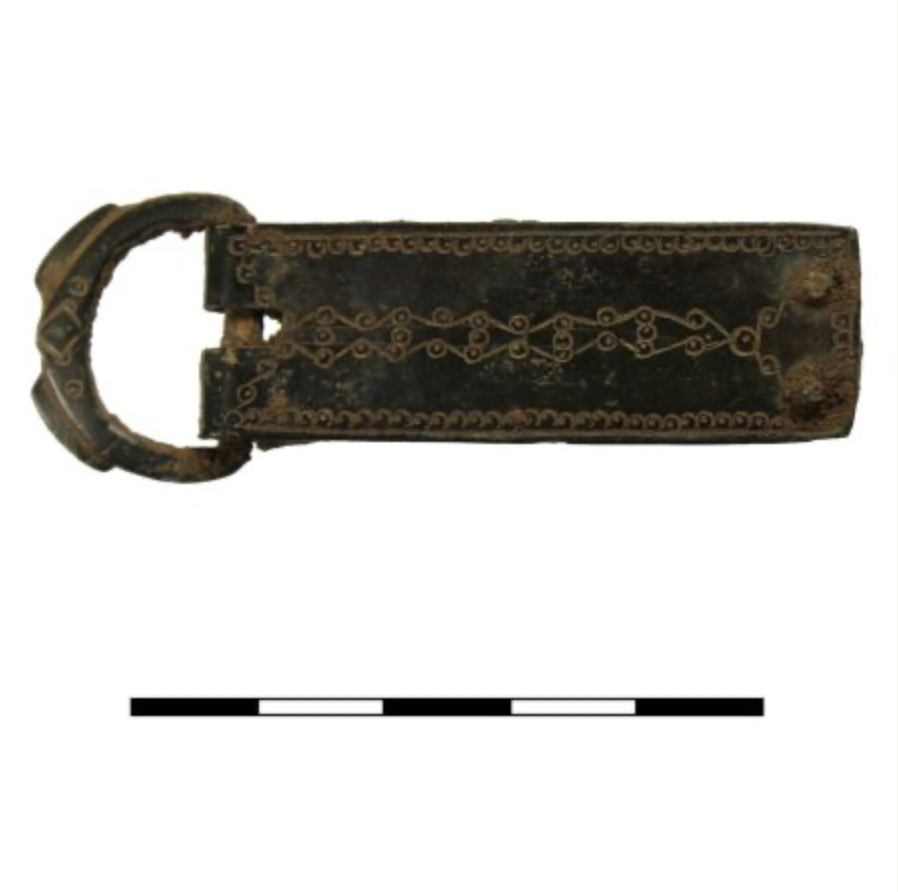
Photo Credit: Archaeological Research Services Ltd.
Stamped circles surrounded its edges, while the centre featured an intricate geometric pattern resembling plant forms. Although the buckle had an obvious practical function, its decoration would also have made it a visible part of the wearer's clothing.
Together, these discoveries provide a much more intimate perspective on life in Roman Gloucestershire. They reveal not only the kinds of objects people used, but also something about how they presented themselves and the beliefs they incorporated into everyday life.
The finds were made at Site 2.1, an area that has produced extensive evidence for settlement, farming and other activities.
Archaeologists have identified numerous ditches, pits, postholes, trackways and enclosed spaces, demonstrating that the landscape was repeatedly divided, reorganised and adapted over time. A well has also been identified, while deposits containing domestic rubbish and material from demolished buildings point towards periods of occupation and redevelopment.
Coins are another particularly important part of the archaeological assemblage. Finds recovered across the wider site span more than two millennia, demonstrating that people continued to use and return to the landscape long after the Roman period had ended.
Some of the later discoveries include 18th-century buttons associated with the Royal Navy, known as ‘dandy’ buttons, as well as 19th-century livery buttons decorated with animals taken from family coats of arms.
Archaeologists have also recovered what may be a lead trade seal associated with Holland and Barrett. It could have been used to secure a sack of flour, providing a fascinating glimpse into much later commercial activity in the area.
The discovery fits into a wider picture of intensive Roman activity across Gloucestershire.
During the Roman period, the Cotswolds and surrounding areas contained a network of farms, villas, settlements and roads. The region was particularly well connected to major centres such as Glevum, the Roman name for modern Gloucester, and Corinium, now Cirencester.
The extensive archaeological investigation associated with the M5 Junction 10 improvements covers approximately 30 hectares. Work began in October 2025 and has already produced a diverse collection of Roman material.
Among the earlier discoveries were coins, brooches and pottery, alongside evidence for agricultural activity including a grain-drying structure. One particularly unusual burial was also identified, in which the individual's skull had been positioned between their knees, adding another intriguing piece to the story of the Roman-period community that once occupied the landscape.
The phallic nail cleaner may be tiny compared with some of the other discoveries made during the excavation, but its significance lies precisely in its personal nature. Rather than representing the power of the Roman army or the wealth of an elite villa owner, the object belonged to an individual who used it as part of their everyday routine.
It is a reminder that archaeology can reveal the everyday lives of individuals just as effectively as it can uncover monuments and grand structures. Sometimes, the smallest objects can provide the most personal connection to people who lived in Britain's distant past.