A tiny red gemstone, measuring just 13 by 11 millimetres, has provided a fascinating glimpse into the world of ancient Greek theatre. Despite its remarkably small size, the intricately carved stone depicts several figures associated with a satyr play, including satyrs, a seated figure thought to represent a poet or playwright, and a statue connected with the god Dionysus.
Researchers have also identified a previously overlooked detail in the composition: a small female figure positioned behind the statue, who may represent Thalia, the Muse of comedy.
The discovery was examined in a study published in Cedrus on 29 October 2026 by researchers Melih Arslan and Ahmet Emirhan Bulut. Their investigation focused on a carnelian gemstone mounted in an iron ring, now held in the Gaye Çarmıklı Collection at the Ankara Ethnography Museum. Based on its artistic style, material and carving techniques, the researchers date the object to the first half of the 1st century BC.
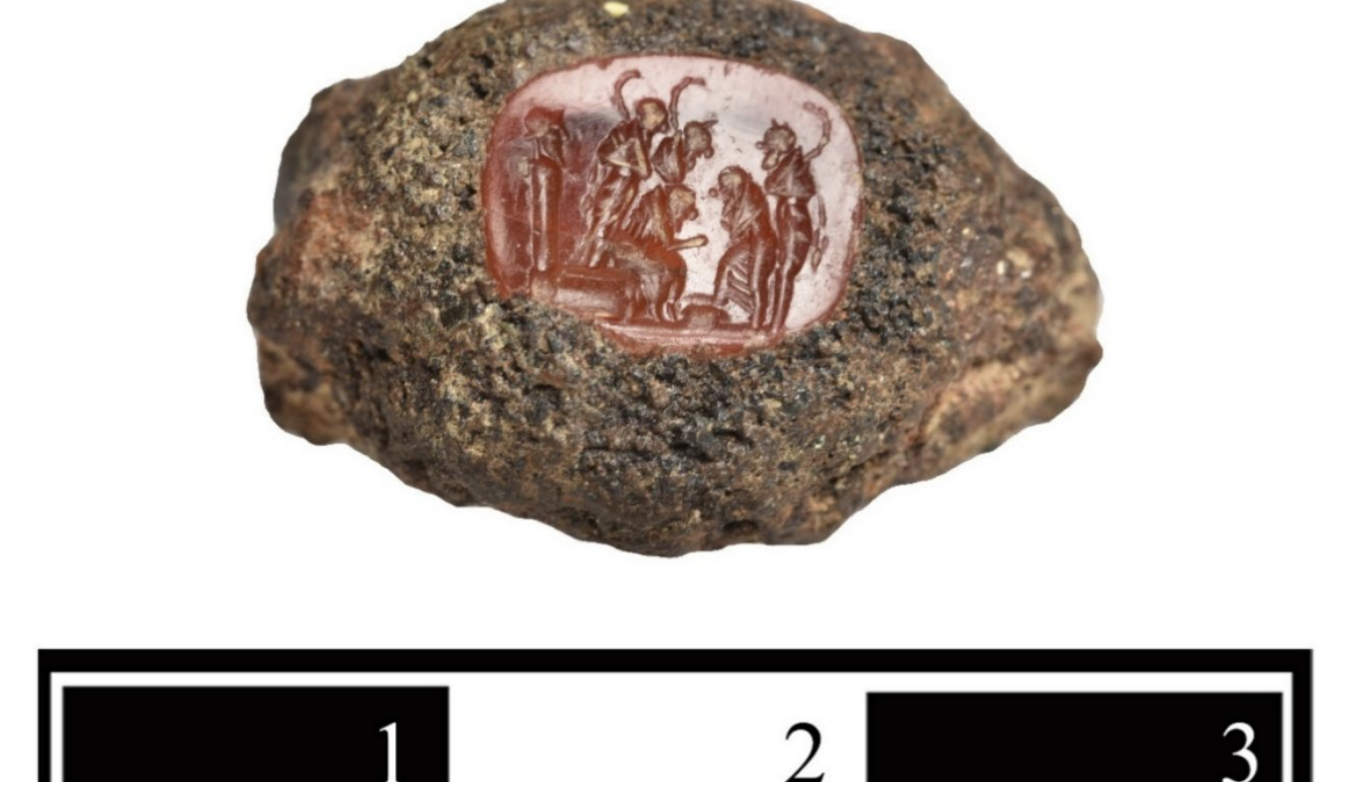
Photo Credit: Arslan & Bulut (2026), Cedrus, Fig. 1.
The reddish-brown carnelian stone measures just 13mm long and 11mm wide, yet its surface accommodates an astonishing amount of detail. The composition includes five principal figures, a herm associated with Dionysus and an additional female figure in the background.
The scene was created using the intaglio technique, in which designs are carved into the surface of a gemstone rather than raised above it. Examination of the carving revealed evidence of the specialist tools used by the artisan, including rounded drills for outlining the figures and rotary abrasives of different thicknesses to create the folds in their clothing. Even the figures' noses were formed using tiny perforations.
At the centre of the composition is a seated male figure wearing a long garment. He appears to be examining a tablet consisting of two leaves, leading the researchers to suggest that he could represent a poet or playwright studying a text. Facing him is another character with one foot resting on a stone, possibly representing the leader of the satyr chorus.
The other figures can be recognised by their distinctive physical characteristics and attributes, including horns, tails and curved staffs carried over their shoulders. These features identify them as satyrs, the mythical half-human, half-animal companions of Dionysus, the Greek god associated with wine and theatre.
One of the most interesting details is found towards the left of the gemstone, behind a bearded herm associated with Dionysus. Herms were a familiar feature of ancient Greek art, typically consisting of a human head or bust positioned on top of a rectangular pillar. Their inclusion is particularly appropriate in this composition, given the close relationship between Dionysus and theatrical performances.
However, the researchers noticed another figure carved behind the herm. This small female character has long hair flowing down her back and appears to have her arms extended outwards.
Arslan and Bulut suggest that she could represent Thalia, one of the nine Muses in Greek mythology. The Muses were divine sources of inspiration for the arts, literature and intellectual pursuits, with Thalia specifically associated with comedy and light-hearted poetry.
Her possible presence would make sense within a scene depicting ancient theatre. Nevertheless, the identification remains tentative, with the researchers considering the figure's appearance alongside the wider theatrical context of the gemstone.
The researchers' interpretation becomes particularly interesting when the gemstone is compared with other surviving examples of ancient theatrical imagery.
Satyr plays were a distinctive part of ancient Greek drama, combining mythological stories and tragic themes with comic and often irreverent elements. They featured choruses of satyrs and formed an important part of Athenian theatrical festivals from at least the 5th century BC. Although the genre eventually developed beyond its original festival setting, only one complete satyr play survives today: Euripides' Cyclops.
Arslan and Bulut compared the Çarmıklı gemstone with similar engraved stones held in the British Museum and the Rijksmuseum van Oudheden in the Netherlands. These comparable examples generally appear to depict theatrical rehearsals. Actors are shown with their masks raised above their heads rather than wearing them, while a central poet or playwright examines a text.
The Çarmıklı gemstone, however, presents something different. Instead of depicting performers wearing or holding theatrical masks, the artisan has carved the characters directly as satyrs, complete with their recognisable mythological features.
The researchers propose that this distinction could mean the scene represents the satyr play itself, rather than actors preparing for a performance. In other words, the gemstone may illustrate the characters and narrative of a theatrical production rather than the process of staging it.
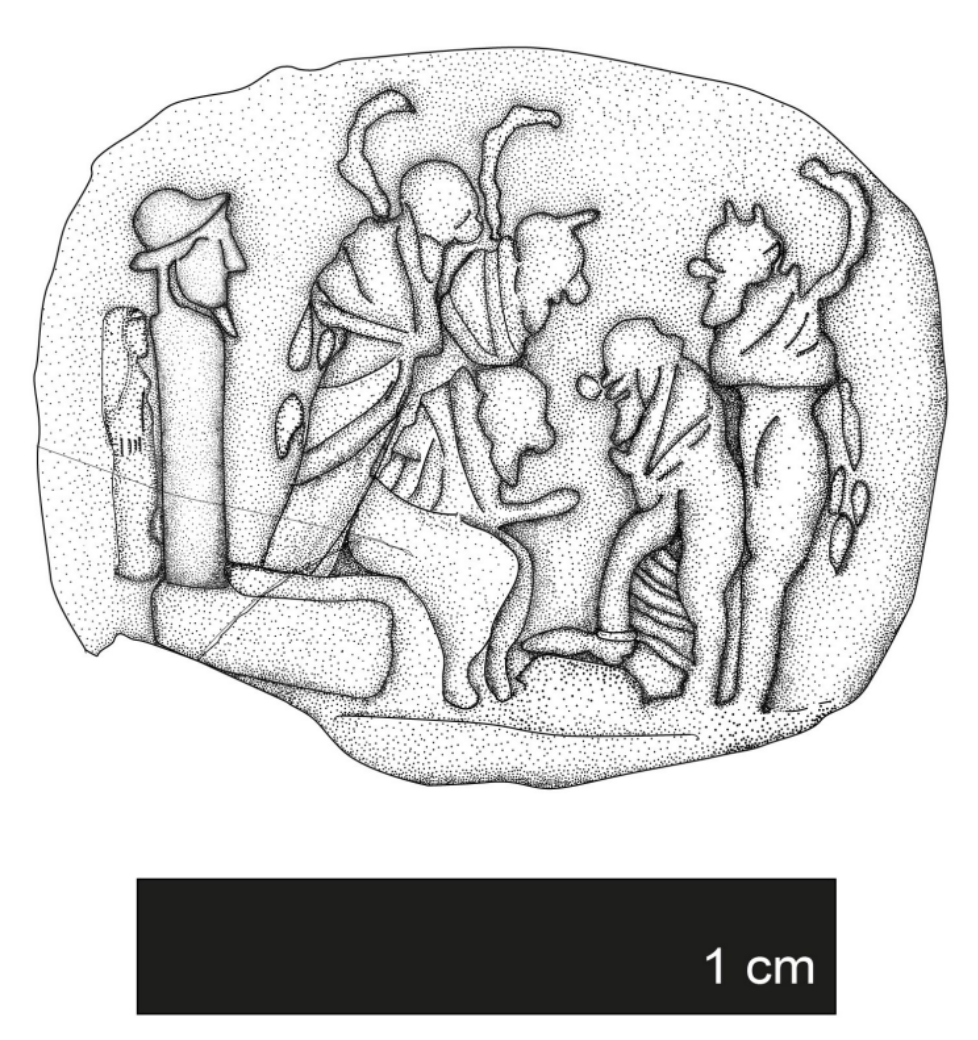
Illustration: R. Selim, from Arslan & Bulut (2026), Cedrus, Fig. 2.
This makes the object particularly noteworthy. The researchers argue that its direct depiction of satyrs represents an unusual, previously undocumented approach to the visual representation of ancient theatre when compared with the other surviving examples.
Although the gemstone has survived remarkably well, much of its original iron ring has not. Only a heavily corroded fragment of the metal setting remains, while the carnelian itself has developed two fine cracks and some surface wear. Fortunately, the carved figures are still clearly recognisable.
The object's archaeological origins are less certain. It was not recovered through a controlled excavation, meaning there is no reliable archaeological context to establish precisely where it was found. Museum records suggest a possible connection with the area around Sardis, although this cannot currently be confirmed.
The identity of the ring's original owner is equally uncertain. Arslan and Bulut suggest that it may have belonged to someone involved in the theatre, or perhaps an individual with a particular interest in the performing arts. Personal jewellery could communicate aspects of its owner's identity, profession or cultural interests, although there is insufficient evidence to establish who actually wore it.
Its dating to the first half of the 1st century BC is instead based on a combination of factors, including the gemstone's form, the technical characteristics of its carving and comparisons with other surviving artefacts.
Despite its tiny dimensions, the Çarmıklı gemstone offers a remarkable example of how ancient artists incorporated theatrical imagery into personal objects. Its unusual portrayal of satyrs, possible reference to the Muse Thalia and intricate depiction of a theatrical scene make it a particularly interesting addition to our understanding of ancient Greek performance and artistic traditions.