2,300-Year-Old Troy Coin Discovered in Berlin!
What began as an ordinary walk across farmland in Berlin has turned into something quite extraordinary. In the district of Spandau, a 13-year-old student stumbled upon a small bronze coin, an object that has since been identified as a rare artefact dating back over two millennia to ancient Troy.
At just 12 millimetres wide and weighing around seven grams, the coin might seem insignificant at first glance. Yet its discovery is anything but. Found on agricultural land during what appeared to be a casual outing, it marks the first confirmed Greek antiquity ever recorded in Berlin. More importantly, it offers a fascinating glimpse into ancient links between the Mediterranean and Northern Europe.
Experts have dated the coin to between 281 and 261 BC, placing it firmly within the Hellenistic period. It was minted in Ilion, better known as Troy, in what is now north-western Türkiye.
The design itself reflects its Greek origins beautifully. One side features the head of the goddess Athena, wearing a Corinthian helmet. On the reverse, Athena Ilias is depicted with a distinctive headdress known as a kalathos, holding a spear in one hand and a spindle in the other. These details not only show the craftsmanship of the time but also highlight the cultural and mythological importance of the region it came from.
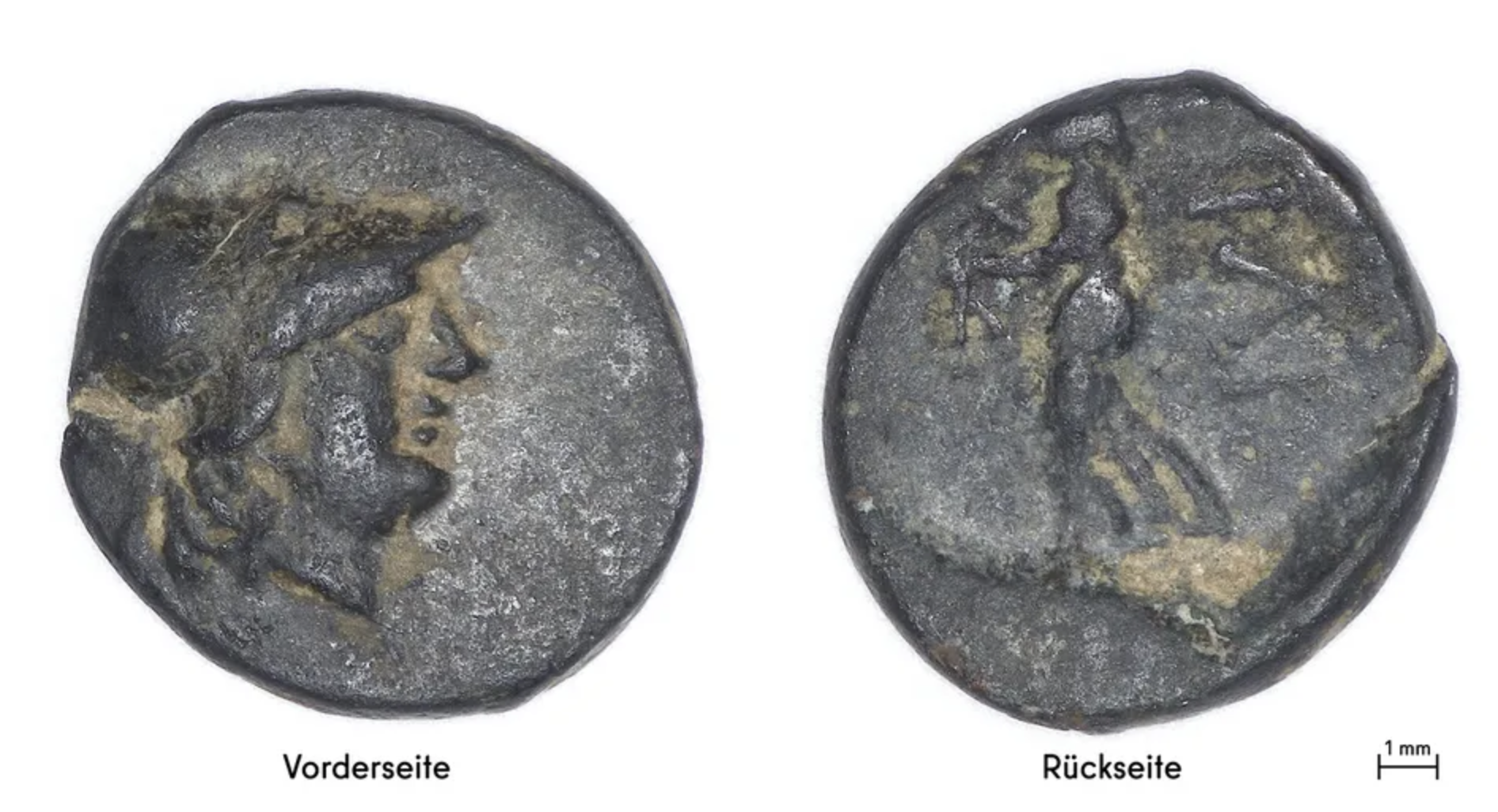
Photo Credit: State Office for Monument Protection Berlin | Photo: Ulrike Scheibe
When the coin was first discovered, there was some uncertainty about whether it had been recently dropped or if it truly belonged to a historical setting. However, further investigation by archaeologists confirmed its authenticity.
The surrounding area revealed clear signs of long-term human activity, particularly as a burial ground. Finds included ceramic fragments, cremated remains, and a bronze double button, all pointing to use during the Bronze Age and early Iron Age. There were also artefacts from the Roman Imperial period, along with a Slavic knife sheath fitting, suggesting the site remained significant across multiple eras.
This layered history strongly supports the idea that the coin is part of an ancient cultural landscape rather than a modern intrusion.
While Roman artefacts have occasionally turned up in Berlin, Greek finds have been notably absent, until now. That makes this discovery in Spandau particularly significant, adding something entirely new to the region’s archaeological record. It also raises an intriguing question: how did a coin from ancient Troy end up so far north?
Although its exact journey remains a mystery, historians believe established trade routes could hold the answer. In antiquity, networks connected the Mediterranean to the Baltic region, with amber (known to the Greeks as elektron) being one of the most sought-after commodities.
There are also references to the Greek explorer Pytheas, who travelled around 330 BC and is thought to have reached parts of Northern Europe. His journey is often linked to early connections between these distant regions.
Interestingly, experts suggest the coin may not have been used as currency at all. Given its relatively low material value and its discovery within a burial context, it may have held symbolic or ritual significance, perhaps placed as an offering.
Today, this remarkable find is on public display at PETRI Berlin. Visitors can view it as part of the “Current Finds” exhibition, offering a rare chance to see such an unusual artefact up close.
This unexpected discovery is a powerful reminder of how even the smallest objects can reshape our understanding of history. It highlights the importance of preserving archaeological sites and sheds light on the deep, and sometimes surprising, connections between ancient cultures.
From the ruins of Troy to a field in modern Berlin, this tiny coin tells a story of movement, exchange, and shared human experience across thousands of years.