430,000-Year-Old Wooden Tools Discovered in Greece!
Archaeologists have identified two remarkably well-preserved wooden objects from Greece as the oldest securely identified handheld wooden tools made by hominins. Dating to approximately 430,000 years ago, the artefacts provide an unusually rare insight into prehistoric technology that is normally invisible in the archaeological record.
The discoveries were made at Marathousa 1, a Lower Palaeolithic site in the Megalopolis Basin of the Peloponnese. One of the objects appears to have been a relatively large digging or multipurpose implement, while the other is only a few centimetres long and has proved much more difficult to interpret.
The findings are particularly significant because archaeologists overwhelmingly encounter stone tools when studying early hominin technology. Wood and other organic materials generally decay long before they can be preserved, meaning that the tools recovered at Marathousa offer a glimpse of a much broader technological tradition than is usually visible.
The study, published in the Proceedings of the National Academy of Sciences (PNAS), indicates that wood, stone and bone were being incorporated into technological activities at the site rather than early hominins relying primarily on stone.
Marathousa 1 came to archaeological attention in 2013, when lignite mining exposed fossil-bearing sediments in the Megalopolis Basin. Excavations conducted between 2013 and 2019 revealed an unusually rich assemblage, including animal remains, more than 2,000 stone artefacts, worked bone and large quantities of preserved plant material.
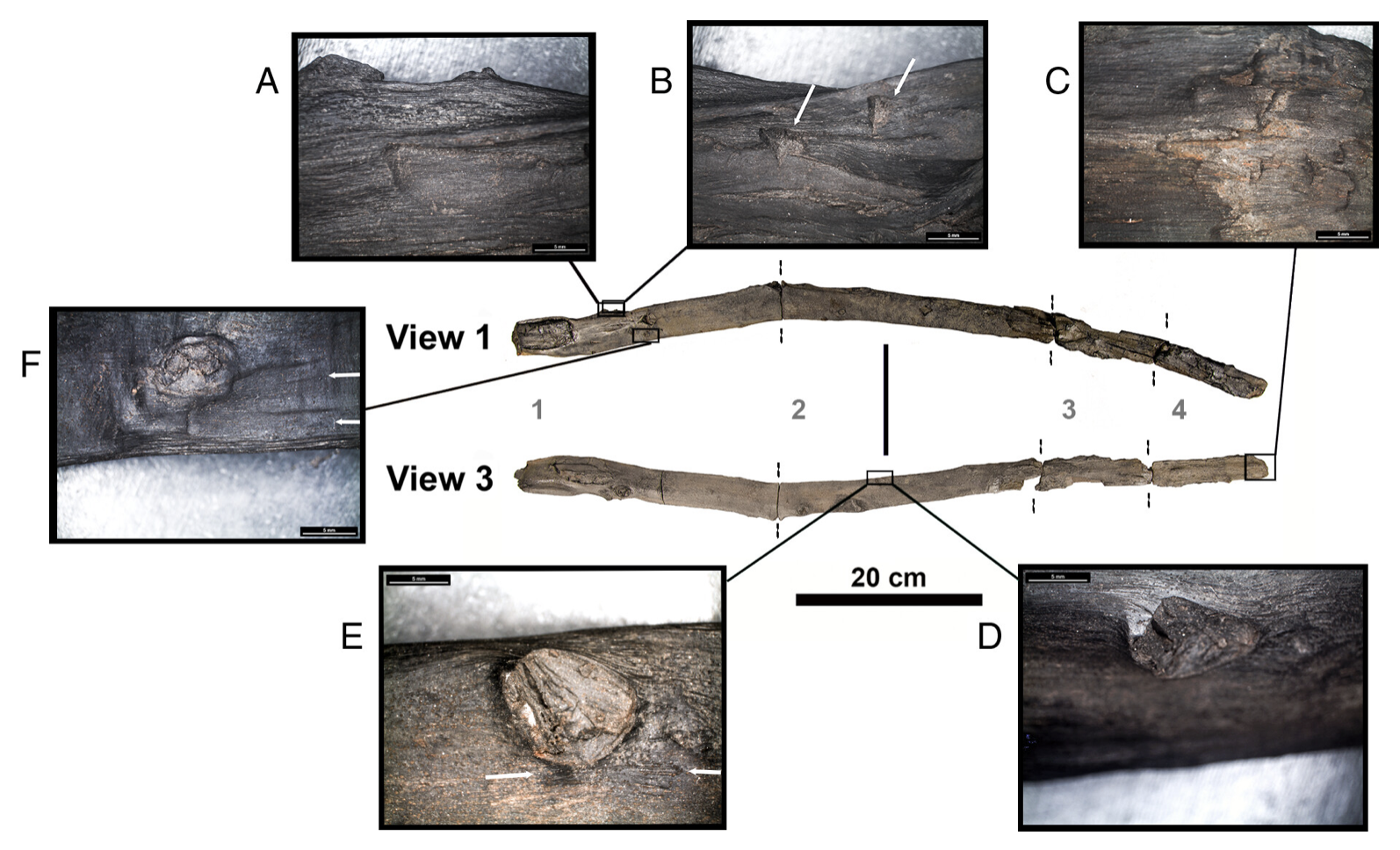
Photo Credit: Milks et al. (2026) / PNAS
The archaeological deposits date to around 430,000 years ago, during Marine Isotope Stage 12, a particularly severe glacial period of the Pleistocene. Despite the cold conditions, environmental evidence suggests that a permanent freshwater body remained in the basin, surrounded by open woodland and vegetation growing around the water.
This environment appears to have played an important role in preserving the wooden objects. The artefacts were rapidly buried in waterlogged sediment, where the limited availability of oxygen slowed the processes responsible for decomposition. As a result, organic material that would ordinarily have disappeared survived for hundreds of thousands of years.
The site has already produced important evidence for hominin activity. Among its most notable discoveries is an almost complete skeleton of the straight-tusked elephant Palaeoloxodon antiquus. Cuts and percussion damage on the bones indicate that hominins butchered the animal.
The wooden artefacts were recovered in association with this wider activity, providing an opportunity to examine how wood fitted into the technological activities taking place at Marathousa 1.
Researchers from an international team led by Annemieke Milks and Katerina Harvati examined 144 pieces of wood recovered during excavations between 2015 and 2019.
Rather than assuming that marks on the wood were human-made, the team used a combination of morphological, microscopic, taxonomic and taphonomic analyses. This allowed them to distinguish intentional modification from marks created naturally, through animals, insects, trampling or the burial environment.
Only two specimens were ultimately identified as wooden artefacts. The larger of the two was placed into Category 1, meaning that the evidence for deliberate human modification is clear. The smaller object was considered a probable Category 2 wooden tool, reflecting greater uncertainty over its interpretation.
The larger artefact was produced from a small alder trunk and consists of four fragments that can be fitted back together. Once reconstructed, the object measures approximately 81 centimetres long and reaches around 4.5 centimetres in diameter. Its original form would have been somewhat different, however, as pressure from the overlying sediment compressed the wood over time.
Evidence of deliberate working can be seen around knots and branches. Researchers identified carving and chopping marks, along with stop marks indicating that the wood had been intentionally shaped.
Wear is particularly concentrated towards one end. Fraying and microscopic splintering suggest that this was not simply a piece of wood that had been modified and abandoned, but an object that was probably used repeatedly.
Its exact purpose remains uncertain. Its shape is compatible with a digging stick or another multipurpose implement, potentially used to work the soft sediments around the lakeshore.
However, other uses cannot be ruled out. The researchers suggest that it could have been involved in processing bark or perhaps activities associated with the nearby elephant carcass.
The second wooden artefact is considerably more unusual. Made from either willow or poplar, the object measures just 5.7 centimetres in length. Its tiny dimensions distinguish it from many of the larger wooden implements known from the Pleistocene.
Despite its size, the object preserves several indications that it was deliberately worked. It had been stripped of its bark and shaped, while probable tool facets and scraping marks can be seen on its surface.
The researchers also identified deliberate removal of growth rings on both sides near one end. The opposite end displays rounding, pitting and small areas where splinters appear to have been removed, potentially as a result of use.
Its small size raises the possibility that it was held between the fingers rather than gripped in the hand like a conventional stick. Exactly what it was used for, however, remains unknown. One possibility is that it played a role in producing or modifying small stone tools. Numerous lithic flakes and pieces of debitage were found nearby, while other evidence from Marathousa suggests that early hominins were using organic materials alongside stone.
The uncertainty surrounding this little object is itself significant. Archaeologists are generally much better equipped to recognise large wooden artefacts, such as spears or digging sticks. A piece measuring only a few centimetres could easily be mistaken for an insignificant fragment, particularly when working at sites where organic material has not survived.
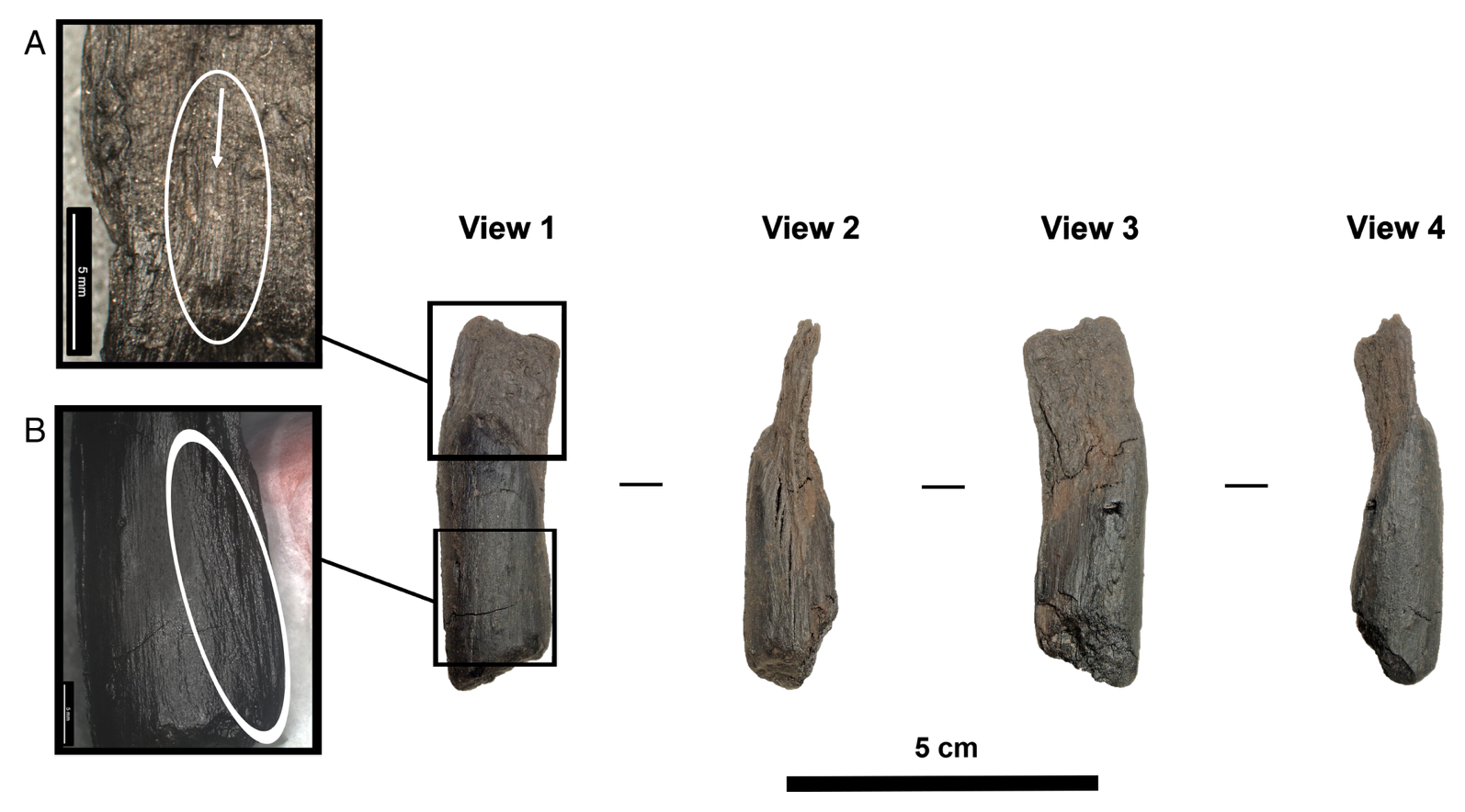
Photo Credit: Milks et al. (2026) / PNAS
Although these are the oldest securely identified handheld wooden tools, they are not the earliest evidence that hominins were working wood.
At Kalambo Falls in Zambia, wooden elements dating to at least approximately 476,000 years ago have been interpreted as components of a structure. This means that hominins were manipulating wood for construction considerably earlier than the Marathousa tools.
There is also a possible polished wooden object from Gesher Benot Ya’aqov in Israel, dating to approximately 780,000 years ago. However, that specimen has not been reassessed using modern analytical techniques, so its interpretation remains less certain.
The distinction is therefore important. The Greek discoveries do not push back the earliest known use of worked wood. Instead, they push back the oldest securely identified examples of handheld wooden tools.
Other handheld wooden artefacts have previously been recovered from Kalambo Falls, Schöningen in Germany and Poggetti Vecchi in Italy. The Marathousa discoveries, dating to around 430,000 years ago, are earlier than these known examples and provide the first evidence of this particular category of technology from southeastern Europe.
The waterlogged deposits at Marathousa also preserved evidence of another animal that once occupied this landscape. A larger fragment of alder was found bearing several deep, approximately parallel grooves. Researchers considered a range of possible explanations, including trampling, insect activity and modification with stone tools, before ruling these out.
The marks were instead interpreted as fossilised claw traces left by a large carnivore. It is not possible to determine exactly which animal made them. Bears, lions and potentially leopards are among the large carnivores known from other Middle Pleistocene sites within the Megalopolis Basin.
Their presence helps reconstruct the environment in which the hominins lived. They were sharing this landscape with other large predators that could also have been exploiting animal carcasses and competing for access to resources.
The elephant remains provide another piece of this picture. Hominin butchery marks show that people had accessed the carcass, while damage to animal bones caused by carnivores demonstrates that predators were also active around carcasses in the wider environment.
Perhaps the most important aspect of the discovery is what it tells us about the limitations of the archaeological record itself. Stone dominates discussions of Palaeolithic technology largely because it survives. Materials such as wood, bark and plant fibres are far more vulnerable to decay, meaning that enormous portions of prehistoric technology have probably disappeared without leaving a trace.
The larger Marathousa tool illustrates just how straightforward some wooden technology could have been. Much of its manufacture involved removing branches and making relatively limited alterations to the trunk.
The smaller object is even more revealing. Its subtle modifications demonstrate that prehistoric wooden tools did not necessarily have to be large or visually obvious. Similar objects could easily have been overlooked at other sites, even where some organic material survived.
Together with the worked bone and evidence for the processing of plant materials with stone tools, the discoveries suggest that the inhabitants of Marathousa 1 were working with a range of raw materials. Their technological world was therefore likely much more varied than the stone tools alone would suggest.
The two wooden artefacts offer a rare window into that otherwise lost world. Around 430,000 years ago, hominins were selecting and deliberately shaping wood for different purposes, from substantial handheld implements to a tiny tool whose function remains a mystery.
What makes the discovery particularly valuable is not simply the age of the objects, but the reminder that the technology we can see in the archaeological record may represent only a fraction of what early humans actually used.