Enamelled Roman Sword Fitting Discovered at Vindolanda!
A small but remarkably decorative piece of Roman military equipment has been uncovered during excavations at Vindolanda, the famous Roman fort located just south of Hadrian’s Wall in Northumberland.
The object is a copper-alloy scabbard chape, a fitting attached to the bottom of a sword sheath. It was recovered by the excavation’s Period 10 Team and was found in a context dating to the 2nd century AD.
Although scabbard chapes served a practical purpose by protecting the lower end of a sword sheath, they could also be decorated. This newly discovered example is particularly striking because traces of its original enamel decoration have survived, offering a glimpse of the colour and ornamentation that could be incorporated into Roman military equipment.
Today, the object may look small and relatively modest, but its discovery adds another piece to the growing collection of evidence for life at Vindolanda. The site has produced thousands of artefacts since excavations began, providing an unusually detailed picture of the people who lived and worked along Rome's northern frontier.
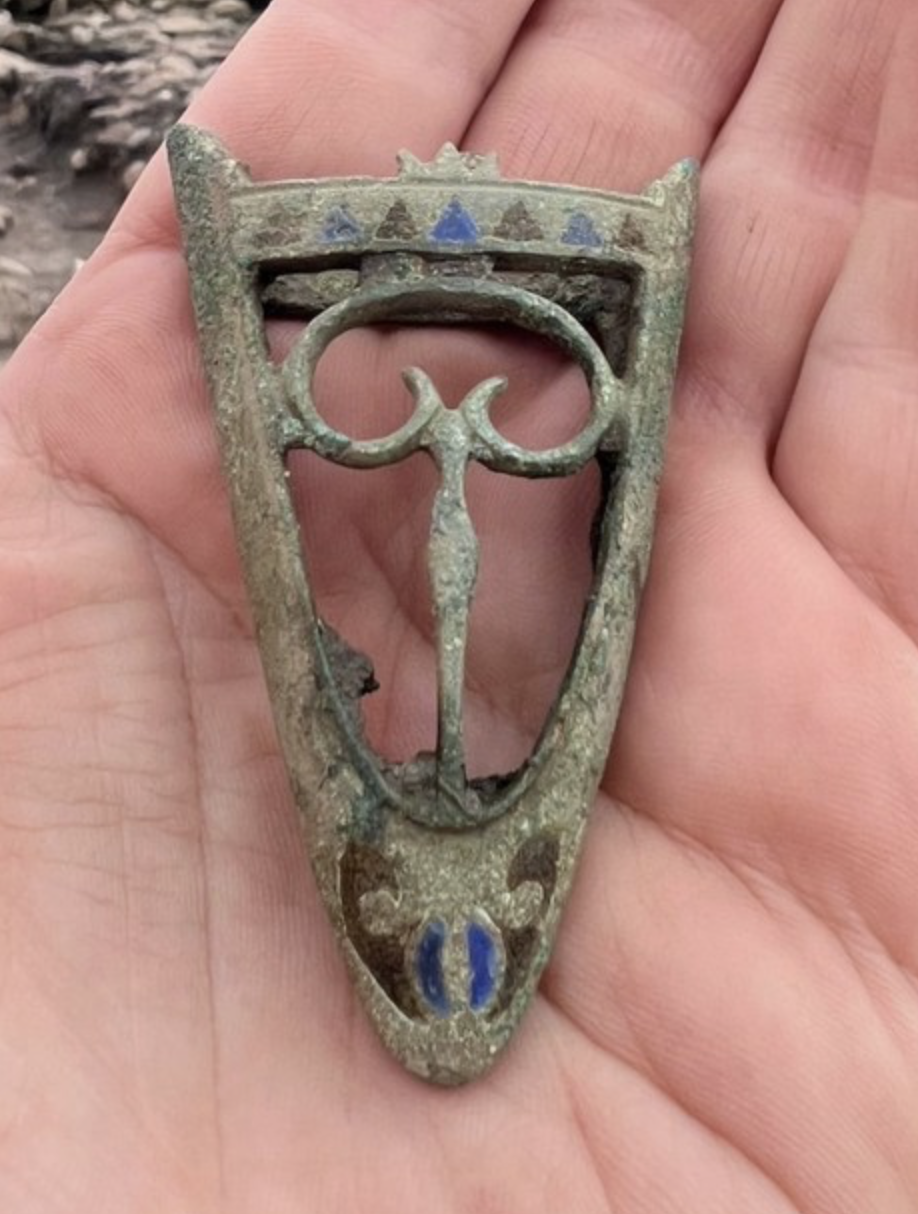
Photo Credit: Vindolanda Trust
These discoveries range from everyday objects such as shoes and tools to weapons, writing tablets and personal possessions. Together, they help archaeologists reconstruct aspects of daily life that are rarely visible in monumental architecture alone.
Vindolanda itself was established around AD 85, during the period when Rome was consolidating its control over northern Britain. The fort went through numerous phases of occupation, with successive timber and stone structures being built on the site.
Its location was also strategically important. Vindolanda stood along the Stanegate, a major Roman military road that existed before the construction of Hadrian's Wall. The settlement remained occupied for centuries as Rome's presence in the region developed and changed.
The newly discovered chape is therefore part of a much wider archaeological story. Rather than simply demonstrating that swords were present at Vindolanda, its decoration provides evidence for the care and craftsmanship that could go into the equipment associated with Roman soldiers.
However, there is still much we do not know about the find. The Vindolanda Trust has so far released only limited information, meaning that its exact date, typological classification and decorative parallels have not yet been established. There is also currently no evidence linking the fitting to a particular soldier or military unit.
Further study may reveal more about where this particular type of chape was produced, how it was decorated and how it fits into the wider development of Roman military equipment.
For now, the object offers a fascinating example of how even the smallest discoveries can contribute to our understanding of Roman Britain. After spending around 1,800 years underground, this tiny fragment of a sword sheath has once again emerged into the light, with plenty more still to learn about its story.