5,300-Year-Old Metal Drill Discovered in Egypt Rewrites Early Technology History!
A tiny metal tool discovered in a Predynastic cemetery in Upper Egypt is now reshaping what we thought we knew about early Egyptian technology. Researchers have identified it as the oldest known metal drill from Egypt, dating back to the late fourth millennium BCE, long before the first pharaohs ever ruled.
The object was originally uncovered nearly a century ago at Badari. In excavation notes from the 1920s, it was simply described as a short copper awl with a strip of leather wrapped around its shaft. The entry was brief, and for decades the tool attracted very little attention.
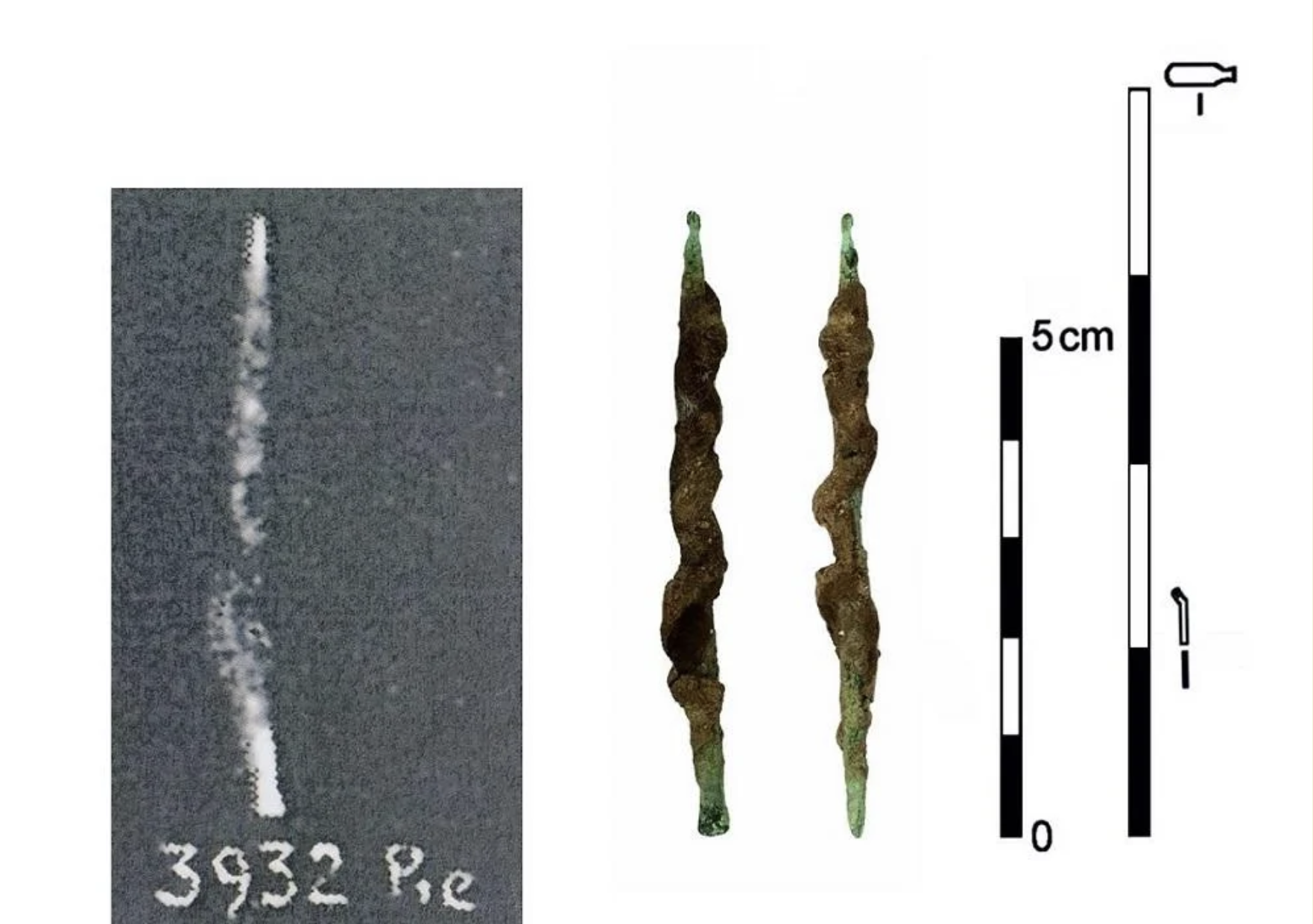
Photo Credit: Martin Odler
Measuring just 63 millimetres long and weighing around 1.5 grams, it hardly seemed remarkable at first glance. That changed when a research team from Newcastle University and the Academy of Fine Arts Vienna decided to take a closer look.
Under magnification, the tool began to tell a very different story. The tip shows fine parallel lines, while the edges are rounded in a way that suggests repeated spinning rather than simple pushing or piercing. There’s even a slight bend near the working end, consistent with stress caused by rotational use against hard materials.
These wear patterns clearly differ from damage you would expect from a basic awl. Instead, they point to something far more sophisticated: rotary drilling.
Even more intriguing, small coils of dried leather still cling to the shaft. Researchers believe these fibres were once part of a bow drill system. In this type of device, a cord wraps around the drill shaft, and a bow is moved back and forth to spin the drill rapidly.
We know from later Egyptian tomb paintings, particularly from the New Kingdom, that similar tools were used to bore holes in beads and wood. Physical examples survive from the second millennium BCE. What makes the Badari find so significant is that it pushes this technology back more than two thousand years earlier.
The drill was found in Grave 3932, the burial of an adult male. The wider cemetery has produced evidence of highly skilled craftsmanship, including bead making, stone vessels and wooden objects. All of these tasks require careful, controlled drilling. A rotary tool would have offered much greater precision and speed compared to simple hand piercing. This suggests that Predynastic communities possessed more advanced technical knowledge than previously assumed.
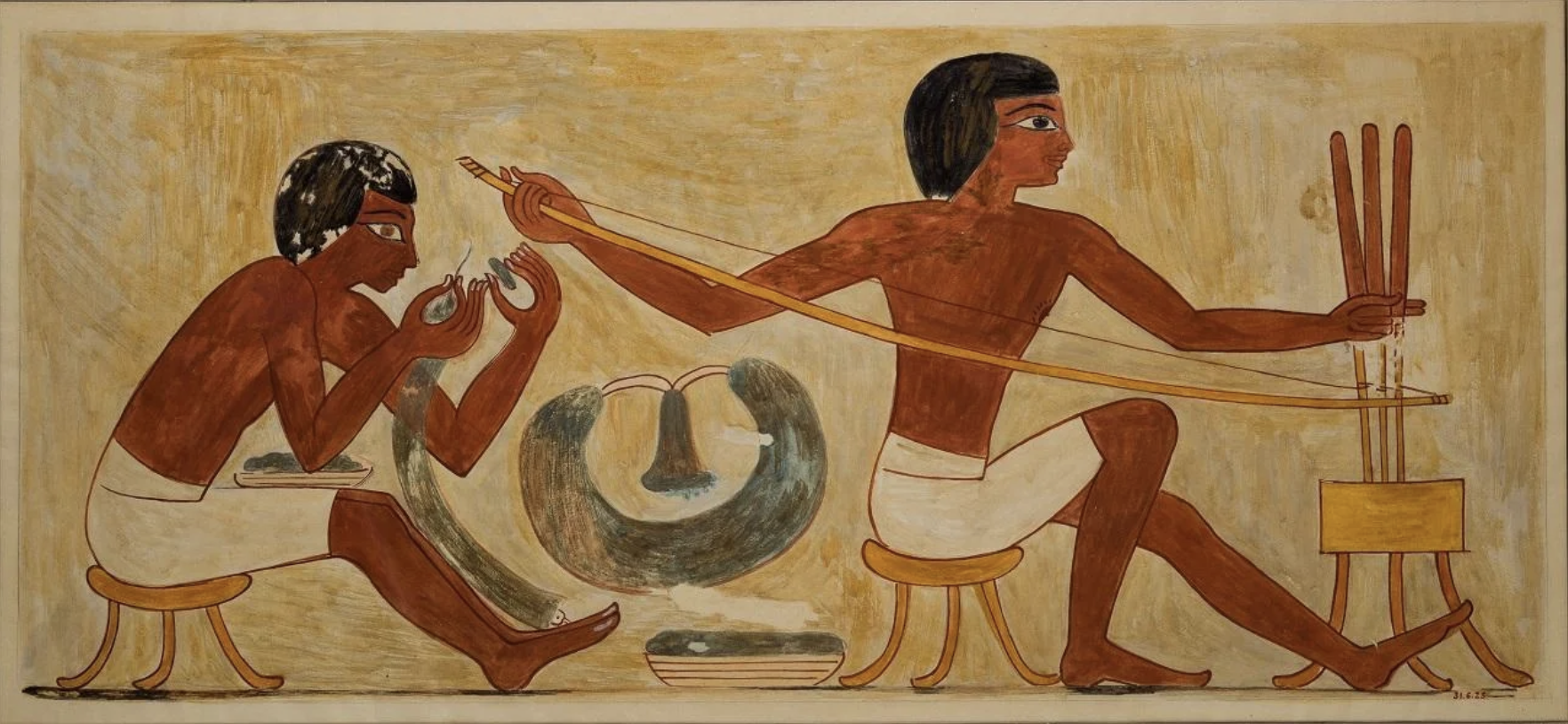
Photo Credit: Object 31.6.25, The Metropolitan Museum of Art, public domain
Scientific analysis added yet another layer to the story. Portable X-ray fluorescence testing revealed that the tool isn’t made from pure copper. Instead, it contains copper alloyed with arsenic and nickel, along with small amounts of silver and lead. This mixture would have created a harder, more durable metal, ideal for drilling.
The presence of silver and lead also hints at access to varied ore sources or trade networks beyond the Nile Valley, possibly reaching into the Eastern Desert or even across the eastern Mediterranean. In other words, this small tool may reflect not just technological skill, but broader patterns of exchange and resource acquisition.
Scenes from New Kingdom tombs, painted more than two thousand years after this Badari drill was made, show craftsmen using remarkably similar bow drills. The basic design appears to have remained consistent for generations. Woodworkers and bead makers relied on the same simple but effective principle for thousands of years. That kind of technological continuity is remarkable.
Perhaps one of the most important lessons from this discovery is the value of museum collections. For decades, this artefact sat largely unnoticed, summarised in a single catalogue line. Yet careful reanalysis has now revealed direct evidence for early rotary drilling, deliberate metal alloy selection and even preserved organic tool components.
It’s a powerful reminder that history isn’t fixed. Sometimes, revisiting old discoveries with fresh eyes and modern scientific tools can completely reshape our understanding of the past. And in this case, a 5,300-year-old drill has quietly rewritten a chapter of early Egyptian technology.