6,500-Year-Old Human Tooth Pendant Discovered in Neolithic Serbia!
A small artefact held in a Serbian museum collection has been identified as something considerably more unusual than archaeologists originally believed. Once classified as a bead fashioned from an animal tooth, the object has now been recognised as a modified human canine that may have been worn as a pendant more than 6,500 years ago.
The discovery comes from Jablanica, a Late Neolithic settlement south of Belgrade associated with the Vinča cultural tradition. Researchers Nemanja Marković from the Institute of Archaeology in Belgrade and Ana Maričić of the Belgrade City Museum re-examined the object after it had spent almost 20 years in the museum's collection.
Their findings, published in the International Journal of Osteoarchaeology, reveal that the tooth was intentionally altered, perforated and probably suspended from a cord or fibre. Even more intriguing is the possibility that the tooth was not taken from a living person, but recovered from human remains after the individual's death.
The unusual pendant was originally discovered not through a formal excavation, but during a surface survey at Jablanica. Agricultural activity had already damaged the artefact, breaking part of its crown. When it was initially recorded, archaeologists interpreted it as a bead manufactured from an animal tooth. Its true identity only became apparent when Marković and Maričić subjected the object to a more detailed examination.
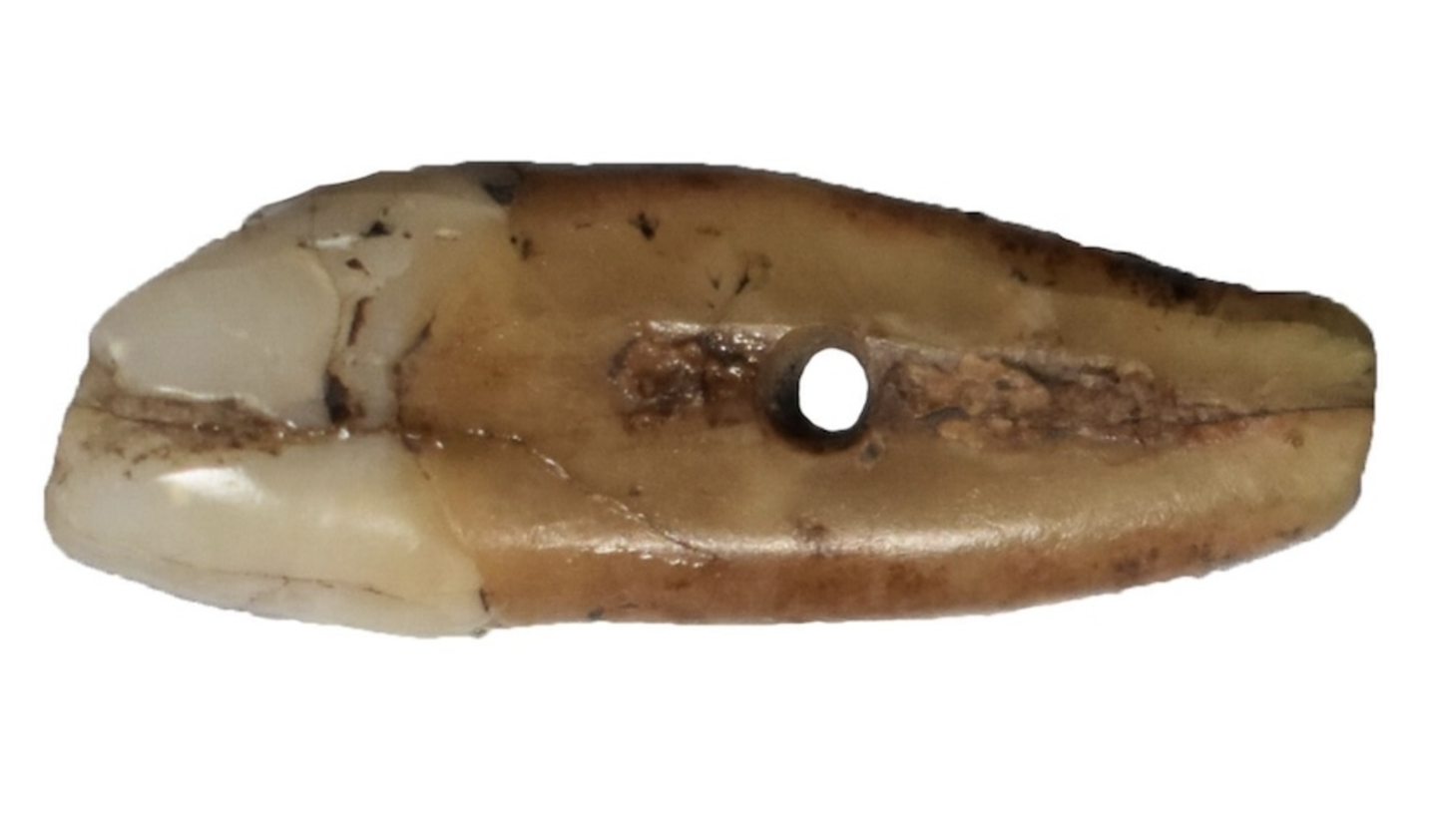
Photo Credit: Nemanja Marković.
Macroscopic inspection and radiographic analysis established that it was actually an upper right canine from a human maxilla. The tooth measures approximately 23 millimetres in length. Closer analysis also revealed that it had been deliberately modified. The tip of the root had been reshaped, and a hole had been carefully drilled through the root from one side to the other. This perforation provides some of the strongest evidence that the tooth was intended to be worn.
Microscopic examination identified traces of repeated friction within the hole. These marks indicate that a cord or organic fibre had passed through it and moved repeatedly against the tooth over time. Rather than being an unfinished object or an isolated piece of worked bone, the evidence therefore suggests that the canine had functioned as a pendant and had been worn for a considerable period.
The workmanship is also noteworthy. Altering a tooth without causing it to fracture would have required a degree of technical knowledge and care. The microscopic traces suggest that whoever produced the ornament was deliberately working the material rather than simply making an opportunistic modification.
Although archaeologists cannot determine who originally possessed the tooth, its physical condition provides some clues. The degree of wear visible on the crown indicates that it came from an adult and may have belonged to a middle-aged individual. However, it is the condition of the root that raises the most interesting questions about how the tooth was obtained.
If a tooth had been forcibly removed from a living person, researchers might expect to find signs of trauma associated with extraction. Instead, the root lacks the characteristic damage that such a process could produce.
Its relatively smooth and undamaged condition has led the researchers to suggest that the canine was probably recovered after the individual's death. More specifically, it may have been taken from a skeleton after the body had decomposed. If correct, this means the object was not simply made from an animal product or discarded human material. It may have retained a connection with a particular deceased individual long after their death.
The discovery raises questions about how Neolithic communities understood the relationship between the living and the dead. Human remains were not necessarily regarded as something that had to remain permanently within a grave. Across prehistoric Europe, there is evidence that bones, teeth and other parts of human bodies could sometimes be removed, handled and incorporated into objects.
The reasons behind these practices are much harder to establish. A human-tooth pendant might have represented an individual who had died, a family or ancestral connection, or perhaps the social position or identity of the person wearing it. It could also have had a symbolic meaning that is now impossible to reconstruct.
The researchers therefore avoid assigning a single interpretation to the Jablanica pendant. With only one object available, it is not possible to determine precisely why the tooth was retained and transformed into an ornament. Nevertheless, its existence demonstrates that human remains could have a continuing significance beyond the burial itself.
Establishing the precise age of the tooth is more complicated because it was recovered from the surface rather than from a sealed archaeological layer. The canine itself was not directly radiocarbon dated. Instead, the researchers used the archaeological context of Jablanica and comparisons with other artefacts from the settlement to establish a probable date.
The site belongs to the Late Neolithic Vinča cultural period, which the study broadly places between approximately 5300/5200 and 4600/4500 calibrated BCE.
Another useful comparison came from a shell bracelet discovered at Jablanica. Unlike the tooth, the bracelet could be securely dated to around 4700 BCE. Researchers examined the manufacturing techniques used on the shell ornament, including its drilling traces, and compared them with the modifications visible on the canine.
Taken together, the evidence supports assigning the human-tooth pendant to the Late Neolithic occupation of the settlement. The frequently cited figure of approximately 6,500 years old should therefore be understood as an estimate based on the archaeological evidence rather than the result of direct radiocarbon dating of the tooth itself.
The find is particularly significant because personal ornaments appear to have been relatively uncommon at Jablanica. The researchers identify only a small number of comparable ornaments from the settlement, including a fragment of a shell bracelet and another shell pendant.
Modified human teeth have been documented elsewhere in prehistoric Europe, demonstrating that the practice was not entirely unknown. However, examples remain rare, particularly in the central Balkans. According to the researchers, the Jablanica canine represents the only reliably documented human-tooth ornament currently known from the Neolithic central Balkans.
Its discovery also highlights the value of revisiting archaeological collections. The artefact had been sitting in a museum for years under an incorrect identification, yet modern examination revealed evidence of a distinctive prehistoric practice.
What initially appeared to be an ordinary animal-tooth bead may instead preserve a direct connection between the living and the dead: a human tooth deliberately reshaped, pierced and worn as an ornament thousands of years ago.
The tiny pendant therefore offers an unusually personal glimpse into Neolithic society, where parts of the human body could continue to hold meaning even after death.