Monumental Statues of Hadrian and Sabina Discovered at Kibyra!
Archaeological excavations at the ancient city of Kibyra in southwestern Türkiye have uncovered fragments of enormous marble statues representing the Roman emperor Hadrian and his wife, Empress Sabina. The sculptures once formed part of an elaborate monumental display positioned above one of the principal entrances to the city.
The discovery provides a rare glimpse into how Kibyra presented its relationship with Rome during the second century AD. Among the finds is a substantial portrait head of Hadrian, which has been reunited with an armoured torso discovered during an earlier stage of excavation. Conservation work has enabled archaeologists to reconstruct the emperor's statue to an impressive height of approximately 2.14 metres.
Significant fragments of Sabina's statue have also been recovered, together with pieces belonging to several other large marble figures. The sculptures are thought to have occupied the upper section of Kibyra's Monumental City Entrance Gate, creating a highly visible representation of imperial authority for people entering the city.
The excavations are being conducted by Burdur Mehmet Akif Ersoy University as part of Türkiye's Legacy to the Future Project. The statues were probably installed around AD 130, during Hadrian's reign, which lasted from AD 117 until 138. They may therefore have formed part of Kibyra's response to the emperor's extensive travels across the eastern provinces of the Roman Empire. Their eventual destruction appears to have occurred much later.
Archaeologists believe that the gateway and its sculptures were brought down by a major earthquake in AD 417. The force of the collapse appears to have shattered the marble figures, leaving their remains buried amongst the architectural debris of the monumental entrance.
Excavations have so far produced roughly 20 sculptural fragments. These include sections of arms, legs and feet, as well as the exceptionally well-preserved head of Hadrian. Identifying the portrait was crucial because it allowed the archaeologists to establish its connection with the armoured torso found previously.
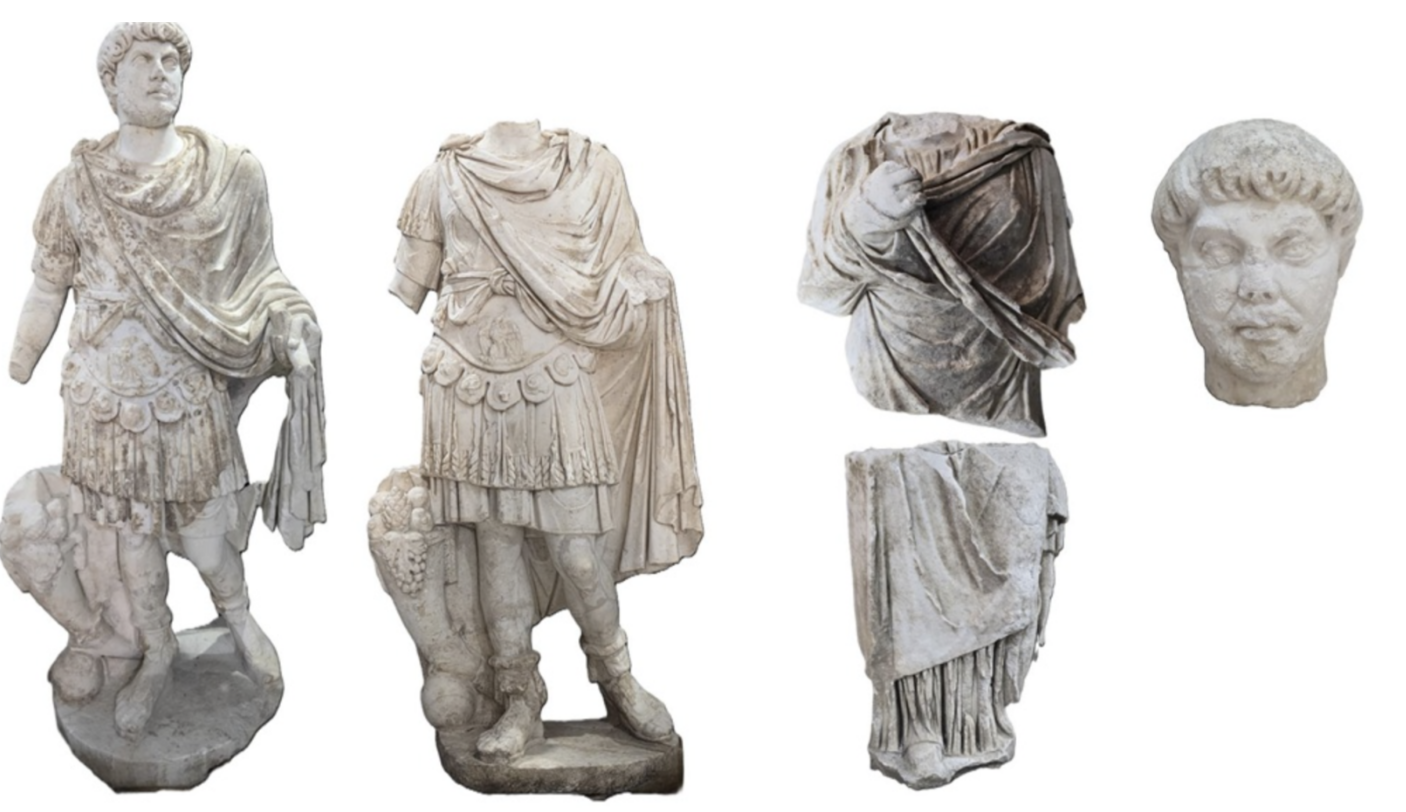
Photo Credit: Council of Higher Education (YÖK), Türkiye
Once the fragments had been carefully matched and conserved, the team was able to reconstruct a substantial portion of Hadrian's figure. The resulting statue would originally have stood more than two metres tall, making it considerably larger than a life-size representation.
The conservation and reconstruction work undertaken in 2026 was carried out by the excavation restoration team under Professor Ünal Demirer of Mehmet Akif Ersoy University.
Hadrian's appearance offers clues about the message the sculpture was intended to convey. Rather than being shown in civilian clothing or presented in an explicitly divine form, the emperor wears military armour. His cuirass is decorated with prominent reliefs featuring a lion and an eagle, imagery closely associated with Roman military power and imperial authority.
The quality of the marble is also notable. Researchers have identified stone originating from the Afyon-Döğer and İscehisar areas, demonstrating the use of high-quality regional marble for the monument.
According to excavation director Professor Şükrü Özüdoğru, the portrait features provided the key evidence for identifying the statue as Hadrian. Although numerous portraits of Hadrian survive across the Roman world, substantially preserved statues of the emperor are considerably less common in Anatolia. Imperial sculptures frequently survive only as individual heads, torsos or isolated fragments, making the partial reconstruction at Kibyra particularly valuable.
The statue therefore offers more than an image of Hadrian himself. It provides evidence for the scale and visual impact of imperial representation within a provincial city.
The discovery becomes even more significant because Hadrian was not represented alone. Archaeologists have also recovered considerable portions of a marble statue of his wife, Vibia Sabina. Sabina belonged to one of the most prominent families in the Roman imperial establishment. She was the grand-niece of Emperor Trajan and married Hadrian in AD 100, seventeen years before he became emperor. During Hadrian's reign, she occupied an important position within imperial representation and received the title Augusta in AD 128.
Her image appeared throughout the Roman Empire, including on coinage, and cities in the eastern provinces honoured her through inscriptions and monuments.
Evidence from other Anatolian sites demonstrates that Sabina was sometimes commemorated alongside her husband. Dedications connected with the imperial couple are known from locations including Patara, Tlos, Rhodiapolis and Hierapolis.
The pairing of Hadrian and Sabina at Kibyra therefore fits into a wider pattern of imperial representation during the second century AD. However, the discovery does not demonstrate that either Hadrian or Sabina actually visited the city.
One possibility is that the sculptures were commissioned in anticipation of an imperial visit. Hadrian was particularly well known for travelling extensively throughout the Roman Empire. Unlike many emperors who spent much of their reign in Rome or on military campaigns, Hadrian devoted considerable time to visiting provincial territories. His journeys through Anatolia created opportunities for cities to demonstrate their loyalty to the emperor and strengthen their connections with the imperial administration.
Professor Özüdoğru has suggested that the Kibyra sculptures may have been produced in connection with Hadrian's travels through the region. There are, however, several possible explanations.
The sculptures could have been intended to welcome an anticipated imperial visit, commemorate Hadrian's journey through the wider region, or simply demonstrate Kibyra's allegiance to the emperor. Without an inscription or other direct evidence linking the statues to an actual visit, it is impossible to determine which explanation is correct. Further excavation may provide additional evidence.
The scale of the monument reflects the considerable importance of Kibyra during antiquity. The city occupied a strategic position in southwestern Anatolia, close to the areas associated with Lycia, Caria, Phrygia and Pisidia. Its inhabitants were described in antiquity as multilingual, while the region was particularly associated with activities such as horse breeding, leatherworking and iron production.
Before Roman administrative restructuring, Kibyra also played a leading role in a regional federation that included Boubon, Balboura and Oinoanda. The city's prosperity is reflected in its surviving architecture. Archaeological remains include a large stadium, theatre, agora, Roman baths and an impressive odeon. The latter is particularly renowned for its elaborate Medusa floor, produced using the opus sectile technique, in which carefully cut pieces of coloured marble were assembled to create intricate designs.
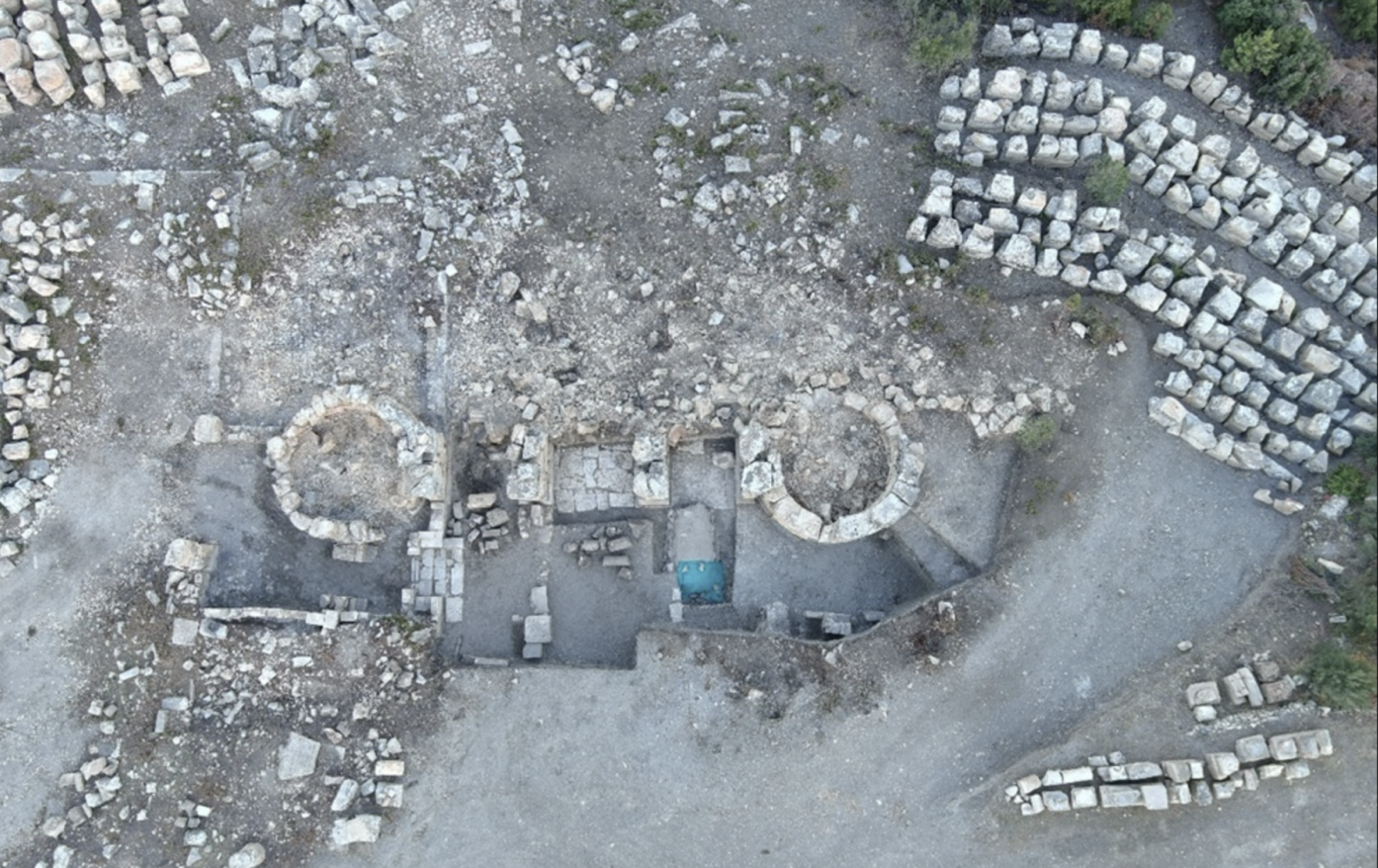
Photo Credit: Council of Higher Education (YÖK), Türkiye
The Monumental City Entrance Gate formed another major component of this urban landscape. The gateway stood along the road leading from the necropolis towards the city. Two large round towers flanked the structure, while three arched openings provided access into Kibyra. Placing monumental sculptures of the emperor and empress above such an entrance would have ensured that their presence was highly visible to those approaching the city.
Archaeologists began investigating the entrance in 2025. Rather than encountering an intact monument, they were faced with a huge accumulation of collapsed architectural material. Since then, approximately 2,500 individual stone blocks have been moved, recorded and classified. The sheer quantity of material demonstrates the scale of the original gateway and the force of the event that brought it down.
Excavation of the structure is still underway. Another season of archaeological work is expected before conservation and large-scale restoration can begin. There is also the possibility that further missing sections of the statues remain buried within the collapsed remains.
The imperial figures discovered so far may represent only part of a larger sculptural programme. Archaeologists have identified material belonging to another armoured imperial figure, a female statue and a male portrait head. Continued excavation should help establish whether these sculptures belonged to the same display and determine how the figures were originally positioned.
The eventual reconstruction of the statues could significantly enhance our understanding of Roman visual culture in Anatolia.
The remains of Hadrian and Sabina demonstrate that imperial imagery was not confined to Rome or the major centres of the empire. Provincial communities could create imposing monuments that placed the emperor and his household prominently within their own urban environments.
At Kibyra, the location of the sculptures is especially revealing. Positioned above a major city gateway, the imperial figures would have greeted visitors as they approached the urban centre, making Roman authority part of the city's architectural identity.
The surviving fragments also provide an opportunity to study the production, transportation and use of high-quality marble sculpture in Roman Anatolia.
Following conservation and reconstruction, the statues are expected to become part of the collection of the Burdur Museum, where they will eventually be accessible to the public.
Almost 1,900 years after the sculptures were created, the discovery is allowing archaeologists to reconstruct part of a monumental scene that once dominated the entrance to Kibyra. The figures of Hadrian and Sabina offer a rare insight into how a prosperous Anatolian city used monumental art to express its connection with the Roman imperial household.