Ancient Roman Funerary Inscription Found Near Livorno, Italy!
Sometimes history doesn’t come from carefully planned excavations; it simply appears when you least expect it. That’s exactly what happened in the countryside near Livorno, where a remarkable piece of ancient Roman history has recently come to light.
Following heavy rainfall, a well-preserved funerary inscription was uncovered in a muddy canal, offering a rare and intimate glimpse into life during the Roman era.
The discovery was made by Roberto Tessari, a former firefighter and keen member of a local archaeological group. While out walking in a remote wooded area, ironically searching for wild asparagus, he spotted something unusual: a rectangular stone partially buried in water and silt.
Curious, he took a closer look and noticed three lines of Latin text carved into its surface. It quickly became clear that this wasn’t just any stone, but a Roman funerary inscription. Recognising its potential importance, Tessari wasted no time in contacting local authorities and sharing photographs of the find.
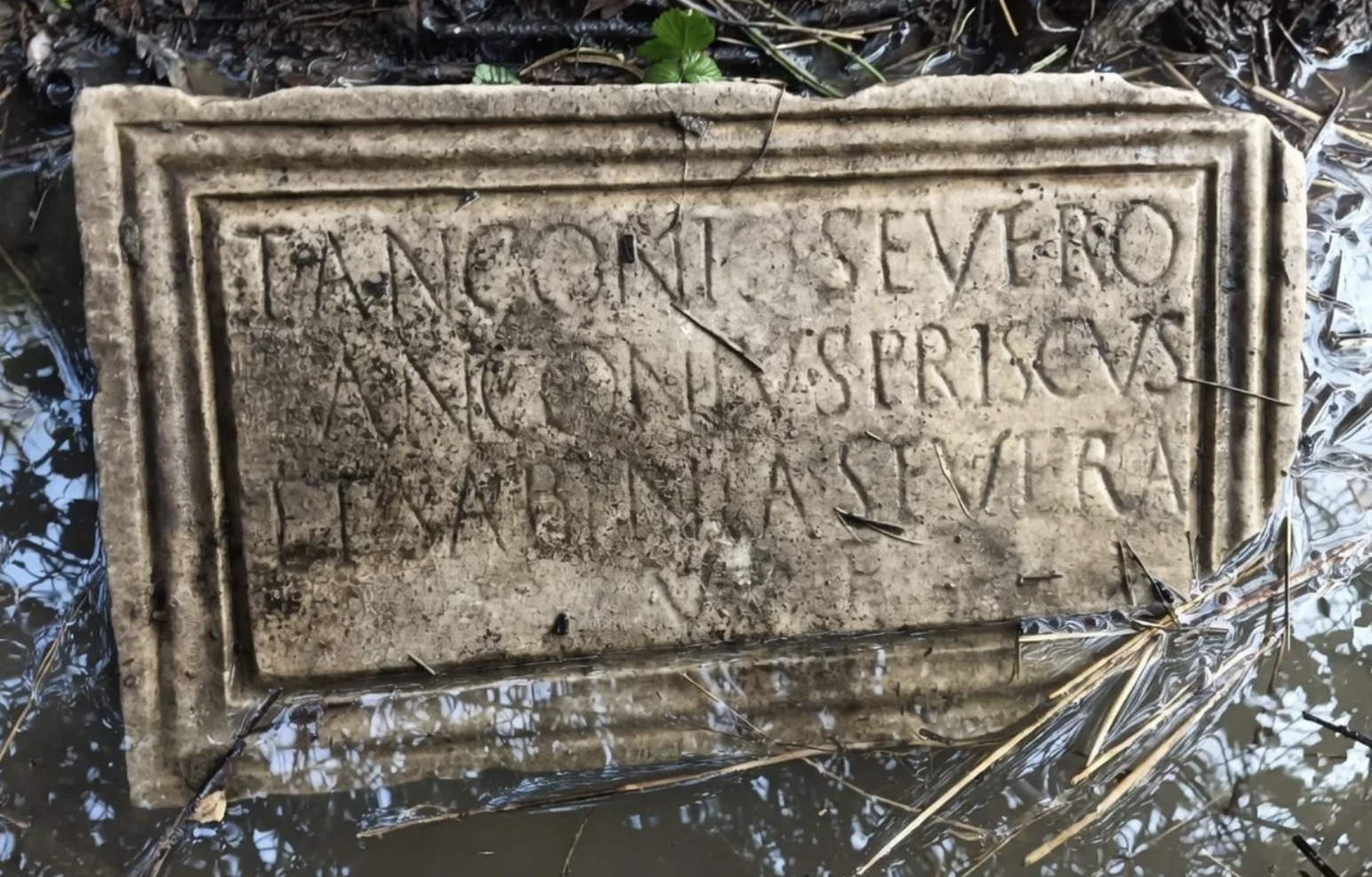
Photo Credit: Superintendency of Archaeology, Fine Arts and Landscape
Experts were immediately intrigued. Lorella Alderighi, an archaeologist with the regional Superintendency, described the discovery as “a real surprise.” Finds like this are rare in the Livorno area, especially in such good condition.
Interestingly, it was the very environment that concealed the stone for so long that also preserved it. The mud and water had protected the inscription for centuries, only for recent rainfall to finally dislodge it.
Retrieving the stone was no simple task. The location was difficult to access, with no proper roads leading to the site. Firefighters were brought in to assist, and after a careful operation, the slab was transported to laboratories in Pisa for further analysis.
The inscription reads:
T(ito) Anconius Severus
Anconius Priscus
et Sabinia Severa
V(ivi) F(ecerunt)
While brief, it tells a deeply human story. The monument commemorates Titus Anconius Severus, likely a young man who died too soon. It appears to have been commissioned by his parents, Anconius Priscus and Sabinia Severa. The final phrase, Vivi fecerunt, translates roughly as “the living made this”, a common Roman practice where families prepared memorials in advance to ensure proper remembrance.
Even the names themselves offer clues. “Anconius” is a relatively uncommon family name, thought to originate from the city of Ancona. Combined with the lack of certain formal titles, experts believe the family may have been freedmen, former slaves or their descendants.
In Roman society, freedmen were often striving to establish their identity and status. Funerary monuments like this weren’t just about remembrance; they were also powerful statements of social position.
During the 2nd and 3rd centuries AD, freedmen became an increasingly significant part of society in this region. Inscriptions like this allowed them to assert their place in the world in a very public and lasting way.
As Alderighi explains, what makes this discovery so compelling isn’t just the physical artefact, but the story behind it. For families of humble origin, commissioning an elegant monument, often while still alive, was a way of achieving recognition and dignity that life may not always have afforded them.