Apollo AI Model Could Help Decode Thousands of Ancient Greek Texts!
Libraries and museums across the world contain vast collections of ancient inscriptions and papyrus fragments, many of which remain only partly understood. Of the more than one million known papyrus fragments, researchers have so far been able to fully decipher only a small proportion, estimated at around 8 per cent.
One of the biggest obstacles is the condition of these ancient documents. Papyrus can survive in extremely fragmented states, with sections of text missing, damaged or impossible to read. Reconstructing the original wording requires specialist knowledge of Ancient Greek as well as considerable time from experienced scholars.
A new artificial intelligence model called Apollo has now been developed to assist with this process.
Apollo was created through a collaboration between the Austrian Academy of Sciences, AI company Mistral, SAIL Reply and Northeastern University. The researchers describe it as the first large language model specifically developed for Ancient Greek.
Rather than simply translating surviving text, Apollo is designed to help reconstruct passages where parts of an ancient document have been lost. It can analyse the surrounding language and propose possible words or phrases to fill the gaps, producing suggestions within seconds.
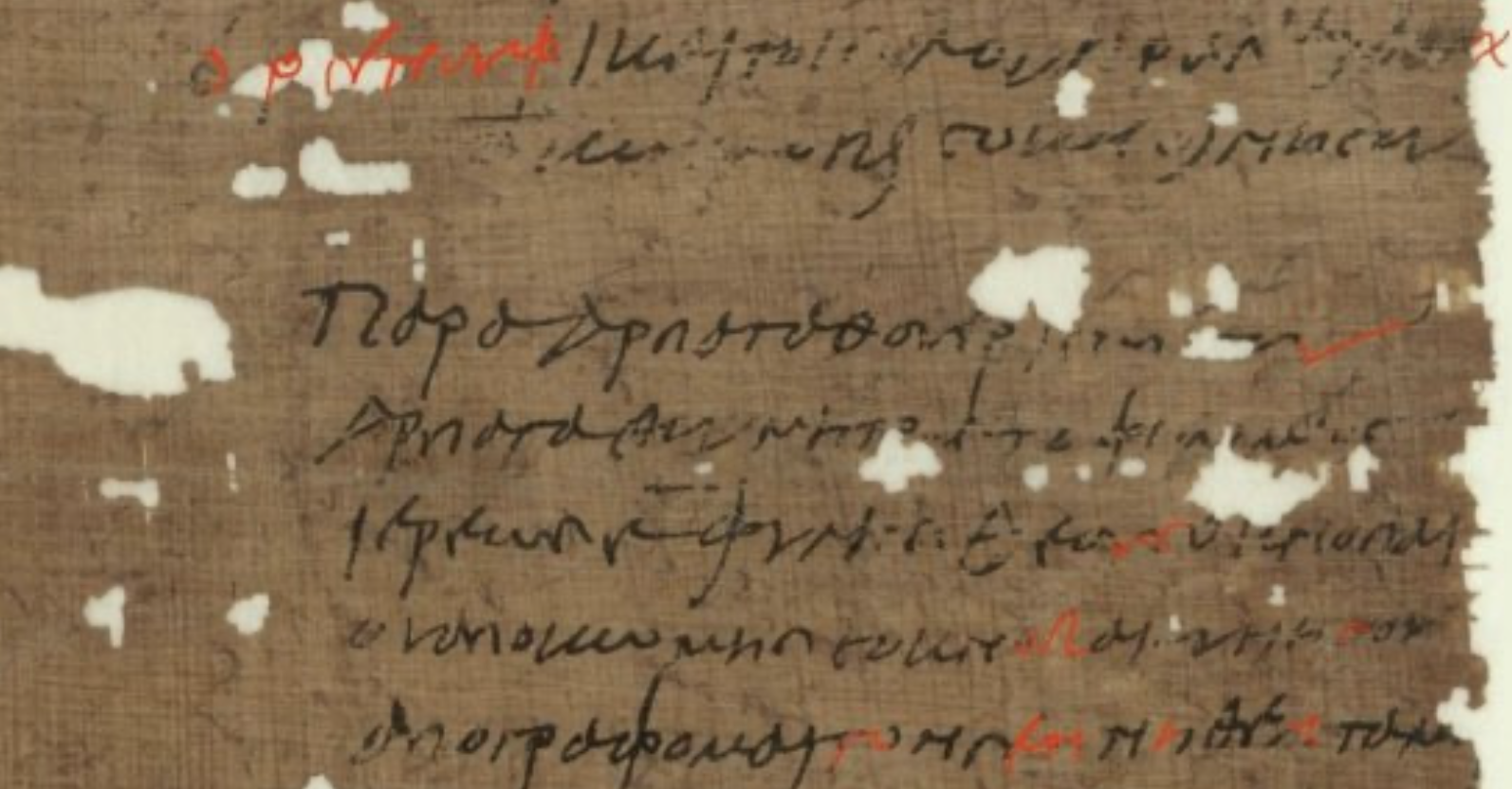
Photo Credit: Österreichische Nationalbibliothek.
This could provide scholars with a new way of approaching damaged texts that might otherwise take considerably longer to reconstruct manually.
Despite being trained on around 600 million words of Ancient Greek, Apollo's training dataset is relatively small compared with those used by many modern AI language models, which can contain tens of billions of words.
The researchers tested the model by taking ancient papyri whose damaged sections had already been reconstructed by scholars. They then concealed parts of the existing texts and asked Apollo to predict what was missing.
The correct reconstruction appeared among the model's top suggestions in approximately 80 per cent of cases.
The researchers also conducted a blind assessment involving 20 specialists in papyrology, epigraphy and philology. The experts compared Apollo's proposed readings with established scholarly reconstructions.
For documentary papyri, the researchers found that Apollo's suggested reading was considered at least as good as the published reconstruction in around 77 per cent of cases.
Interestingly, when the AI and published scholarly readings differed, the experts preferred Apollo's suggestion in approximately 16 per cent of documentary-papyrus cases and around 20 per cent of inscription cases.
The model has already been put to work on several genuine ancient texts.
Among its demonstrations, Apollo has been used to reconstruct an ancient birth certificate and to recover passages from a papyrus scroll damaged during the eruption of Mount Vesuvius.
It has also helped researchers identify evidence relating to Roman law in an ancient city on the Black Sea. One particularly revealing passage includes a reference to a Roman tax associated with prostitution, providing a glimpse into aspects of the legal and economic systems of the ancient world.
Apollo is also capable of recognising differences in period and literary style. According to researcher Sergey Dolganov, the model can identify when the vocabulary and structure of a damaged passage resemble works such as Homer's Odyssey, allowing it to suggest missing text that fits the style of the surviving material.
The potential significance of Apollo lies not necessarily in replacing specialists, but in giving them another tool for working through enormous quantities of damaged material.
Instead of spending hours developing possible reconstructions from scratch, researchers could use the model to generate suggestions almost instantly and then assess those suggestions using their own knowledge of the language, historical context and document.
With hundreds of thousands of inscriptions and more than a million papyrus fragments held in collections around the world, even a relatively small improvement in the speed of decipherment could make a substantial difference.
If systems such as Apollo continue to improve, they could help bring previously unreadable passages back into focus — potentially revealing new evidence for ancient literature, law, society and everyday life.