Bronze Ring Depicting Ptolemaic Queen Arsinoe III Found Near Anapa!
Archaeologists excavating a Hellenistic settlement close to Anapa, on Russia’s northern Black Sea shoreline, have uncovered a remarkable bronze ring bearing what researchers believe is the likeness of Arsinoe III, queen of Ptolemaic Egypt between 220 and 204 BCE.
The artefact was recovered from Voskresenskoye 6, an ancient estate complex situated roughly 500 metres north-west of Anapa railway station. During antiquity, this area lay within the sphere of Gorgippia, an important city of the Bosporan Kingdom that played a significant role in linking Black Sea communities with trade networks stretching across the Mediterranean.
The discovery has been described in the journal Problemy istorii, filologii, kul’tury by Mikhail Yu. Treister, Irina V. Rukavishnikova and Denis V. Beylin, who argue that the engraved portrait represents Arsinoe III.
The ring is a substantial cast bronze example featuring a broad hoop and an oval bezel. It belongs to a recognised category of jewellery known as Ptolemaic-type rings, which have been discovered across the northern Black Sea region, particularly within the Bosporan Kingdom.
These rings commonly feature portraits of women believed to represent members of Egypt's Ptolemaic royal family. Previous examples have been linked to queens including Arsinoe II, Berenice II and Arsinoe III, suggesting that royal imagery from Egypt circulated widely beyond its borders during the Hellenistic period.
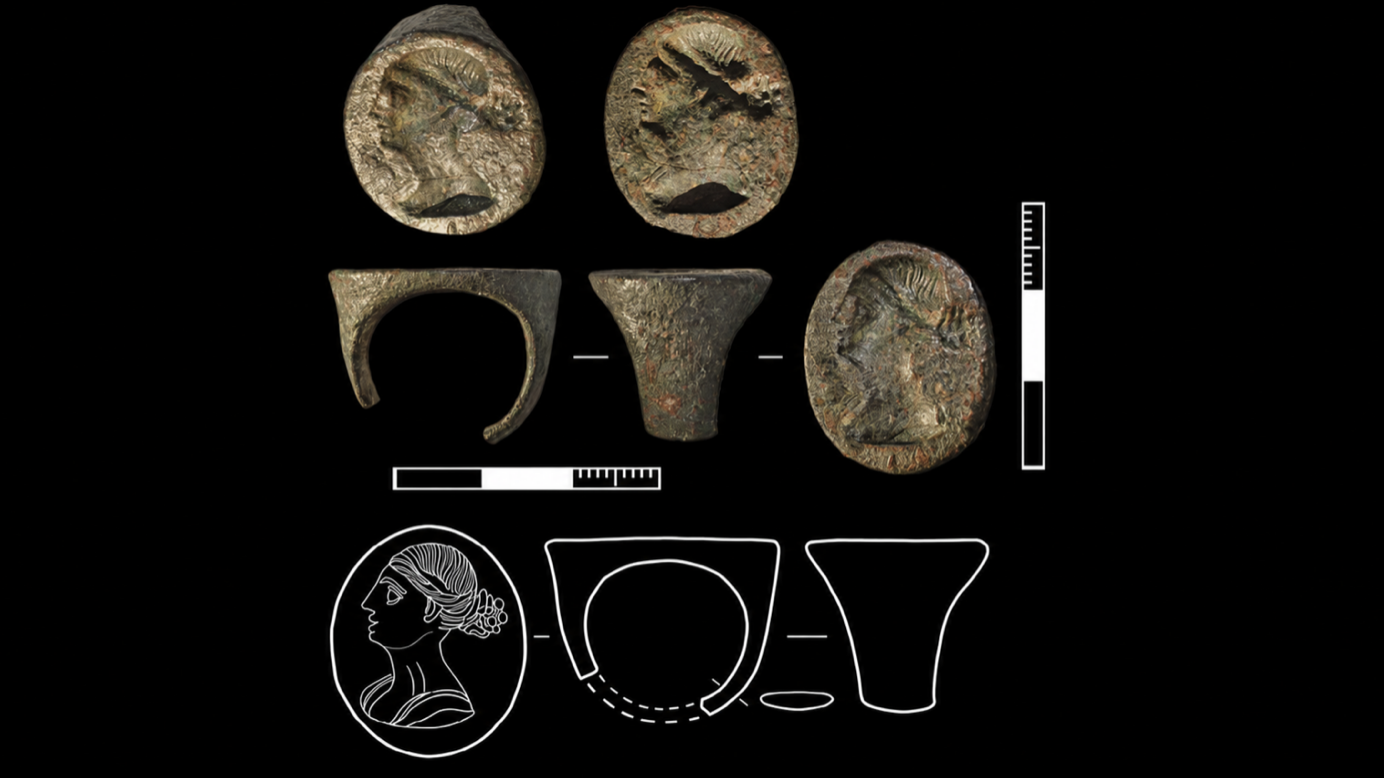
Photo Credit: Treister et al., 2026
The newly discovered ring displays a left-facing female profile with several distinctive characteristics. Among them are a narrow headband, flowing locks extending from the crown, and a rounded bun secured at the back of the head. Small decorative elements surrounding the bun, possibly representing curls, pins or beads, closely resemble features associated with depictions of Arsinoe III. Although only a limited number of comparable rings are known, the similarities are considered significant by the researchers.
Rather than being recovered as an isolated object, the ring was excavated from Pit 4 at Voskresenskoye 6 during fieldwork carried out in 2024 by the Institute of Archaeology of the Russian Academy of Sciences.
The pit contained a diverse collection of archaeological material, including 112 fragments of pottery made up of amphorae, tableware, cooking vessels and building ceramics. Many of the amphora fragments originated from well-known production centres such as Heraclea Pontica, Chios, Colchis and Knidos, highlighting the extensive commercial connections that linked the Black Sea coast with the wider Mediterranean during the 4th and 3rd centuries BCE.
This assemblage provides valuable chronological evidence. While the ceramics broadly date to the Hellenistic period, identifying the portrait as Arsinoe III allows the ring itself to be placed within a much narrower timeframe, corresponding to her reign between 220 and 204 BCE.
Although situated far from Egypt, the region surrounding ancient Gorgippia was deeply connected to the wider Hellenistic world. The Bosporan Kingdom served as a meeting point for Greek settlers, indigenous peoples and steppe communities, with trade helping to spread goods, artistic styles and political symbolism across considerable distances.
Similar portrait rings have previously been found elsewhere in the Bosporan Kingdom, as well as in Maeotian burial sites within the Trans-Kuban region. The Anapa discovery adds another important example to this growing body of evidence, reinforcing the concentration of Ptolemaic-inspired jewellery around Gorgippia and neighbouring territories.
Researchers stress that the ring should not be interpreted as evidence of Arsinoe III herself having any connection with the area, nor does it necessarily indicate that its owner came from Egypt. Instead, it illustrates how royal imagery could travel through commerce, fashion and cultural exchange, eventually becoming part of everyday life in communities located more than 2,200 years ago on the northern shores of the Black Sea.
One of the most significant aspects of the discovery is the close agreement between the archaeological context and the proposed identification of the portrait. If the attribution is correct, the ring can be dated to a remarkably short period of just sixteen years, making it an unusually well-dated personal object from the Hellenistic era.
Scientific analysis has also revealed that the ring was cast from leaded tin bronze, matching the composition of other known Ptolemaic-type rings recovered from the Bosporan Kingdom and Chersonesus.
Taken together, the evidence suggests that this was far more than a decorative accessory. The ring provides fresh insight into the movement of royal iconography across the Hellenistic world, demonstrating how symbols associated with Egypt's Ptolemaic dynasty reached distant Black Sea communities through the extensive cultural and commercial networks of the ancient Mediterranean.