Huge Bronze Age Settlement Found at Wicklow Hillfort!
Archaeologists working in eastern Ireland have uncovered evidence of a prehistoric settlement on a scale never before seen in Ireland or Britain, forcing a rethink of how people lived during the Late Bronze Age. New research published in Antiquity reveals that the hillfort known as Brusselstown Ring in County Wicklow once contained more than 600 houses, making it the largest known nucleated settlement from this period.
Brusselstown Ring forms part of the Baltinglass hillfort cluster, a landscape made up of as many as 13 hilltop enclosures that were used almost continuously from the Early Neolithic through to the Bronze Age. What sets Brusselstown apart, however, is its sheer size and complexity. The site is enclosed by two widely spaced ramparts, with the outer boundary wrapping around not only the main hillfort but also a neighbouring Neolithic enclosure on Spinas Hill. Enclosures spanning more than one hill are extremely rare in Ireland and Britain, and even across Iron Age Europe they are unusual.
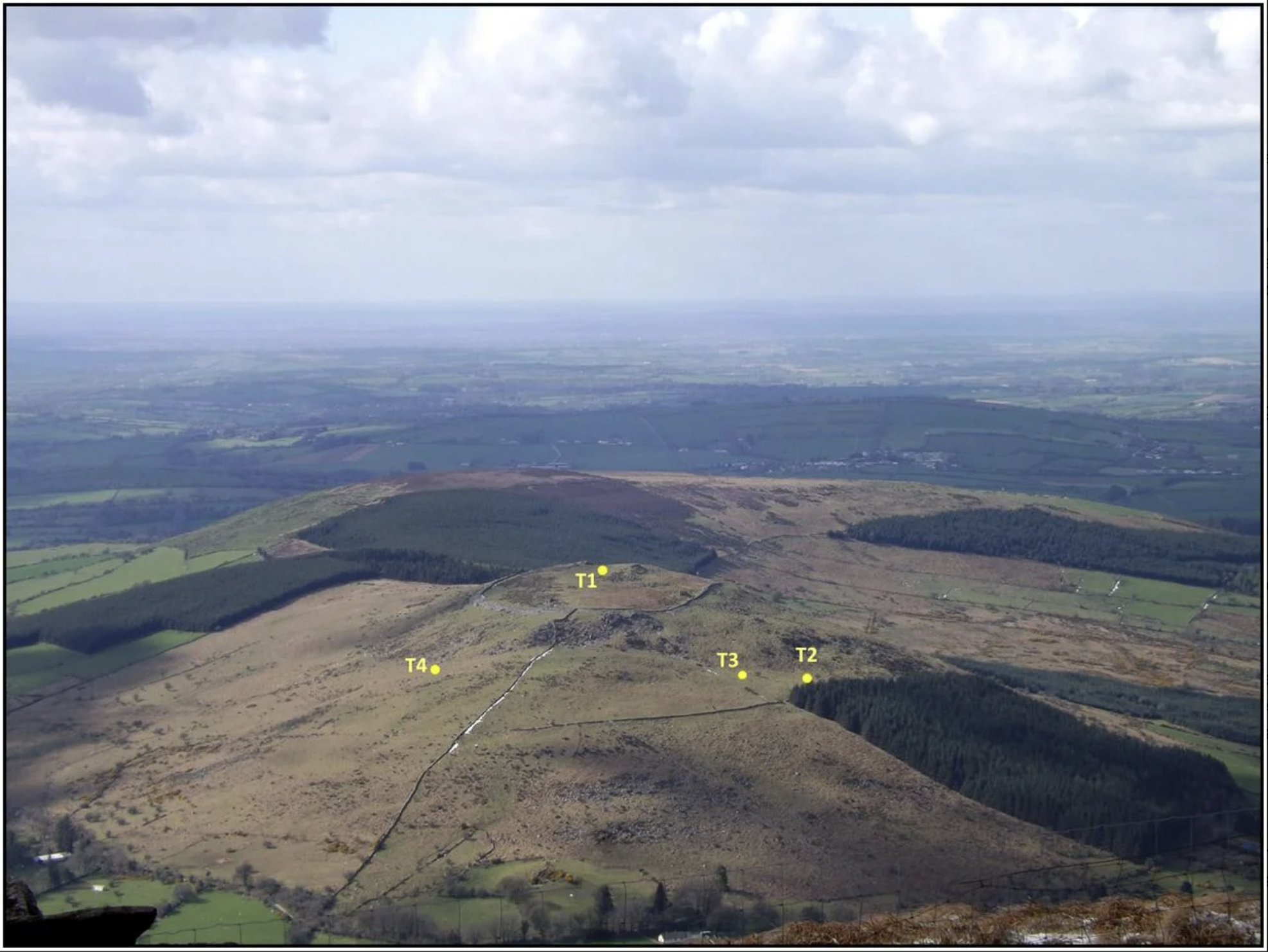
Photo Credit: D. Brandherm et al., Antiquity Publications Ltd (2025)
Using aerial photography and detailed topographical surveys, researchers identified over 600 faint circular platforms believed to be the remains of houses. Ninety-eight of these lie within the inner enclosure, while more than 500 sit between the inner and outer ramparts. This density strongly suggests a large, permanently occupied community, rather than the small, scattered farmsteads that are typical of prehistoric Ireland.
To test these interpretations, archaeologists excavated four house platforms of different sizes across the site. Radiocarbon dating and material finds indicate that the settlement was mainly occupied between around 1200 and 400 BCE, spanning the Late Bronze Age and into the Early Iron Age. Interestingly, houses of varying sizes appear to have been in use at the same time, and there is no clear evidence that larger houses belonged to wealthier or higher-status individuals. Instead, the findings point towards a relatively egalitarian society, despite the settlement’s large population.
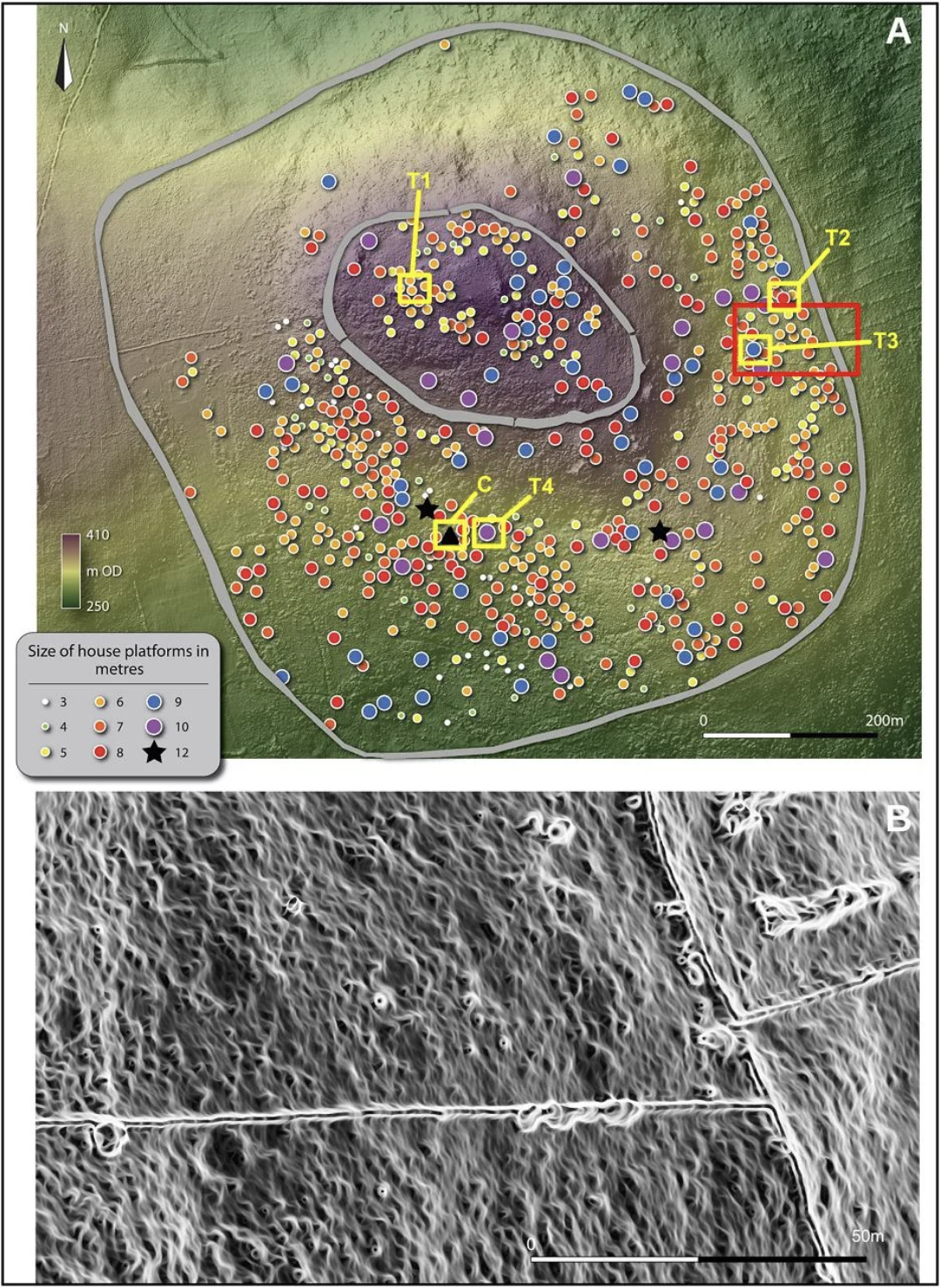
Photo Credit: D. Brandherm et al., Antiquity Publications Ltd (2025)
One of the most intriguing discoveries was a stone-lined structure found near one of the trenches. Its flat interior and proximity to a natural water source make it unlikely to have been a standard roundhouse. Researchers believe it may have functioned as a water cistern, a feature known from parts of continental Europe but not previously identified in Irish hillforts. If confirmed, this would suggest a high level of planning and organisation to support life for hundreds of people on a hilltop.
The settlement appears to have been gradually abandoned during the third century BCE, following a pattern seen at other hillforts in Ireland. There is no strong evidence that climate change was responsible, pointing instead to social or economic shifts as the likely cause.
Ongoing research aims to confirm the function of the possible cistern, establish a clearer timeline for the construction of the ramparts, and better understand why one of the largest communities in prehistoric Ireland eventually fell out of use. What is already clear, however, is that Brusselstown Ring is transforming our understanding of Bronze Age society, showing that large, organised and stable communities existed far earlier than previously believed.