Largest Roman Villa in Wales Discovered at Margam Park!
Archaeologists have uncovered what is now believed to be the largest Roman villa ever found in Wales, hidden just beneath the surface of Margam Country Park in Port Talbot. Described by experts as an “amazing discovery”, the site has even been playfully dubbed “Port Talbot’s Pompeii” because of how well preserved it appears to be.
The discovery was made after ground-penetrating radar scans revealed the outline of a vast Roman structure lying less than a metre underground. Dr Alex Langlands, who leads the project and co-directs Swansea University’s Centre for Heritage Research and Training, said the moment the results came in was unforgettable, admitting he was stunned by the sheer scale of what appeared on the scans.
What makes the find particularly special is its location. The villa sits within a historic deer park that has never been ploughed or built on, meaning the remains have avoided the damage that affects many other Roman sites. As a result, archaeologists believe the villa could be exceptionally well preserved.
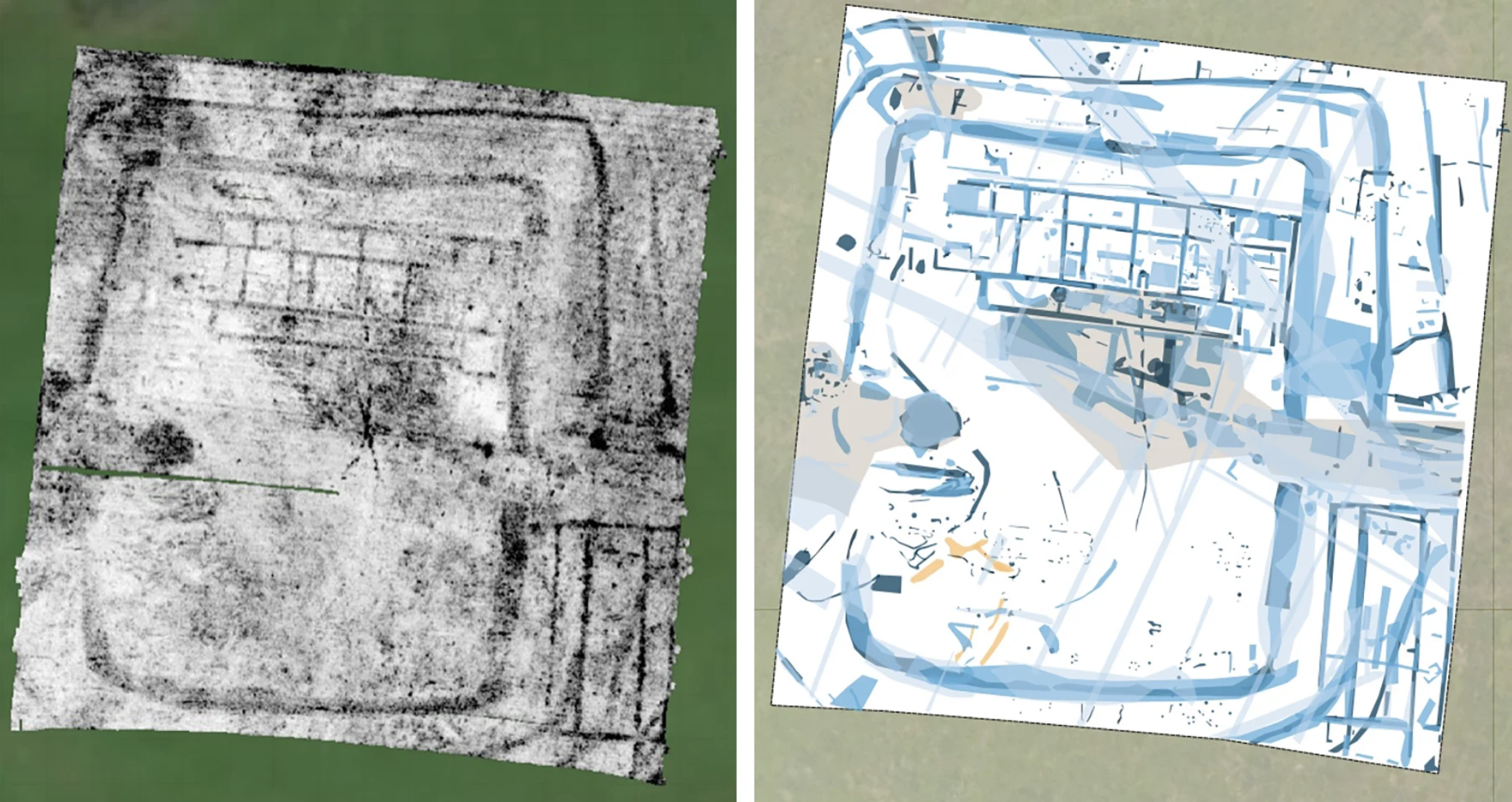
Photo Credit: Terradat Geophysics
The surveys, carried out by Swansea University in partnership with Neath Port Talbot Council, Margam Abbey Church and specialist firm TerraDat, revealed a Roman villa covering around 572 square metres. The building appears to be a classic corridor-style villa, with two wings, a veranda along the front, and multiple rooms laid out both at the front and rear. According to Dr Langlands, it would almost certainly have belonged to a powerful local figure and formed the heart of a large agricultural estate, bustling with activity.
Alongside the villa, the scans also identified surrounding defensive ditches and a large aisled building nearby, thought to have been either a barn or a meeting hall. Experts say the clarity of the imaging has allowed them to map the site in impressive three-dimensional detail.
As a standalone structure, this is the largest Roman villa discovered in Wales to date. While many Roman remains in Wales are linked to military forts and camps, high-status rural estates like this are far rarer. The find challenges long-held assumptions about Roman Wales, suggesting that south Wales was not merely a distant frontier of the empire but home to wealth and sophistication comparable to southern England.
The villa’s exact location is currently being kept secret to protect it from illegal metal detecting. For now, the priority is conservation, with further surveys planned before any future excavation work begins.
The discovery has sparked excitement well beyond the archaeological community. Local residents have spoken of their amazement at learning that such an important site lay beneath a park where generations have played and walked. For many in Port Talbot, a town that has faced significant economic challenges in recent years, the find is a rare piece of good news and a source of pride.
Schools and community groups have already been involved through the ArchaeoMargam project, which aims to connect people with their local heritage. There is hope that, in time, a community excavation could allow residents to play a hands-on role in uncovering more of Margam’s Roman past.
Margam Country Park was already rich in history, home to an Iron Age hillfort, a medieval abbey and a striking Victorian castle. This Roman villa, however, fills a major gap in our understanding of the area’s past and adds yet another layer to its story.
As further details are shared with the public, it’s clear this discovery has the potential to reshape how we see Roman Wales, and to put Port Talbot firmly on the archaeological map.