Roman Marching Camps Discovered in Eastern Germany!
Archaeologists working in eastern Germany have made a remarkable discovery that is reshaping our understanding of Roman military reach. For the first time, confirmed Roman marching camps have been identified in Saxony-Anhalt, providing clear evidence that Roman troops operated far beyond the Rhine frontier in the early 3rd century AD.
The newly identified sites, located near Aken, Trabitz and Deersheim, represent the north-easternmost Roman military camps ever found in what the Romans once called free Germania. These temporary encampments, known as marschlager, challenge long-standing assumptions that Roman campaigns east of the Rhine were limited or short-lived after earlier defeats.
The camps lie between the northern Harz Mountains and the River Elbe, within today’s districts of Anhalt-Bitterfeld, Salzlandkreis and Harz. Archaeologists date them to around 1,800 years ago, placing their use firmly in the early 3rd century AD.

Photo Credit: State Office for Heritage Management and Archaeology
According to state archaeologist Harald Meller, the discovery is nothing short of sensational. While Roman coins and scattered military objects had been found in Saxony-Anhalt before, there was no structural evidence to prove large-scale Roman operations in the region. These camps now provide that missing proof.
Roman marching camps were temporary but highly organised installations built by legions at the end of a day’s march. Despite their short-term use, they followed a strict and recognisable layout: a rectangular plan with rounded corners, defensive V-shaped ditches, carefully controlled entrances and external obstacles known as titula. Inside, a regimented road system led to the central command area.
The camps uncovered in Saxony-Anhalt display all of these characteristic features. Excavations have revealed defensive ditches measuring up to 1.8 metres wide and more than 1.5 metres deep, leaving little doubt about their Roman origin.
Rather than being spotted from the ground, the camps were first identified using modern technology. Satellite imagery, aerial photography and geophysical surveys revealed distinctive geometric patterns in the landscape that stood out from prehistoric or medieval remains. Volunteer heritage researchers were instrumental in flagging these anomalies, which were later confirmed by professional archaeologists through targeted excavations.
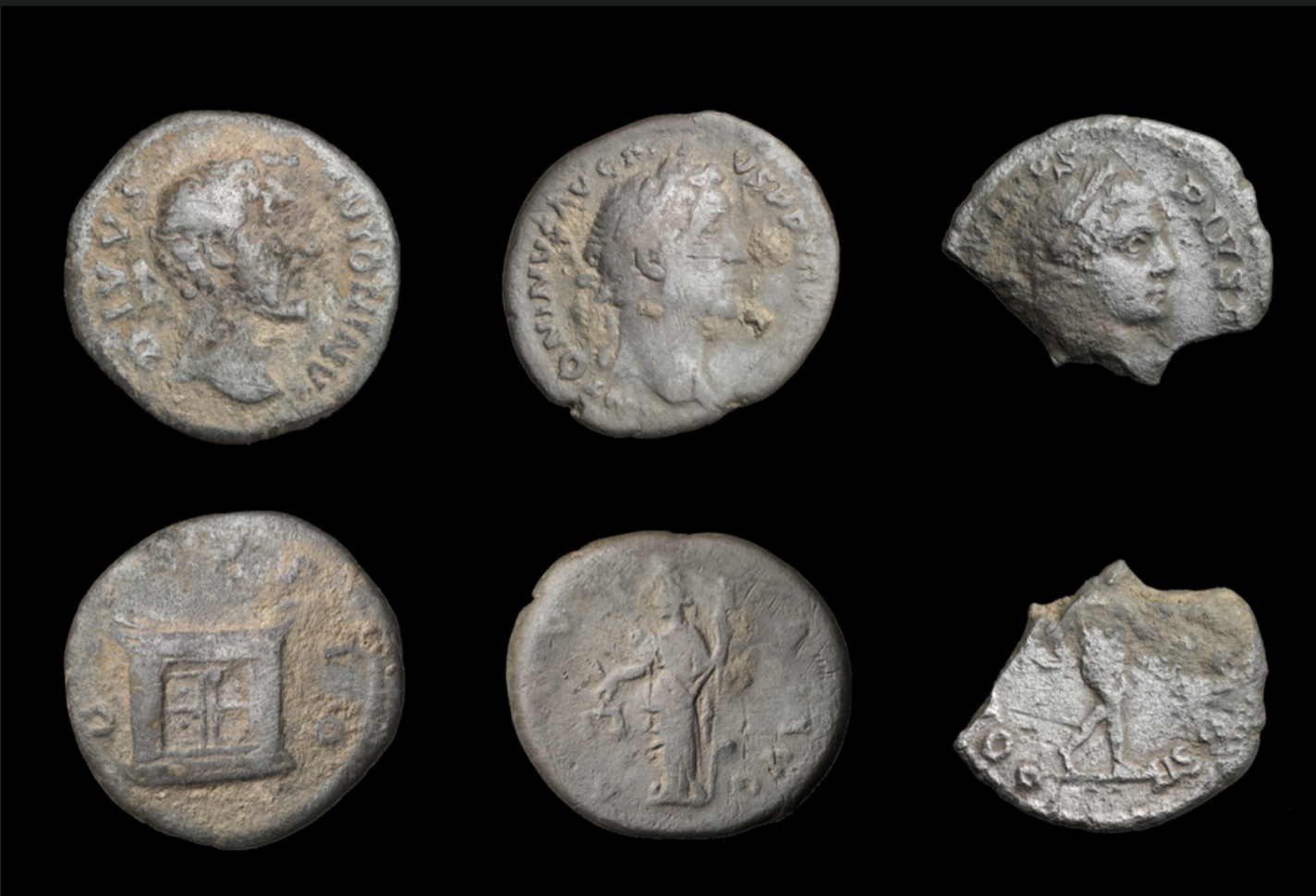
Photo Credit: State Office for Heritage Management and Archaeology
Systematic metal-detecting surveys produced more than 1,500 finds, including iron nails from military footwear, weapon fittings, brooch fragments and Roman coins. One of the most important discoveries was a silver denarius of Emperor Caracalla, who ruled between AD 211 and 217. This coin provides a clear earliest possible date for the camps and supports their use in the early 3rd century. Radiocarbon dating has reinforced this timeframe, pointing to a period of renewed Roman military activity deep inside Germanic territory.
For generations, the Roman defeat at the Battle of the Teutoburg Forest in AD 9 has been seen as the moment Rome abandoned ambitions east of the Rhine. While the empire did step back from permanent occupation, these new findings show that Roman armies continued to carry out large-scale campaigns well beyond the frontier for centuries afterwards.
Ancient sources describe punitive expeditions and defensive operations against emerging Germanic groups during the 3rd century. One account even speaks of an invasion under Emperor Maximinus Thrax that penetrated hundreds of miles into Germania. Another likely candidate is Caracalla’s campaign of AD 213, previously believed to have remained close to the Roman border.
The Saxony-Anhalt camps suggest these expeditions reached much further north-east than historians once thought. Until now, most scholars placed Roman–Germanic conflicts of this period close to the fortified frontier, or limes. These camps force a reassessment of Roman strategic mobility, logistics and intelligence-gathering in central Europe.
The similar size and layout of the camps at Aken and Trabitz also point to a coordinated campaign involving multiple stages of advance, consistent with the movement of a substantial legionary force.
Archaeologists plan to continue investigating the sites through further excavation and landscape analysis. Their aim is to better understand how Roman troops moved through the region, how long they stayed, and how they interacted with local Germanic communities along the Elbe and Saale rivers.
If the camps can be firmly linked to Caracalla’s campaigns, historians may need to revise established views of Roman warfare in the 3rd century. More broadly, the discoveries demonstrate how modern technology and collaborative research are transforming our understanding of the ancient world.
The Roman marching camps of Saxony-Anhalt open an important new chapter in the story of Rome’s northern frontier. Rather than a hard boundary, the Rhine now appears to have served as a launching point for deep and sustained military incursions into Germania long after Rome abandoned plans for permanent conquest.
As research continues, these temporary camps may permanently alter the historical map of Roman Europe and offer rare, tangible insight into one of antiquity’s most contested border regions.