Oldest Rock Art in the British Isles Confirmed in 17,000-Year-Old Welsh Cave Discovery!
Scientists have finally resolved a long-running archaeological debate by confirming that red markings inside a Welsh cave are the oldest known rock art in the British Isles. The discovery brings closure to a controversy that has persisted for over a hundred years and firmly places the site among Europe’s earliest examples of symbolic expression.
The paintings are located deep within Bacon Hole, a limestone cave set into the cliffs of the Gower Peninsula in South Wales. First documented in 1912, the markings were initially celebrated as potential Upper Palaeolithic artwork. However, this early interpretation quickly came under scrutiny. By the 1920s, many experts had dismissed the lines as natural staining or geological features rather than deliberate human creation. Over time, the site faded from academic discussion, and even its exact position within the cave became uncertain.
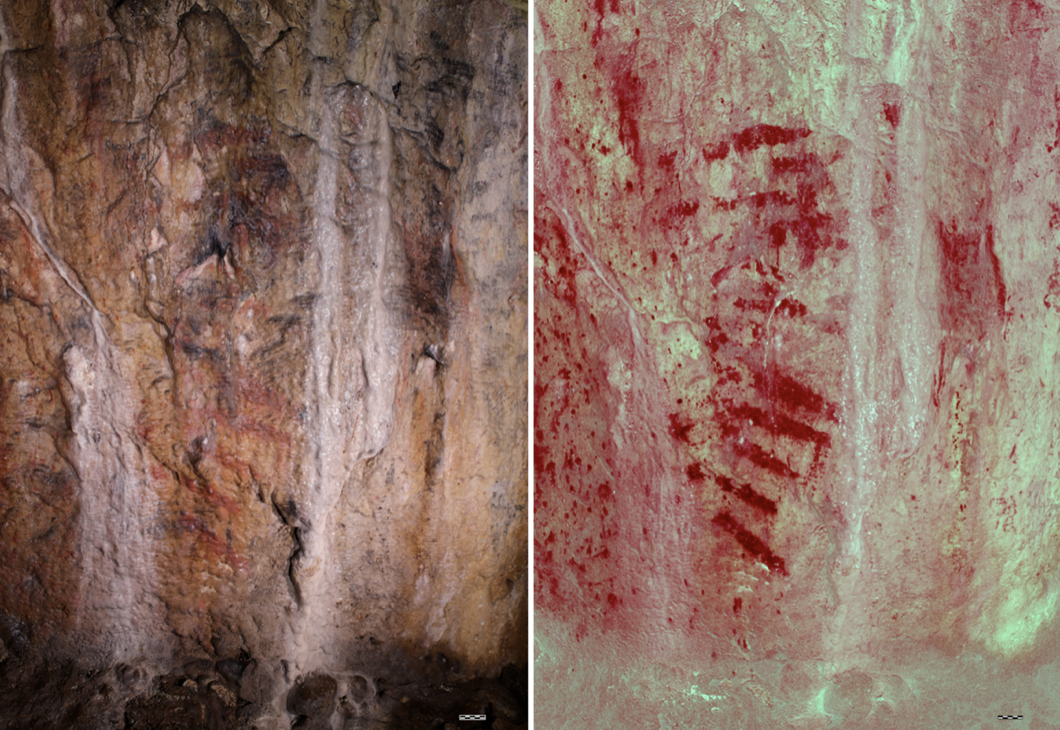
Photo Credit: Nash et al., Quaternary (2026); CC BY 4.0
Interest in the cave was revived in 2022 when an international team returned to Bacon Hole to relocate the forgotten panel. Once rediscovered, researchers carried out a detailed investigation involving pigment analysis, cave surveys, and scientific dating techniques. Their results strongly support the original early 20th-century claim that the markings are indeed human-made.
The artwork itself consists of at least ten horizontal red lines arranged in a deliberate, orderly formation. Analysis revealed that the pigment is rich in haematite, an iron-based mineral commonly used as a red colouring in prehistoric art. Traces of clay mixed into the pigment suggest it was carefully prepared before being applied to the cave wall, rather than occurring naturally.
One of the strongest pieces of evidence for human involvement lies in the structure of the markings. The lines are evenly spaced and run parallel to one another in a pattern that is highly unlikely to have formed through natural processes. Researchers also noted the absence of similar formations anywhere else in the cave. Additional signs, including finger impressions, small dots, and pigment splashes, further support the conclusion that the markings were intentionally created.
To establish the age of the artwork, scientists analysed calcite layers that had formed over the painted surface. Using uranium-thorium dating, they determined that the deposits, and therefore the paintings beneath them, date to between approximately 18,300 and 15,700 years ago. Most estimates place the artwork at around 17,000 years old, making it the earliest confirmed rock art discovered in the British Isles to date.
This period coincides with a dramatic environmental transition at the end of the last Ice Age. Wales would have looked very different from its modern landscape. Much of the region was cold and sparsely vegetated, with large open plains replacing today’s more wooded terrain. The area around what is now the Bristol Channel is believed to have been a broad, exposed landscape where herds of animals moved seasonally across the plains.
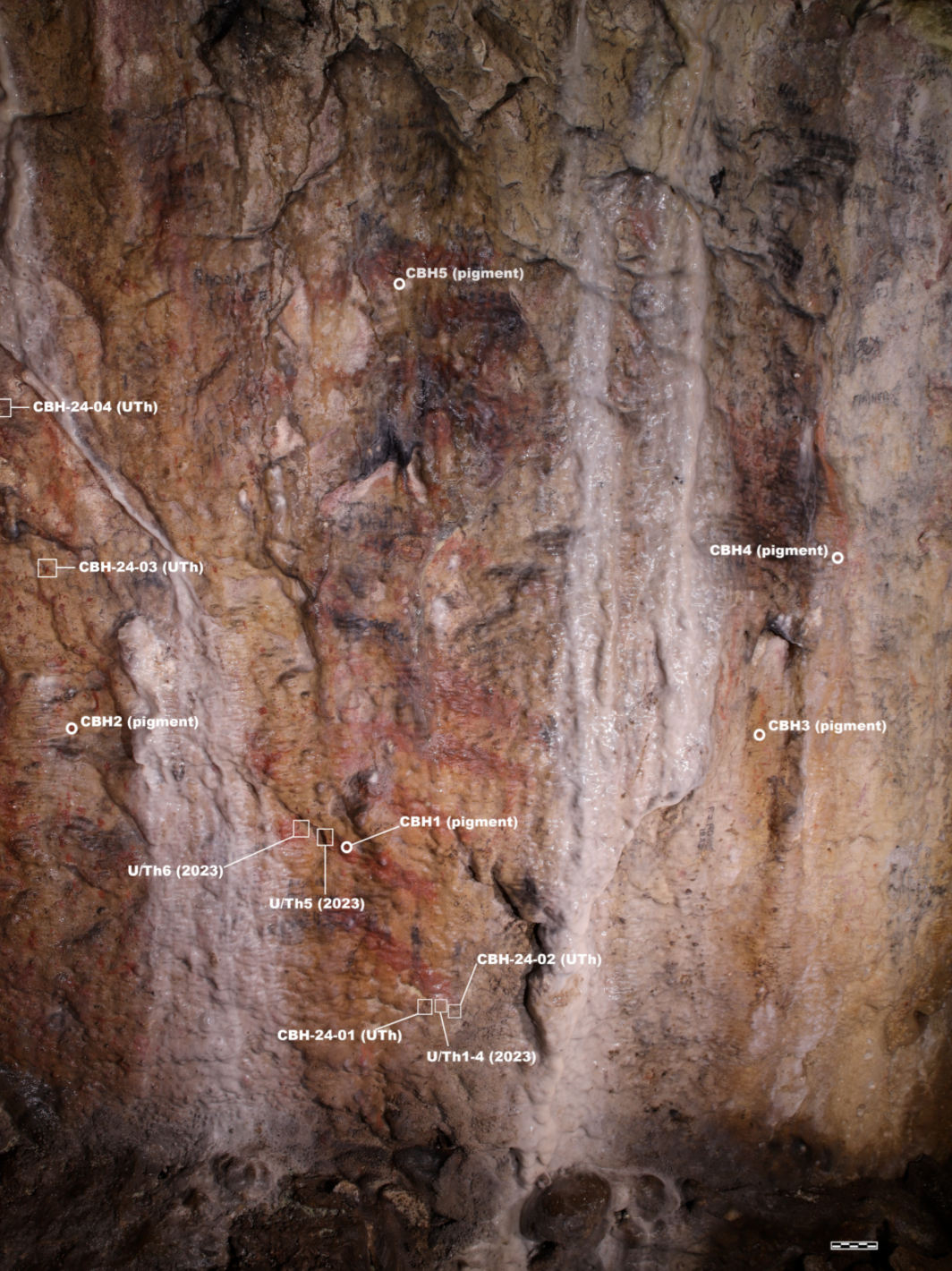
Photo Credit: Nash et al., Quaternary (2026); CC BY 4.0
Although there is no evidence that Bacon Hole was permanently inhabited during this time, it likely provided temporary shelter for hunter-gatherer groups moving through the region. The painted panel is located in a secluded chamber far from natural daylight, suggesting it was not used for everyday practical activities.
Researchers argue that the choice of such a hidden location may be significant. Producing artwork in deep, dark conditions implies that the act carried meaning beyond simple decoration. While the exact purpose of the red lines remains unknown, their placement hints at symbolic or possibly ritual behaviour among Ice Age communities in Britain.
The cave’s history did not end with the creation of the paintings. Archaeological finds from later periods show that Bacon Hole continued to attract human visitors for thousands of years. Objects recovered from the site include pre-Roman pottery, Roman artefacts, early medieval jewellery, Saxon beads, and medieval household items. This long sequence of use suggests the cave held enduring importance across many generations.
Despite the breakthrough, researchers emphasise that further work is still needed. Additional sampling and analysis of other surfaces within the cave could provide a more complete understanding of how the site was used over time. Nevertheless, the current evidence leaves little room for doubt: the red linear markings in Bacon Hole are genuine Palaeolithic artwork, restoring the cave’s status as one of the earliest known centres of human symbolic activity in the region.