Oldest Roman Segmental Armour Found at Teutoburg Forest Battlefield!
A remarkable discovery from the battlefield of Kalkriese in Germany is providing archaeologists with an extraordinary insight into the equipment used by Roman soldiers during the reign of Emperor Augustus.
The find is an almost complete example of lorica segmentata, the famous Roman segmented armour made from overlapping iron plates. Dating to the early first century AD, it is believed to be the oldest and most complete surviving example of this type of armour ever discovered.
However, the significance of the discovery goes beyond military technology. Found alongside the armour was a restraint device positioned near the neck and shoulder area, raising the possibility that the equipment may have belonged to a Roman soldier who survived the battle but was later captured by his enemies.
The armour was uncovered in 2018 during excavations at Kalkriese, a site strongly linked to the catastrophic Battle of the Teutoburg Forest in AD 9.
During this battle, an alliance of Germanic tribes commanded by Arminius ambushed and destroyed three Roman legions led by Publius Quinctilius Varus. The defeat was one of Rome’s most devastating military disasters and brought an end to the empire’s attempts to expand further into Germania.
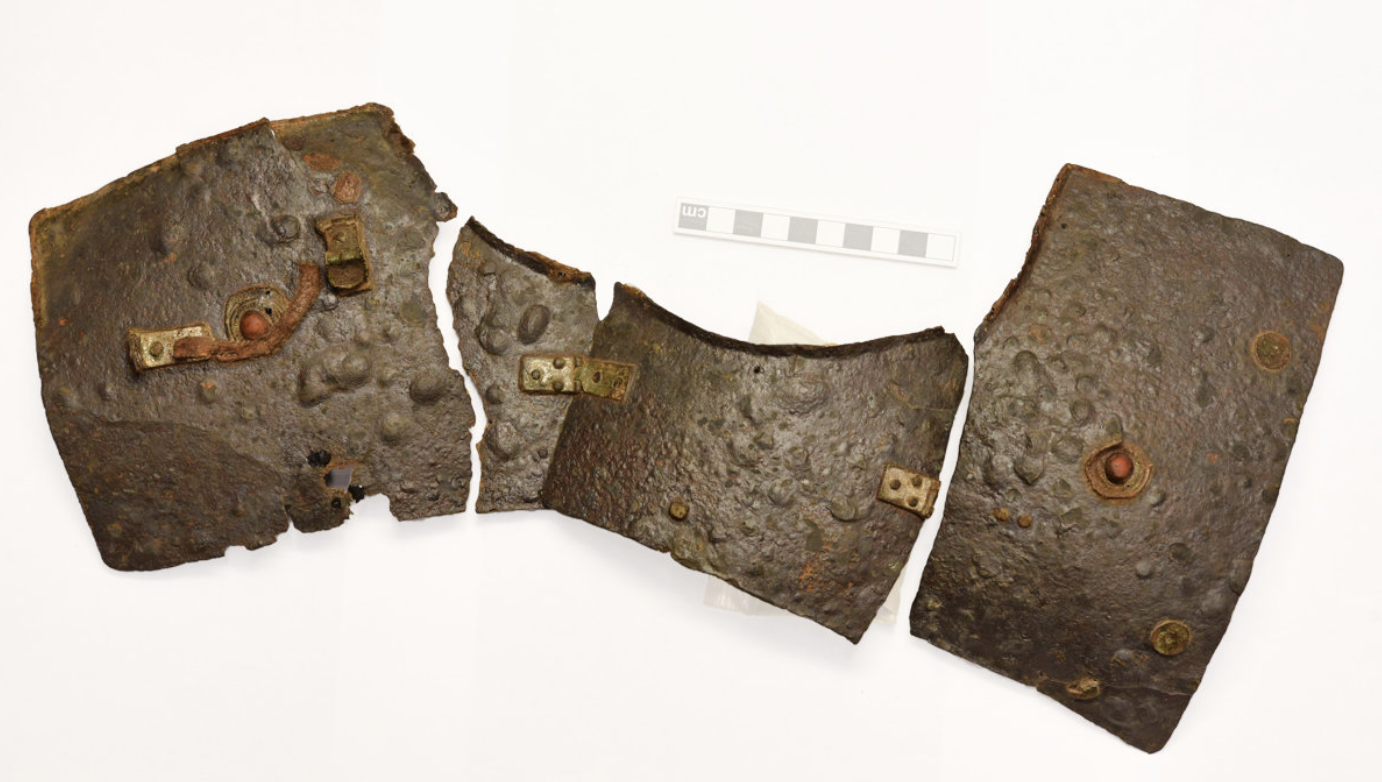
Photo Credit: Varusschlacht im Osnabrücker Land.
The battlefield has produced thousands of artefacts connected to the conflict, including weapons, coins, and military equipment. Yet the discovery of such a well-preserved suit of armour is among the most important finds ever made at the site.
Roman segmented armour is instantly recognisable from ancient sculptures and monuments, where it is often shown being worn by legionaries. Despite its famous appearance, actual surviving examples are extremely rare.
Before the Kalkriese discovery, much of what archaeologists knew about the armour came from incomplete remains, especially fragments discovered at Corbridge Roman Site in northern England. Those examples date to the second century AD, making the Kalkriese armour more than 100 years older.
The newly discovered suit consists of around 30 separate iron plates, with only a small number believed to be missing. Remarkably, parts of the hinges, bronze fittings, buckles, and traces of the leather connections have survived despite the acidic and sandy conditions of the battlefield.
This level of preservation has allowed researchers to study not only the armour’s appearance but also how it was assembled and how it would have functioned when worn by a Roman soldier.
The Kalkriese armour challenges older assumptions that early versions of lorica segmentata were simple prototypes that later developed into more advanced forms.
Instead, the surviving components reveal a highly skilled manufacturing process. The overlapping metal plates created a strong yet flexible defence for the torso, allowing soldiers to move more freely than they could in some other types of armour.
The design also differs from later examples. Unlike many later forms of lorica segmentata, the Kalkriese armour did not include protective plates covering the upper arms. Instead, the shoulder sections created a structure more similar to a sleeveless protective vest.
This suggests that Roman armour designers continued to experiment with the equipment over time. Later versions may have expanded protection around the arms, showing that segmented armour was not a fixed design but something that evolved throughout the imperial period.
Interestingly, the Kalkriese example may even have been more complex than some later versions. Researchers believe that Roman military equipment gradually became simpler in certain areas, possibly because the army needed to produce armour more efficiently for the enormous numbers of soldiers serving across the empire.
When archaeologists first uncovered the object, they could not see the armour itself. Instead, they discovered a large mass of soil and corroded metal buried underground.
To protect the fragile remains, the entire block was removed as a single piece. Measuring approximately 1.25 metres by 1 metre and weighing around 500 kilograms, it was transported for further investigation.
Traditional X-rays were unable to penetrate the dense mixture of soil and metal corrosion, so researchers turned to industrial computed tomography scanning at the Fraunhofer Development Centre for X-ray Technology in Fürth.
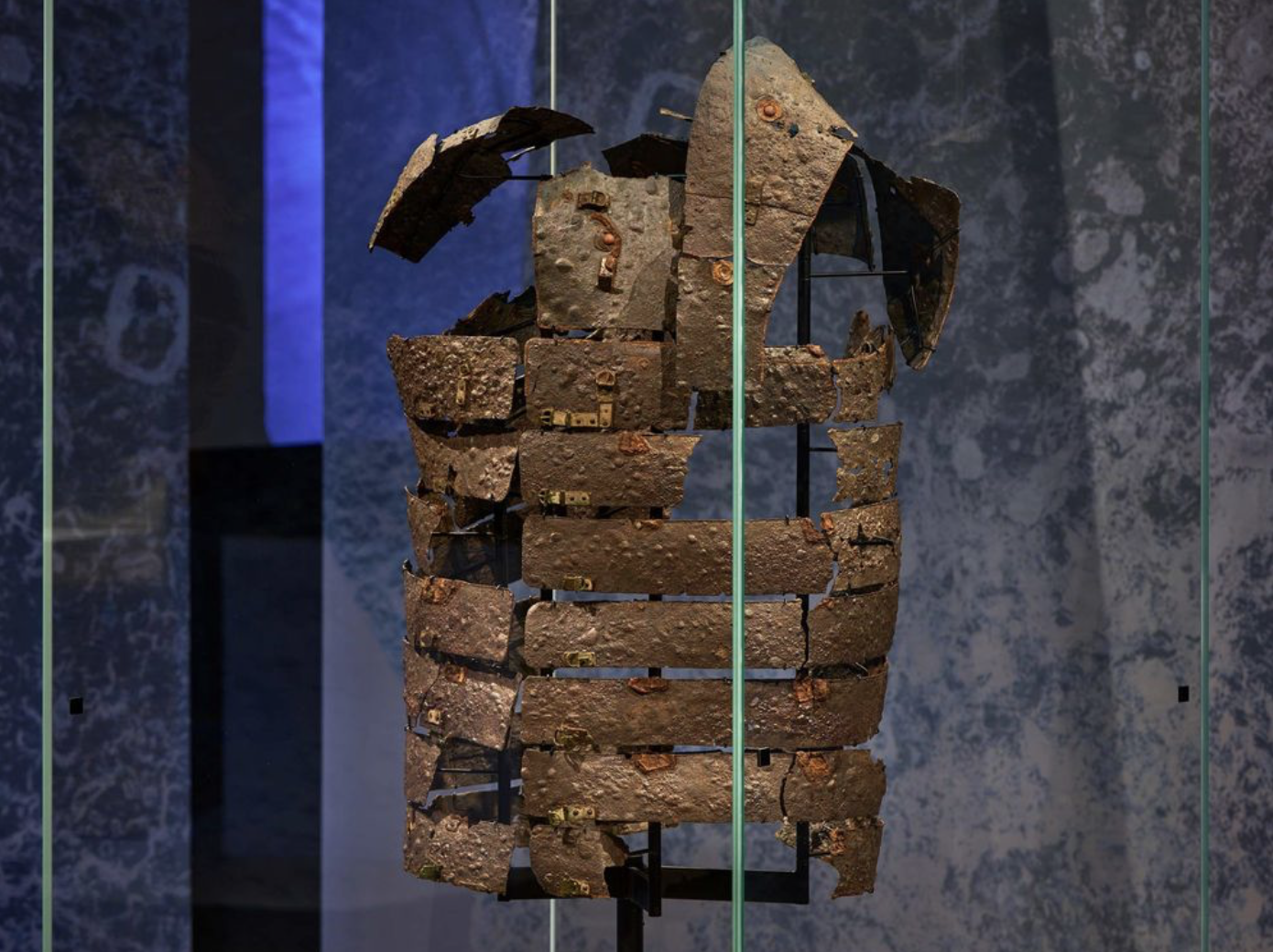
Photo Credit: VARUSSCHLACHT im Osnabrücker Land gGmbH – Museum und Park Kalkriese
Over several days, the block was rotated while around 1,500 images were captured. The resulting scans revealed the hidden outline of the collapsed armour inside, allowing conservators to carefully remove layers of soil and corrosion without damaging the object.
The pressure of nearly two thousand years underground had compressed the armour plates together, creating a shape similar to a collapsed accordion. Conservation work gradually exposed the chest and shoulder sections before revealing the rest of the suit.
Perhaps the most intriguing aspect of the discovery is the presence of a Roman restraint found close to the armour’s neck and shoulder area.
Known as a neck restraint or fiddle-shaped restraint, the device was used to control prisoners by restricting movement of the neck and hands. The Roman military used such equipment when capturing enemies, many of whom could later be enslaved.
Its position beside the armour has led archaeologists to consider a dramatic possibility: that the equipment belonged to a Roman legionary who survived the Battle of the Teutoburg Forest but was taken prisoner by the victorious Germanic forces.
If this interpretation is correct, the discovery could preserve the final moments of an individual soldier caught up in one of Rome’s greatest military disasters.
However, researchers caution that the evidence cannot prove exactly what happened. The armour and restraint may have been placed together during battlefield looting or later activity at the site.
Even so, their association provides a rare personal connection to the events of AD 9. Most battlefield discoveries represent military objects without a known owner, but this armour offers a glimpse into the experience of a single soldier who may have fought, survived, and ultimately fallen into enemy hands.
The Kalkriese armour is therefore more than a remarkable piece of Roman military equipment. It demonstrates the advanced engineering of Augustus’ army while also preserving a haunting reminder of the human cost of Rome’s defeat in Germania.