Possible Byzantine Twin Infants Found Buried in Ancient Roman Latrine at Ephesus!
A remarkable burial discovered beneath the ruins of Ephesus has challenged assumptions about how premature infants were treated in the Byzantine period. Archaeologists have re-examined a small grave containing the remains of two infants, possibly twins, found inside the abandoned drainage channel of a Roman public latrine.
At first glance, the location appears unusual and even troubling. A former toilet channel might suggest abandonment or disposal, but the evidence from the burial tells a very different story. The infants were placed side by side carefully inside a purpose-built stone-lined grave, following Christian burial traditions and possibly wrapped in a protective shroud.
Researchers now believe the disused latrine was not chosen because the children were unwanted, but because it provided a secluded and sheltered place where their remains could be protected from disturbance.
The grave was first uncovered in 2010 within the Odeion of the Artemision, located inside the sacred area of the Temple of Artemis at Ephesus in modern Türkiye. New research carried out in 2025 has provided the first detailed analysis of the burial, combining bioanthropological study with archaeothanatological observations.
The investigation, conducted by Caroline Partiot and Lilli Zabrana of the Austrian Archaeological Institute at the Austrian Academy of Sciences, was published in Childhood in the Past.
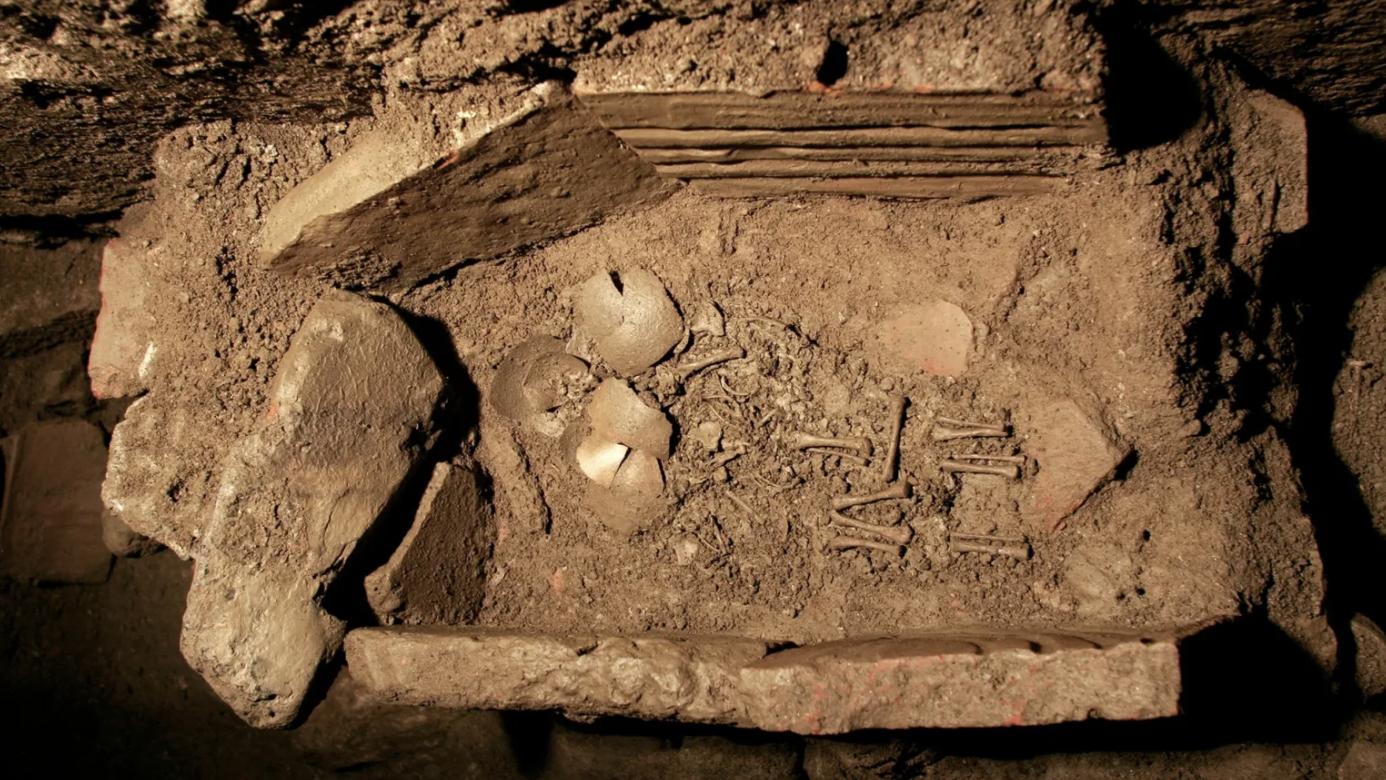
Photo Credit: OeAW-OeAI / J. Wurzer.
The Odeion was constructed during the first century CE, around 175 metres southwest of the Temple of Artemis. Originally, it served as a venue for performances, including musical and vocal events.
During renovations in the late second or early third century CE, an underground area beneath the building was transformed into a public latrine. The facility contained around 30 seats and was likely designed for visitors attending performances in the Odeion.
However, after a major fire and the collapse of the roof in the fifth or sixth century, the building fell into disuse. Valuable marble decoration was removed, while parts of the ruined structure were later used for rubbish disposal, including broken pottery and animal remains.
By the eighth or ninth century, the latrine had been abandoned for several centuries. Its drainage channel remained as an empty, sheltered space beneath the ruins.
It was within this forgotten Roman structure that a small grave was created using reused bricks, roof tiles and stone slabs. Measuring just 67 by 42 centimetres, the burial contained the remains of two infants placed closely together.
Radiocarbon dating suggests the grave was created sometime between AD 692 and 887, with the strongest probability placing it between AD 762 and 887. Analysis of plant remains also indicates that fresh soil was deliberately brought into the grave before the infants were placed inside.
The grave was located away from known cemeteries at Ephesus. It was separate from both the city’s Roman burial grounds and the Byzantine cemetery associated with the Church of Mary.
This makes the discovery especially significant, as little is known about where infants were buried in Ephesus between the seventh and ninth centuries. While infants have been found in formal cemeteries elsewhere, this appears to be the only known isolated burial of perinatal individuals from the city.
Despite its unusual location, the burial itself followed common Christian practices of the Byzantine period.
The two infants were placed lying on their backs, with their heads positioned towards the west. This created an east–west alignment traditionally associated with Christian beliefs about resurrection and the Second Coming.
The orientation was slightly adjusted because the grave builders had to work within the existing direction of the Roman drainage channel. No grave goods were included, which was also typical of many Christian burials at the time.
Analysis of the infants’ bones revealed that both children were extremely premature. Measurements of their upper arm bones suggest they were approximately 43 and 44 centimetres long when they died.
Researchers estimate that both infants had reached around 33 to 34 weeks of pregnancy, roughly seven and a half to eight months of development. They had therefore died before reaching full term.
The skeletons could not reveal whether they died before birth, during delivery, or shortly afterwards. If they were born alive, their premature development suggests they would likely have survived only a short time.
Their almost identical developmental stage, similar size and shared burial place have led researchers to suggest they may have been twins. However, this cannot yet be proven because DNA analysis was not carried out.
A difference of approximately one centimetre in body length does not exclude the possibility. Twins can differ in size due to variations in nutrition, placental conditions or biological differences.
Although the bones showed no evidence of injury, infection or inflammation, researchers identified one unusual feature among the remains: a small extra rib.
A five-millimetre-long cervical rib, a rare additional rib developing from the neck area, was discovered during examination of the remains. While cervical ribs are often harmless in adults, their presence in fetuses and infants can sometimes be linked with developmental disruptions, genetic conditions, congenital abnormalities and premature birth.
The Ephesus infants represent only the second published archaeological example of a cervical rib found in a perinatal individual. The researchers note that no previous archaeological discovery has combined possible twins with evidence of a cervical rib.
However, the finding does not provide a definite explanation for their deaths. Many conditions associated with cervical ribs affect soft tissues and internal organs, leaving no visible marks on bones.
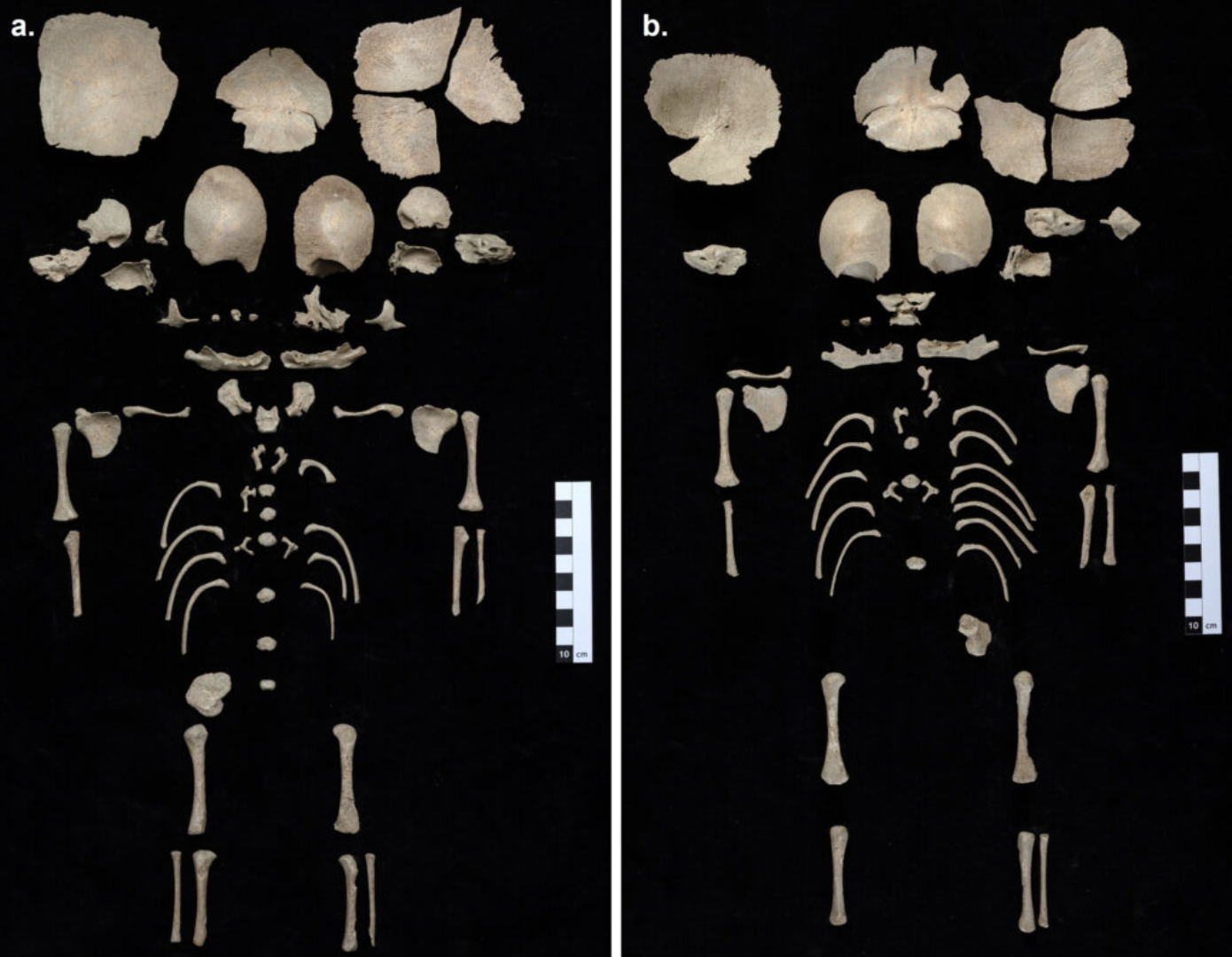
Photo Credit: OeAW-OeAI / J. Wurzer.
The infants may have died because of complications connected to premature birth, pregnancy, delivery or another underlying condition. A twin pregnancy would also have carried additional risks for both mother and children in a period before modern medical care.
The position of the bones provides further clues about how the infants were buried.
Although water movement inside the grave displaced some skeletal remains, most bones stayed within a clearly defined area. Researchers believe this pattern suggests the infants may have been wrapped in a soft material that restricted movement during decomposition.
The most likely explanation is that they were placed inside burial shrouds. A small iron object discovered near their heads may have been a pin used to secure the fabric.
Historical and archaeological evidence shows that Byzantine children could receive the same funerary treatment as adults, including washing, preparation with perfumes and wrapping in white linen before burial.
It remains unclear whether the infants had separate shrouds or were wrapped together.
The unusual location of the grave raises an important question: why were these infants buried inside a former Roman toilet?
Other archaeological discoveries from the ancient world have revealed very different uses of abandoned spaces. At Ashkelon in modern Israel, almost 100 infant remains were found mixed together inside a sewer alongside animal bones and broken pottery. Some researchers have interpreted this as evidence of infant disposal or possible infanticide.
Similarly, a well in the Athenian Agora contained hundreds of infant remains, alongside evidence suggesting that some older children may have suffered violence.
The Ephesus burial, however, shows a completely different pattern. The infants were not mixed with rubbish, thrown into an active sewer or placed carelessly. Instead, they were carefully arranged inside a constructed grave created long after the latrine had stopped functioning.
The location may reflect the uncertain social and religious position of newborns in Byzantine society.
Christian burial practices were strongly influenced by baptism. In many communities, baptism traditionally took place after the mother’s period of purification, around 40 days after birth, although emergency baptism could be performed earlier if a child was seriously ill.
Some infants who died before baptism may not always have been buried in established Christian cemeteries. However, researchers emphasise that there is not enough evidence to conclude that these children were unbaptised or that baptism determined where they were buried.
Newborns occupied a particularly vulnerable position within Byzantine society. They had only recently entered the world and were not yet fully integrated into the wider community. Premature births, unusual physical conditions and multiple births could also carry additional fears and uncertainties, as older beliefs and Christian ideas existed alongside one another.
The abandoned Odeion may therefore have represented a compromise. It was no longer a functioning sacred building, but it still stood within the boundaries of one of antiquity’s most important religious landscapes.
The former latrine channel offered protection from disturbance, while its location within the ancient sanctuary may have retained a sense of spiritual significance.
For more than a thousand years, the two infants remained undisturbed beneath the ruins of Ephesus. When archaeologists finally opened the grave in 2010, they uncovered evidence not of neglect, but of care.
The construction of the grave, its Christian orientation, probable shrouding and protected location all suggest that those who buried the children invested effort and emotion into their final resting place.
The former Roman latrine had lost its original purpose centuries earlier. By the Middle Byzantine period, it had become a sheltered space within a forgotten landscape.
There, a family or community created a small but carefully arranged burial, one that preserved the memory of two infants whose lives were brief but whose deaths were clearly mourned.