Rare Aeschylean Trojan War Scenes Uncovered in Rutland’s Roman Ketton Mosaic!
Archaeologists have taken an important step towards understanding one of the most remarkable Roman mosaics ever discovered in Britain. New research from the University of Leicester has revealed that the famous Ketton mosaic in Rutland doesn’t actually follow the well-known storyline from Homer’s Iliad, as many first believed. Instead, it draws on a much rarer, and largely lost, retelling of the Trojan War traditionally linked to the Greek playwright Aeschylus. Only hints of this version survive today, so the mosaic offers a rare glimpse into a narrative that once circulated widely in the ancient world.
The mosaic, unearthed in 2020 by local resident Jim Irvine during the Covid lockdown, quickly captured national attention for its sheer scale, artistic finesse, and the extraordinary clarity of its scenes. Archaeologists from the University of Leicester Archaeological Services (ULAS), working with Historic England, launched major excavations soon after. The villa complex was swiftly placed under Scheduled Monument protection. Now, this latest study is transforming how experts understand both the mosaic and the cultural mindset of the people who created it.
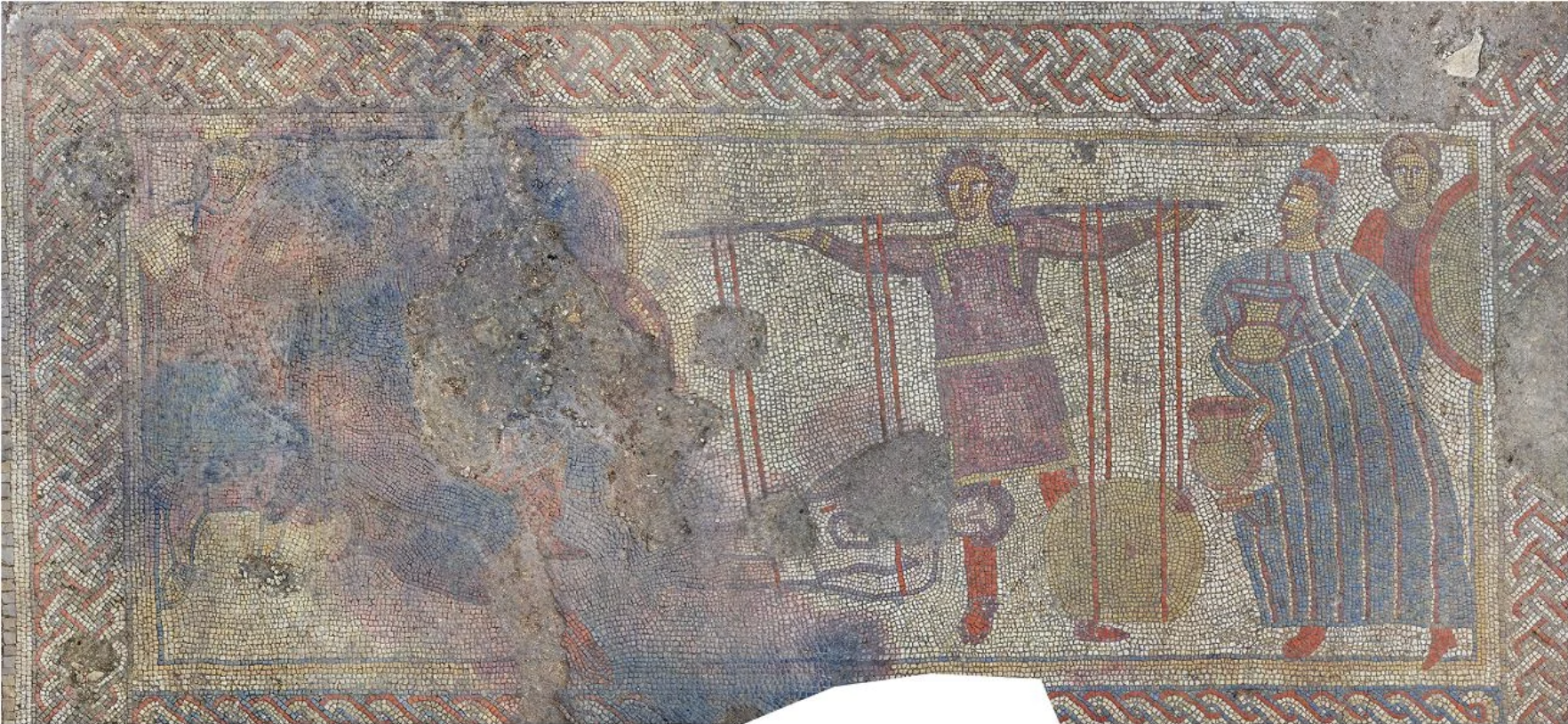
Photo Credit: University of Leicester Archaeological Services (ULAS) / J. Masséglia et al., Britannia (2025)
The artwork is laid out in three dramatic panels, each focusing on key moments from the conflict between Achilles and Hector: their confrontation, the dragging of Hector’s body around Troy, and the poignant scene in which King Priam begs for his son’s return. It is in this final episode that the break from Homer becomes clearest. Rather than showing Priam bartering over a set amount of gold, the mosaic depicts him weighing heavy gold vessels against the weight of Hector’s body, a detail that aligns with Phrygians, an Aeschylean tragedy that has otherwise been lost. This choice suggests that the villa’s owner was drawing on a more scholarly and less commonly known version of the myth, signalling learning, taste, and cultural sophistication.
The researchers also discovered that the mosaic’s makers were anything but provincial craftsmen improvising as they went. Many elements can be traced to artistic motifs that had circulated around the Mediterranean for centuries. Hector standing in his chariot mirrors the image on a second-century coin from Ilion; Achilles dragging Hector’s body is strikingly similar to a Greek vase from around 490 BCE. Smaller details, such as the snake beneath the horses, also have Greek origins. Even the central weighing scene has a close comparison in a silver jug from Roman Gaul. Taken together, these parallels show that the mosaicists in Rutland were plugged into a far-reaching artistic network, working with visual templates and traditions passed down through generations.
The study underscores how tales of the Trojan War spread not only through literature but through a shared visual language found on pottery, silverware, coins, and mosaics across the Roman world. The Ketton mosaic demonstrates that late Roman Britain was far from culturally isolated. Instead, its elite were engaging with the same artistic and intellectual traditions that shaped the broader classical world.
This new interpretation sheds light on the people who lived at the villa and the choices behind their lavish decoration. It paints a picture of a household eager to present itself as educated, connected, and attuned to the prestige of classical myth, a family that wanted its guests to recognise not just wealth, but cultured taste.