Tiny Roman Medusa Cameo Unearthed in Hallstatt, Austria!
Archaeologists working in the picturesque alpine village of Hallstatt in Austria have made a remarkable discovery: an exceptionally rare piece of Roman jewellery depicting Medusa, the fearsome Gorgon of Greek mythology. Measuring just 1.5 centimetres high, the tiny cameo is already being hailed as one of the most significant individual Roman finds ever uncovered in Upper Austria.
The discovery was made during archaeological work at the site of the new funicular railway valley station. In Roman times, this area formed part of a thriving lakeside settlement, long before Hallstatt became famous for its prehistoric salt mines. Excavations carried out by ARDIS Archäologie GmbH, in partnership with Upper Austrian cultural heritage institutions, revealed the remains of ancient foundations and a scattering of everyday objects. Among these finds, however, the Medusa cameo stands out as an extraordinary work of art.
Although historians still do not know the Roman name of the settlement or its exact layout, the cameo reinforces the idea that Hallstatt has been an important centre of human activity for centuries. This single object offers a powerful glimpse into the region’s Roman past and its connections to the wider empire.
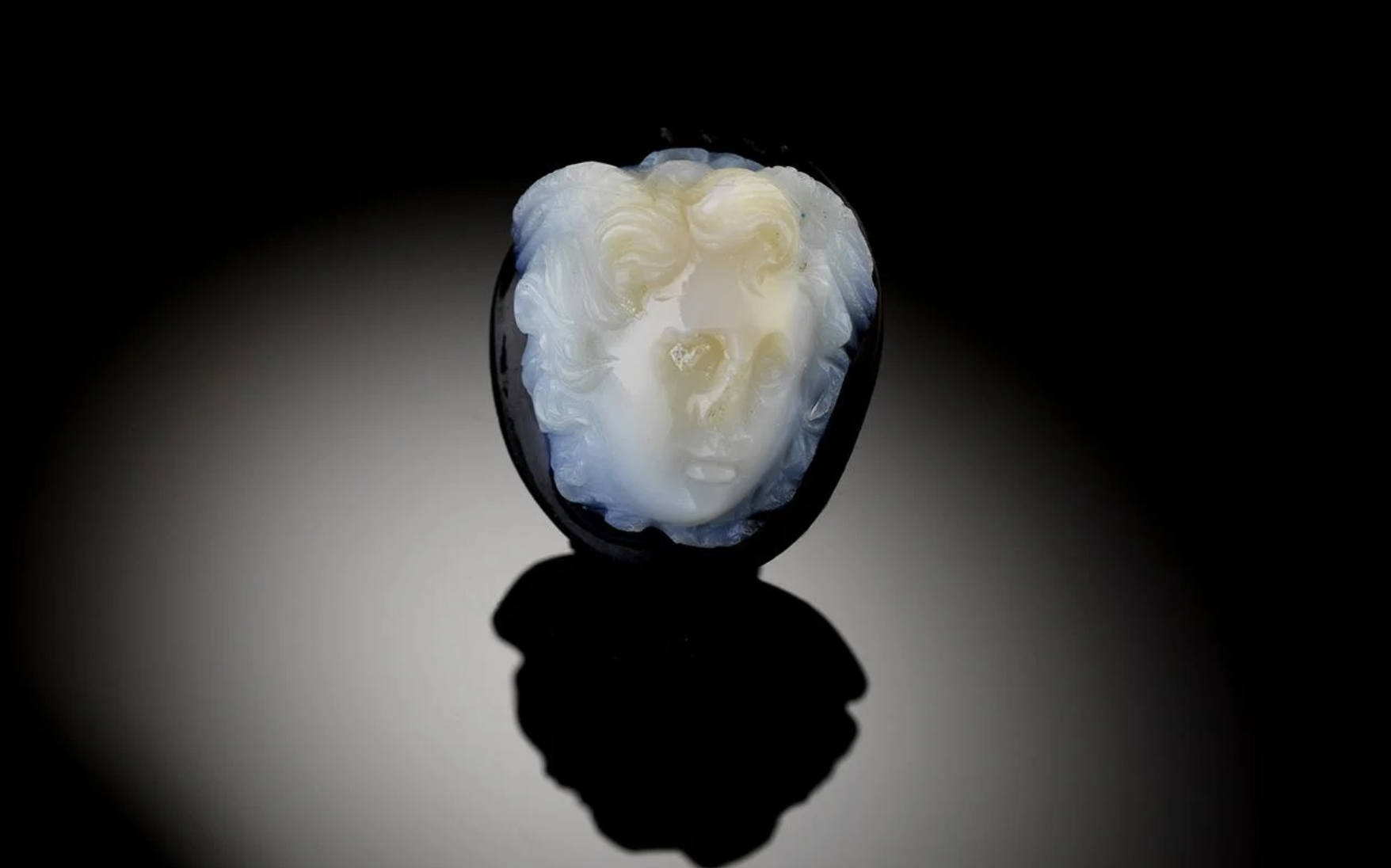
Photo Credit: M. Maritsch
Experts date the cameo to the 2nd century CE and believe it was crafted in Aquileia, a major Roman city on the northern Adriatic coast. Aquileia was renowned for its master gem cutters, whose work was traded across the Roman world. The Medusa’s head was carved from black-and-white banded agate, also known as onyx, a material highly prized in Roman luxury jewellery.
Despite its small size, the cameo displays astonishing craftsmanship. The sculptural relief is deeply carved, giving the face a striking three-dimensional quality. The artist even angled the image slightly, skilfully working with the natural layers of the stone to enhance depth and perspective. It is a vivid reminder of the technical sophistication achieved by Roman artisans nearly two thousand years ago.
The image itself is a classic Gorgoneion: Medusa’s winged head surrounded by writhing snakes. In both Greek and Roman culture, this motif was widely used as an apotropaic symbol, believed to protect the wearer by warding off evil and misfortune. Such images appeared everywhere in the ancient world, from shields and armour to buildings, household items and personal adornments. They carried both religious meaning and decorative appeal.
What makes the Hallstatt cameo particularly special is its size and form. Researchers note that it is larger and more sculptural than comparable examples found in the region. It is far too big to have been worn as a ring, leading archaeologists to conclude that it once formed the centrepiece of a necklace. This suggests it was owned by a wealthy Roman woman, someone with both the means and the taste to wear such an elaborate and symbolic object.
At present, only two other Roman cameos are publicly displayed in all of Upper Austria, highlighting just how rare this find is. Beyond its artistic beauty, the cameo provides valuable evidence of Roman life in the Alpine region. It demonstrates that Hallstatt was not an isolated outpost but part of a network of trade and cultural exchange that linked the mountains to the Mediterranean world.
In a place already famous for its deep history, this tiny carving adds another remarkable chapter, reminding us how far-reaching and interconnected the Roman Empire truly was.