Rare Ancient Funeral Pyre Unearthed at Sizewell C Site Sheds Light on Prehistoric Rituals!
Archaeologists working on the Sizewell C development have uncovered an exceptionally rare prehistoric funeral pyre, offering a fascinating glimpse into burial customs that are rarely preserved in the archaeological record.
The discovery was made at Goose Hill, one of several locations currently being explored as part of the wider investigation linked to the Sizewell C project. What initially looked like nothing more than a dark patch of charcoal-rich earth soon turned out to be something far more remarkable: the remains of a cremation pyre likely used in an ancient funerary ceremony.
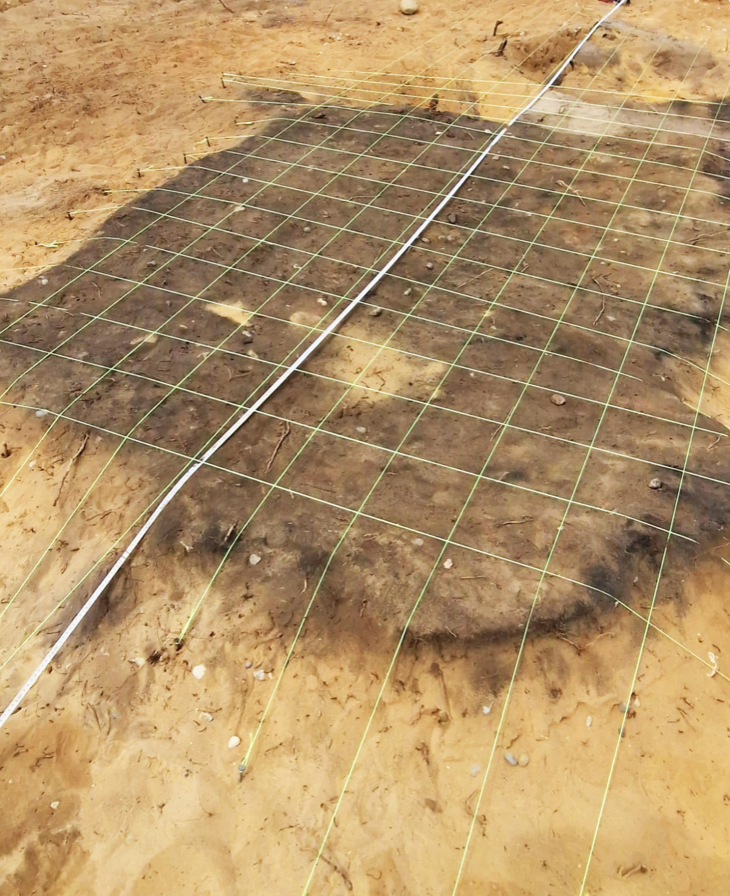
Photo Credit: Oxford Cotswold Archaeology
Unlike graves dug into the ground, funeral pyres were generally built above the surface, making them notoriously difficult to detect centuries later. Once cremation had taken place, remains were often gathered and buried elsewhere, stored in urns or scattered. Combined with the effects of farming, erosion and natural disturbance over time, very little physical evidence tends to survive. That is exactly why the Goose Hill find is attracting so much attention.
The remains of the pyre were uncovered on sloping ground overlooking what is now the Suffolk coastline. Researchers believe the structure may once have stood as a raised timber platform measuring roughly three metres long and two metres wide, potentially reaching up to 1.5 metres in height.
The construction itself may have involved stacked timbers supported by upright posts, with kindling and scrub vegetation forming part of the fuel source. The deceased would likely have been placed upon this elevated platform before it was set alight as part of a carefully performed cremation ritual.
Although time has erased much of the original structure, important clues still remain. Archaeologists identified blackened soil rich in charcoal alongside fragments of burnt bone. Nearby sand had turned pink due to exposure to extreme temperatures, while several postholes around the feature hint at a deliberately built framework rather than an ordinary fire site.
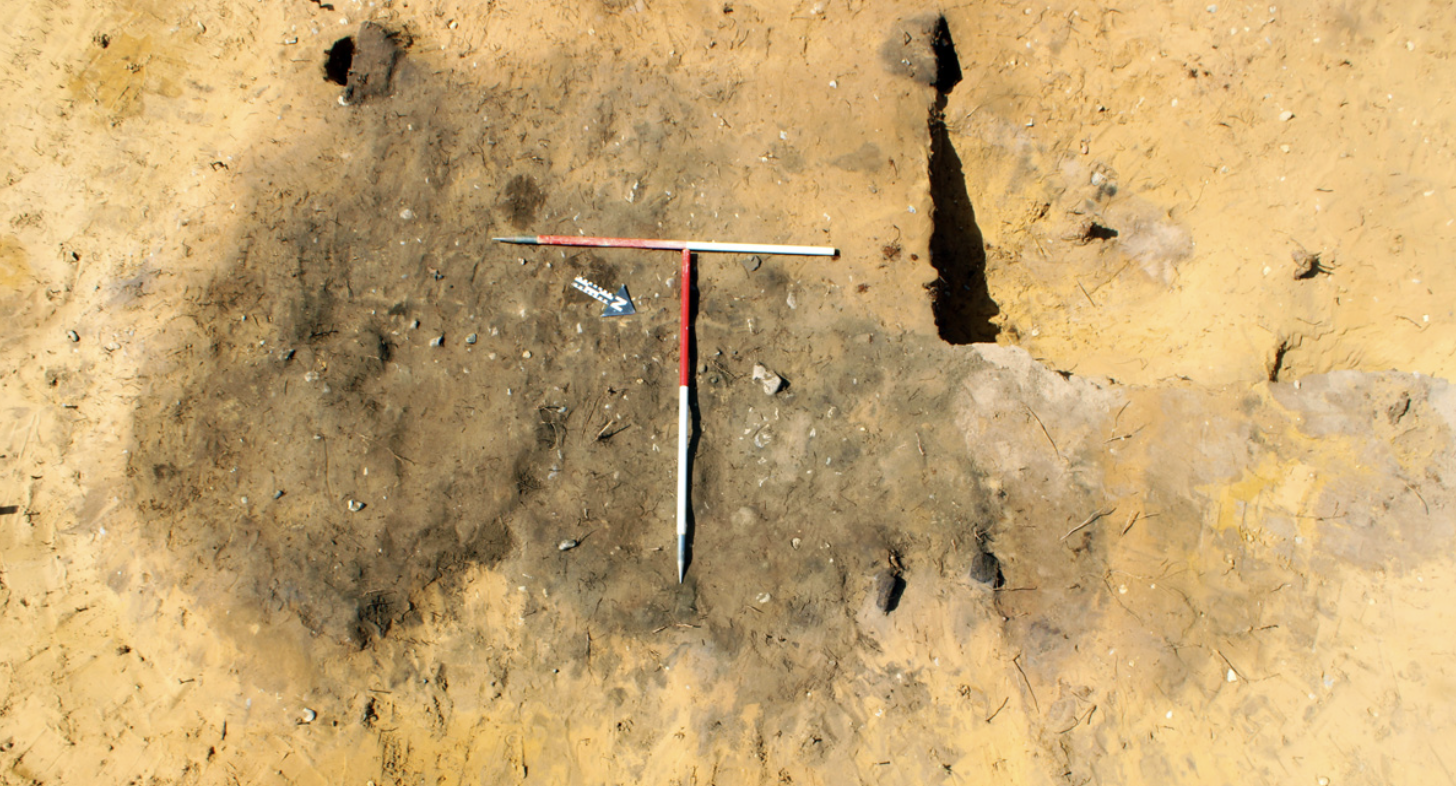
Photo Credit: Oxford Cotswold Archaeology
Experts are now examining the bone fragments to determine whether they are human. If preserved well enough, they may reveal information about the person’s age, biological sex, health and even evidence of illness.
Curiously, only a very small quantity of burnt bone was discovered at the site. Rather than being disappointing, this may actually support an important theory. Archaeologists suspect that after the cremation ceremony, most of the remains were intentionally collected and removed, possibly placed inside a pottery vessel for burial elsewhere.
This practice aligns with known prehistoric traditions in Britain, where cremated remains were frequently deposited in carefully chosen places or sealed inside funerary urns.
At Goose Hill, evidence of burial activity is surprisingly scarce. Previous finds include a Bronze Age cremation burial contained within a Collared Urn, dating from approximately 1950 to 1600 BC, alongside another possible cremation deposit. Because examples are so limited, the newly uncovered pyre could help bridge a missing chapter in understanding how these ceremonies unfolded.
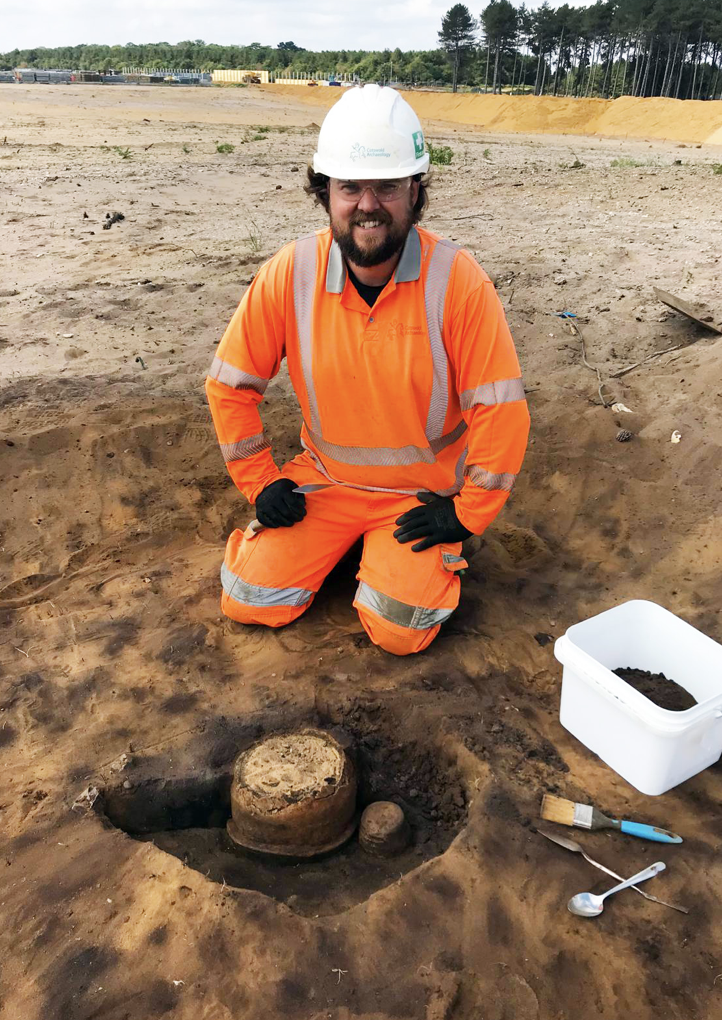
Photo Credit: Oxford Cotswold Archaeology
Another intriguing detail lies in where the pyre was found. The feature sat slightly off-centre within a ring ditch, a circular earthwork commonly linked to burial mounds or barrows. Archaeologists believe the pyre may have endured for so long because it was once shielded beneath a mound that has since been worn away through centuries of ploughing.
Exactly how the pyre relates to the ring ditch remains uncertain. It may have formed part of the original monument, or perhaps it was added later beside an already existing burial mound.
No burial was found at the centre of the ring ditch, although researchers stress this does not necessarily mean one never existed. Later activity disturbed the area, and a ditch cut through the middle may have removed earlier evidence entirely.
The monument itself appears to pre-date the Iron Age, as an Iron Age pit was dug into a ditch that had already filled in. Elsewhere on site, archaeologists also recovered a polished flint axe dating to the Early Neolithic period, though it is believed to have been residual, meaning it was already old before eventually ending up in the deposit.
While cremation practices appeared throughout several periods of British history, including prehistoric times, the Roman era and the Early Anglo-Saxon period, current evidence suggests Goose Hill is more likely to belong to a prehistoric landscape.
This is partly because there is little indication of Anglo-Saxon activity in the area. Although Suffolk contains important Anglo-Saxon burial sites, including Snape to the south-west where another pyre has previously been identified, Goose Hill currently points more strongly towards a Bronze Age or possibly Iron Age date.
Scientific testing should eventually provide clearer answers. Radiocarbon dating of charcoal and bone samples may help pinpoint when the cremation took place, while plant remains could reveal what materials were burned and offer clues about the surrounding environment at the time.
The funeral pyre is only the latest discovery to emerge from excavations linked to Sizewell C. Archaeologists working across the development area have already uncovered traces of Early Bronze Age farming, Beaker-period activity, Roman salt-making, medieval ovens, Second World War military defences and an early medieval burial ground considered nationally significant.
Goose Hill itself appears to have been revisited and reshaped by communities over thousands of years. For prehistoric people, elevated ground overlooking the sea may have held both practical importance and symbolic meaning, a place connected to land, water and sky.
Although the newly uncovered pyre has not yet revealed the identity of the individual cremated there, nor provided a precise date, its significance lies in how uncommon such discoveries are. Rather than showing only the final resting place, it preserves evidence of the ceremony itself: scorched earth, traces of timber, intense heat and the remains of a final farewell carried out thousands of years ago.