Roman Hunting Mosaic Rediscovered in Marsala Reveals Ancient Lilybaeum’s Hidden History!
A long-lost Roman hunting mosaic has resurfaced in Marsala, Sicily, after remaining buried for over fifty years, shedding fresh light on the artistic culture of ancient Lilybaeum, once a key city in Roman Sicily.
The floor mosaic, which depicts a lively venatio (a hunting scene), was originally uncovered in 1972 by archaeologist Carmela Angela Di Stefano in the Capo Boeo district, between the Church of San Giovanni Battista al Boeo and Viale Isonzo. Following its initial discovery, it was reburied to safeguard it. It has now been revealed again as part of renewed excavations linked to the creation of the Lilibeo Archaeological Park.
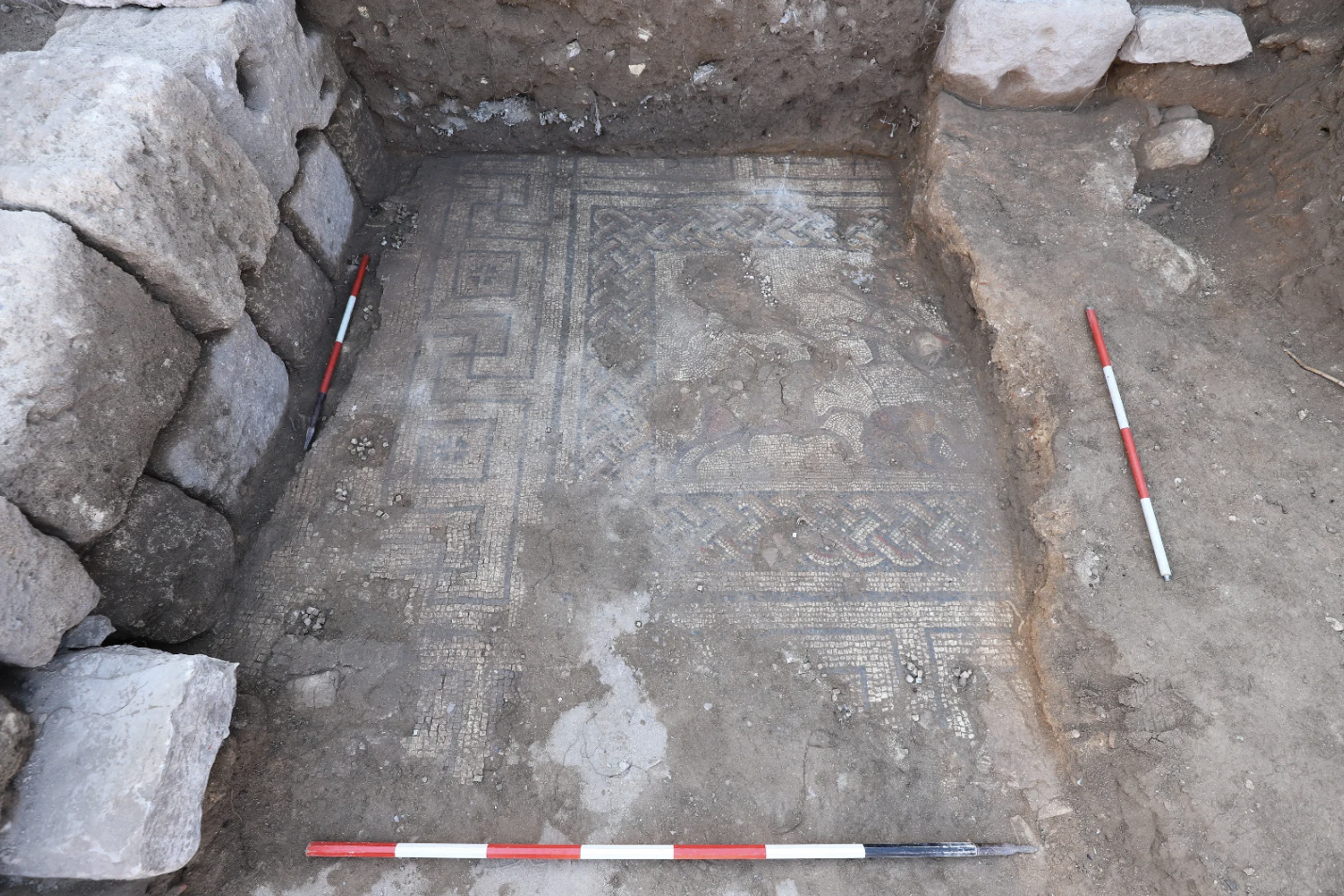
Photo Credit: Parco Archeologico di Lilibeo-Marsala / Regione Siciliana
Its rediscovery is particularly important not just for its artistic quality, but also because it is associated with the so-called Casa della Venatio. This late Roman domestic setting may provide valuable insight into the development of Marsala across the Roman, Byzantine, Islamic, and early medieval periods.
The artwork itself is a sophisticated example of Roman floor decoration using opus tessellatum, a technique in which small pieces of stone or glass (tesserae) are arranged to form detailed images and patterns. A rich colour range (black, blues, reds, ochre yellows, and browns) was employed, with subtle shading used to create depth and motion.
The composition is enclosed within two decorative frames. The outer border features an interlaced meander pattern interrupted by square panels containing a central cross-shaped floral motif. Inside this, a four-strand braid in blue, red, and white forms the inner border.
Within these boundaries, the hunting scene is organised into two levels. The upper section shows a man in a short tunic and boots, accompanied by a running dog, chasing a deer that is partly missing due to damage on the left side of the mosaic. Below, a horseman drives a spear into a lion that lies wounded on the ground.
Although dramatic, the scene follows a well-established Roman artistic tradition. Hunting imagery often symbolised elite status, bravery, control over nature, and aristocratic leisure. In domestic spaces, such imagery went beyond decoration, helping to express the identity and social standing of the household.
One of the most intriguing aspects of the discovery is the unfinished or unexcavated section on the right-hand side. Archaeologists note that two overlapping floor layers exist there, and future excavations are expected to explore this area using careful stratigraphic methods.
This is significant because it may reveal not only the full extent of the mosaic, but also the sequence of occupation and alteration within the house. Roman domestic buildings were frequently modified over time, with floors replaced and layouts adjusted as cities evolved.
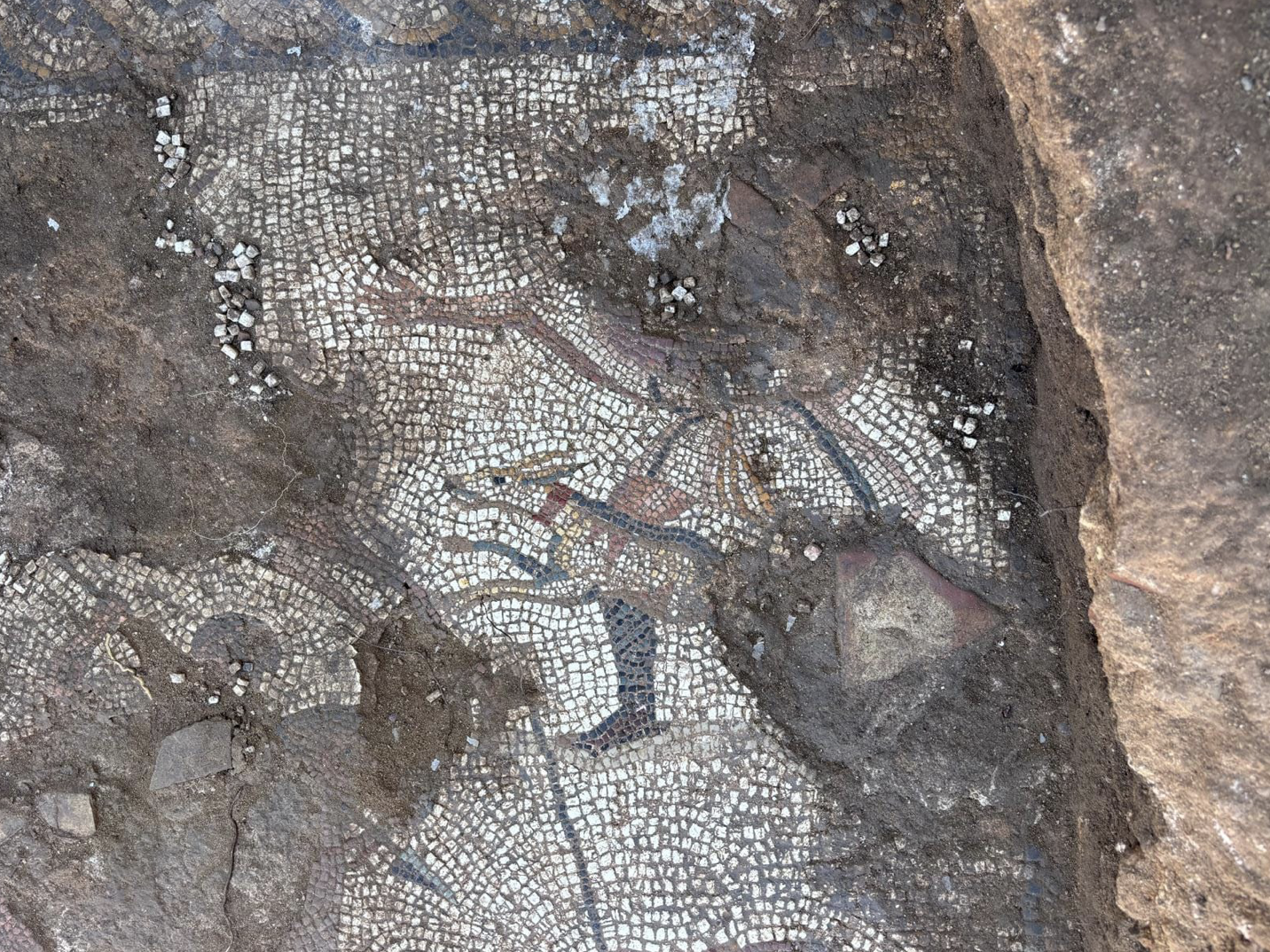
Photo Credit: Parco Archeologico di Lilibeo-Marsala / Regione Siciliana
This matters particularly in Lilybaeum, a city that did not simply vanish after the Roman era but instead underwent continuous transformation through late antiquity and into the early medieval period, eventually becoming modern Marsala. The research therefore focuses on broader urban change, not just a single decorative floor.
Modern Marsala sits directly above ancient Lilybaeum, which was founded at Capo Boeo on Sicily’s western tip. Its position facing the Egadi Islands gave it strategic importance in the Mediterranean, and during both the Punic and Roman periods it developed into a significant hub for trade, movement, and military activity.
The Lilibeo Archaeological Park today preserves parts of this ancient city, including houses, streets, baths, and mosaics that reflect its long and complex history. The newly revealed hunting mosaic adds an especially refined example to this archaeological record.
Its location at the edge of the protected archaeological zone highlights how closely the ancient city is intertwined with the modern urban landscape of Marsala.
The current excavation campaign is led by Anna Occhipinti, director of the Lilibeo Archaeological Park, in collaboration with the ArcheOfficina cooperative, with archaeological work supported by Maria Grazia Griffo. The project also involves the Escuela de Estudios Árabes of Spain’s National Research Council in Granada, focusing on late Roman and Byzantine phases of Lilybaeum and its transition into the Islamic and early medieval periods, when the city became known as Marsā ‘Alī.
This broader research context gives the mosaic additional importance, placing it within a city that repeatedly shifted identity, from Punic stronghold to Roman centre, and later into its medieval form as Marsala.
Plans are in place to incorporate the mosaic into future visitor routes within the archaeological park, allowing the public to view it as part of the site’s heritage. For researchers, however, further excavation will be crucial. The unexplored sections beneath the overlying floors may help clarify how the house developed over time and could also refine interpretations of the mosaic’s imagery and purpose.
After more than half a century hidden underground, the Roman hunting mosaic has re-emerged not just as an artwork, but as a key piece in understanding the layered history of ancient Lilybaeum, where domestic life, urban evolution, and centuries of Mediterranean history intersect beneath present-day Marsala.