Roman Mass Grave Beneath Vienna Football Pitch Reveals Forgotten Battle!
A mass burial uncovered beneath a modern football pitch in Vienna is offering archaeologists a rare glimpse into a violent episode on the Roman frontier nearly 2,000 years ago. The remains of more than a hundred men were found packed into a single shallow pit, with their skeletons carrying extensive evidence of injuries sustained around the time of death.
What makes the discovery particularly intriguing is the unusual location of the wounds. A striking proportion of the recorded injuries occurred around the pelvis, with projectile trauma appearing far more frequently in this area than researchers would normally expect. The pattern is raising new questions about how the men died and what kind of fighting took place.
The grave was discovered in Vienna's Simmering district and has already been associated with the Roman military thanks to weapons and pieces of military equipment recovered alongside the bodies. Yet archaeologists have so far been unable to identify the precise battle or conflict responsible for the deaths.
The remains came to light in October 2024 during renovation work at the Ostbahn-XI sports ground on Hasenleitengasse. Archaeological excavations revealed a shallow burial measuring approximately five by 4.5 metres.
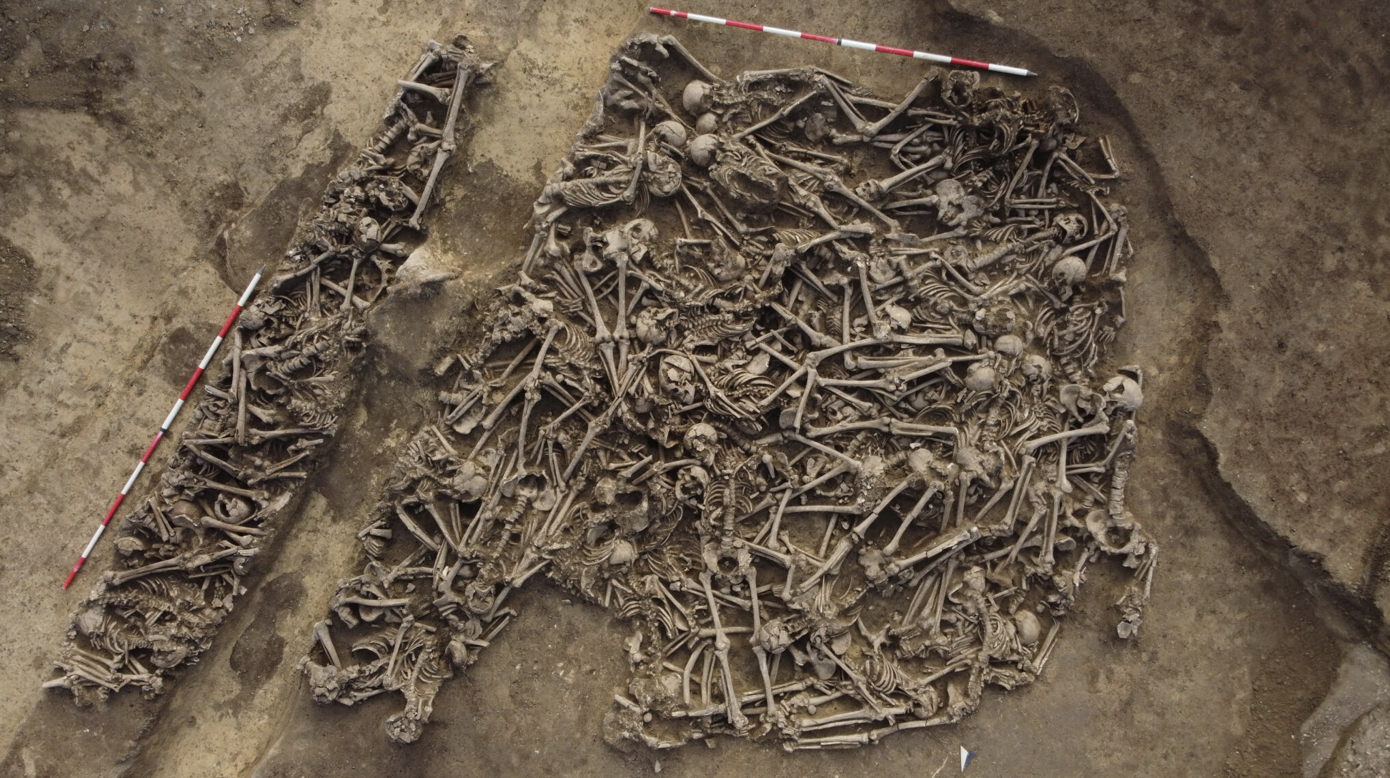
Photo Credit: A. Slonek/Novetus.
Inside were 129 complete or partially complete skeletons. Other scattered bones found in the area suggest that the original number of individuals may have been closer to 150.
The arrangement of the bodies immediately indicated that this was not a conventional cemetery. The dead had been placed on top of one another in as many as four layers, with no consistent orientation. Arms and legs were frequently tangled together, while there were no clear layers of soil separating the bodies.
This suggests that the individuals were deposited in the pit during a single episode rather than being buried gradually over an extended period. The lack of evidence for scavenging also indicates that the bodies were probably covered relatively soon after they were placed there.
The biological evidence adds another important clue. Researchers were able to establish the sex and approximate age of 92 individuals in the 2025 study. Every one of those individuals was male, with most apparently dying between the ages of approximately 20 and 35.
Such a strongly male and relatively young demographic profile, combined with the burial circumstances and associated artefacts, is highly consistent with a group connected to military activity.
Several objects recovered from the burial strengthen the connection with the Roman army. Archaeologists identified two iron lance heads, fragments of Roman scale armour, part of a Roman helmet cheek guard, military footwear nails and a badly corroded dagger.
The dagger has proved particularly useful for dating the burial. X-ray examination revealed decoration made from silver wire on its sheath, indicating that it was produced sometime between the middle of the first century and the beginning of the second century AD.
One of the lance heads was also discovered embedded directly in the sacrum of one of the individuals, providing particularly direct evidence of the violence involved.
Radiocarbon dating, together with the archaeological material, places the burial broadly in the late first or early second century AD.
The skeletons provide some of the strongest evidence for reconstructing what happened. The original analysis recorded injuries caused by several different types of weapons, including sharp-edged implements, blunt-force trauma and projectiles. Cuts and other sharp-force injuries were particularly common on the skull, including around the face and forehead.
However, the distribution of injuries across the entire skeleton revealed something much more unusual. Approximately 40 per cent of the recorded trauma was concentrated in and around the pelvis. A substantial proportion of these injuries appear to have been caused by projectiles, potentially including weapons such as lances or the Roman pilum.
A further examination by Sheridan Strang and Michaela Binder, presented at the 25th European Meeting of the Paleopathology Association in Berlin in August 2026, has reinforced this finding.
Their assessment identified traumatic injuries in 48 individuals. Of those who had evidence of trauma, approximately 85 per cent displayed injuries inflicted around the time of death. Once again, the pelvis emerged as the most heavily affected region, accounting for roughly 40 per cent of the recorded injuries.
The finding has attracted attention because it is easy to interpret the evidence as suggesting that the men were deliberately attacked in the groin. However, the archaeological evidence does not allow such a precise conclusion.
Instead, the researchers are describing an unusually high concentration of projectile injuries across the pelvic region. The distinction is important because the skeletons cannot reveal exactly where an attacker was aiming.
One possibility is that the lower torso was particularly exposed during combat. Body armour offered greater protection to some parts of the upper body, potentially leaving gaps around the hips and lower abdomen that could be exploited by projectiles. The injuries may therefore reflect the practical realities of fighting rather than a deliberate attempt to target a particular part of the body.
More importantly, the combination of different wound types and their distribution is much more compatible with battlefield violence than with a systematic execution.
The location of the burial provides another important piece of the puzzle. When the men died, the site at Hasenleitengasse was only around three kilometres from the Danube. The river represented a crucial frontier zone within the Roman Empire, separating Roman territory from populations to the north.
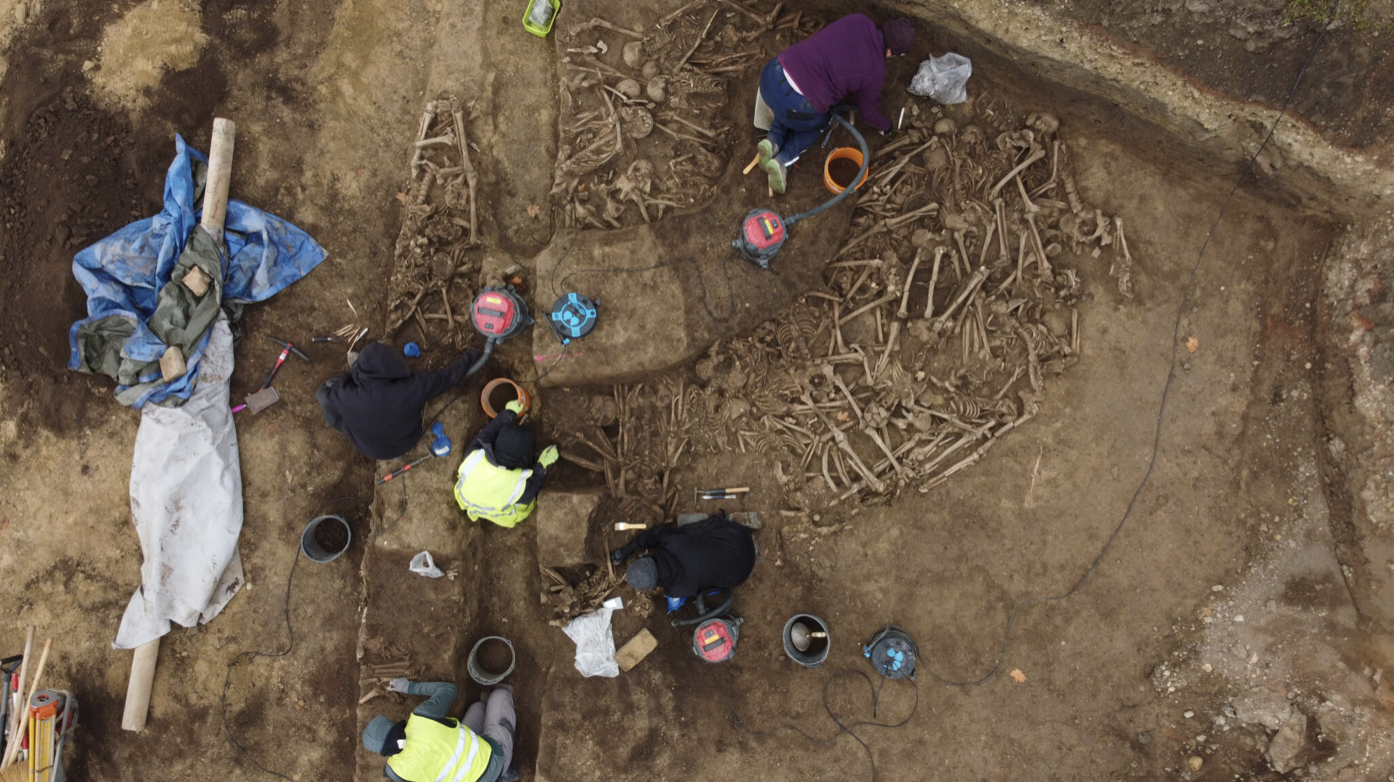
Photo Credit: A. Slonek/Novetus.
The burial was also positioned between two Roman military installations. Vindobona, which would eventually develop into the major legionary fortress associated with Roman Vienna, was approximately five kilometres to the north-west. Another military site, Ala Nova, was situated around four kilometres to the south-east near modern Schwechat.
The grave was therefore not located within a Roman fortress itself. Instead, it occupied a landscape between military positions along one of the empire's most important frontiers. This setting makes the possibility of a military confrontation particularly compelling.
During the late first century AD, the middle Danube region was far from peaceful. Under Emperor Domitian, Rome became involved in repeated conflicts with groups including the Sarmatians and the Germanic Marcomanni and Quadi.
Written sources record serious military activity in the region during the 80s and 90s AD. What they do not provide, however, is a clear reference to a battle at Hasenleitengasse.
The mass grave could therefore represent the archaeological remains of a conflict that never made it into the surviving historical record.
Troops travelling between military installations, responding to attacks or attempting to defend routes towards the Danube could all have moved through this area. At present, there is no way to determine which scenario produced the burial, but its position within the frontier landscape provides an important context for understanding the discovery.
The discovery may also have implications for the development of Roman Vienna. At the end of the first century AD, Vindobona was still relatively modest in size. Over the following decades, however, Rome expanded and strengthened its military presence along the Danube, with Vindobona eventually becoming a major legionary fortress.
Martin Mosser of Vienna City Archaeology has suggested that the defeat represented by the mass grave could potentially have been one factor behind Rome's decision to increase its military presence in the area.
For the moment, however, this remains a possibility rather than an established historical fact. There is currently no evidence that definitively connects the burial with a particular campaign, nor can archaeologists say with certainty whether the men were killed during one of Domitian's conflicts or another confrontation entirely.
The circumstances of the burial are themselves significant. Cremation remained a widespread funerary practice across much of the Roman world during this period, making the rapid burial of more than a hundred complete bodies especially unusual.
The chaotic arrangement of the skeletons suggests that whoever buried them was dealing with a large number of casualties in unusual circumstances. There appears to have been little opportunity, or perhaps little inclination, to provide the dead with the sort of individual funerary treatment that would normally have been expected.
Further scientific investigation could eventually reveal more about who these men were and where they came from.
DNA analysis and stable-isotope studies may help establish whether the individuals shared similar geographical origins and whether they belonged to a single military unit or group.
Archaeologists are also continuing to investigate the wider landscape around the burial, including ancient courses of the Danube and evidence that might help reconstruct the environment in which the confrontation occurred.
For now, the Hasenleitengasse mass grave represents the aftermath of a violent episode whose details have largely vanished from the historical record.
The names of the men are unknown. The opposing forces remain uncertain, and the exact battle that claimed their lives has yet to be identified.
Yet the archaeological evidence is beginning to fill in some of those gaps. The weapons, military equipment, burial conditions and patterns of skeletal trauma all point towards a violent confrontation on Rome's Danube frontier.
Almost two millennia later, the skeletons beneath a Vienna football pitch are providing evidence for a battle that ancient writers never recorded.