Roman Shrine in Suffolk Reveals Ancient Rituals Around Bronze Age Burial Mound!
An archaeological site in Suffolk has revealed a remarkable story of changing beliefs and ritual practice spanning more than 3,000 years. At Red Lodge, a Roman religious complex was built around an ancient Bronze Age burial mound, with worshippers returning to the monument for generations to leave coins, animals and other offerings.
Among the most unusual discoveries are several pig skulls found close to the shrine. The animals had been deliberately arranged with their heads facing towards the religious building, and two of the skulls still had Roman coins resting on them. Another showed traces of copper staining, possibly indicating that a coin had once been placed there too.
The sanctuary was excavated in 2016 by Archaeology South-East before the area was developed for housing. A new study by Angus Forshaw, published in Britannia, has now brought together the evidence from the site, showing how an ancient funerary monument was given a new purpose during the Roman period before the landscape was transformed again during the Middle Ages.
Long before the Romans arrived in Britain, the site had already acquired considerable importance. At its centre was an Early Bronze Age round barrow, constructed sometime between approximately 2200 and 1600 BC.
The monument was surrounded by a substantial ditch around 45 metres in diameter. Most of the original mound had disappeared through later agricultural activity, and archaeologists were unable to identify the original burial. Nevertheless, the scale of the monument would have made it a highly visible feature of the surrounding landscape.
Interestingly, there appears to have been little other Bronze Age activity immediately around it. This may indicate that the area surrounding the barrow was intentionally left relatively open, helping the monument stand out.
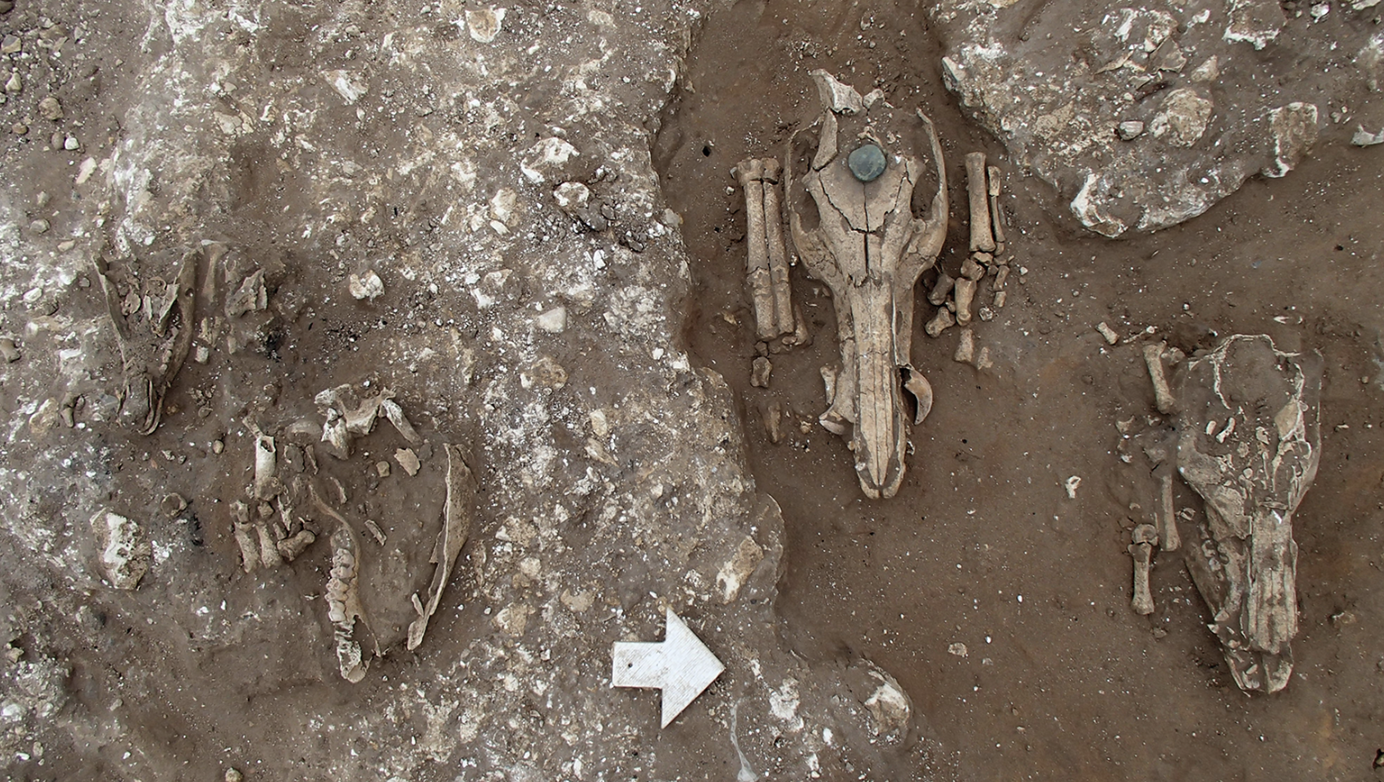
Photo Credit: Forshaw, A. (2026)
By the Roman period, the people using the site probably no longer knew the original significance of the burial mound. Its age, however, may itself have given it a special quality.
Sometime around the beginning of the second century AD, the Romans incorporated the prehistoric monument into a large sacred enclosure known as a temenos. This rectangular precinct covered roughly 200 by 160 metres and appears to have been designed specifically for religious activity rather than everyday settlement.
A series of boundaries, pits, animal burials and a possible well were identified inside the enclosure. Most importantly, the prehistoric ditch was maintained or recut, suggesting that the ancient barrow was not simply an inconvenient feature left within the Roman complex. It remained an important part of the sanctuary.
The main shrine stood immediately to the east of the ancient mound. Although relatively small, measuring approximately 5 by 4.5 metres, the building appears to have been carefully constructed. It was a post-built rectangular structure, and two possible settings in its south-eastern corner may have supported columns or formed part of an altar arrangement.
The layout could have directed visitors approaching from the north towards this particular area of the building, perhaps making it the principal focus of worship.
Inside and around the structure, archaeologists recovered an impressive quantity of painted wall plaster. Around 48 kilograms was found, including pieces decorated predominantly in white and red, alongside smaller areas of pink and green.
The building also appears to have had a tiled roof, with more than 111 kilograms of roof tile recovered from its vicinity.
Forshaw compares the structure with a lararium-style shrine, although its setting makes it rather different from the household shrines normally associated with that term. Here, the small religious building formed part of a much larger rural sanctuary centred on an ancient monument.
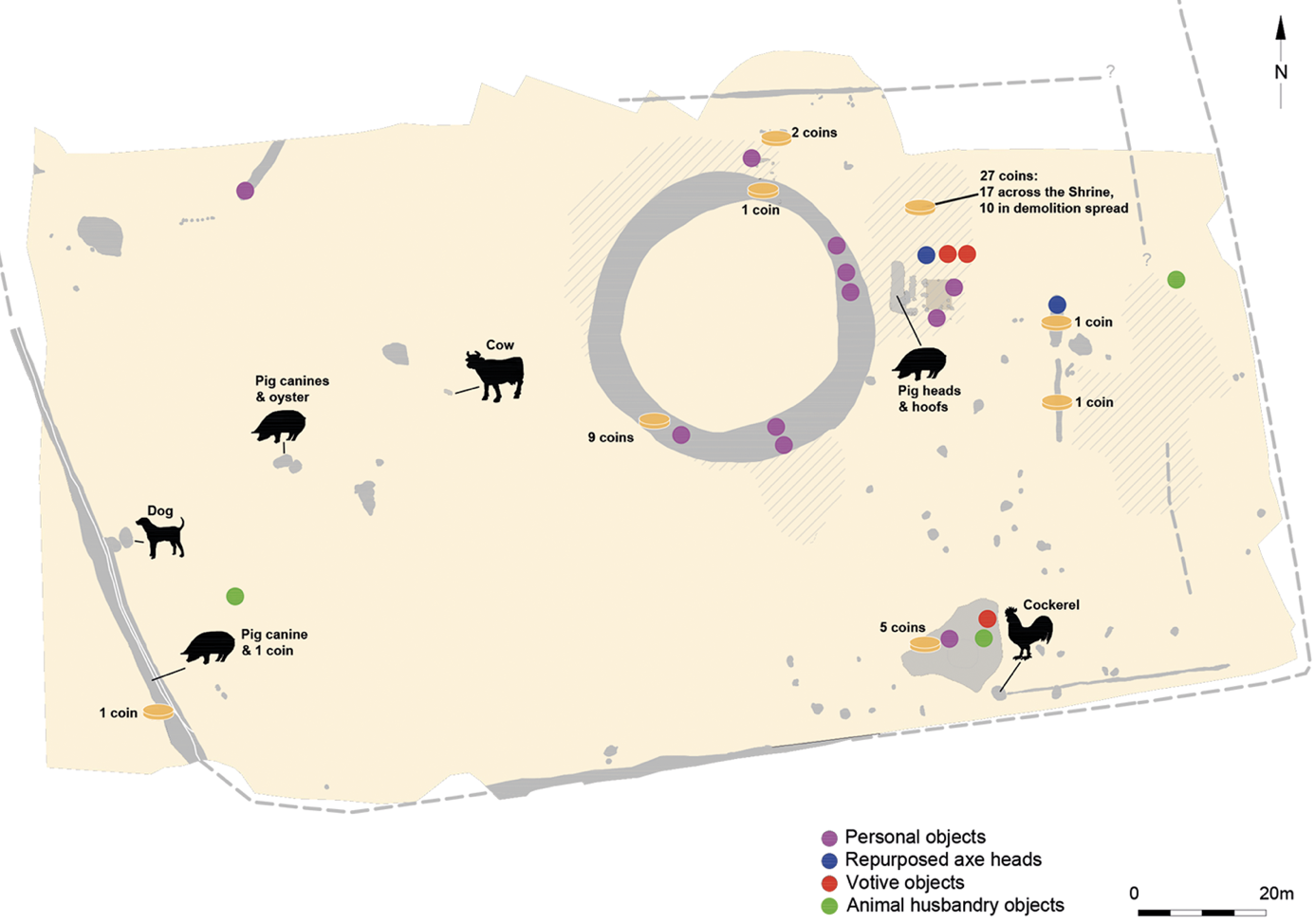
Photo Credit: Forshaw, A. (2026)
The most compelling evidence for what people actually did at Red Lodge comes from a series of pits positioned immediately west of the shrine.
Six deposits contained pig heads accompanied by articulated limbs. The arrangement was clearly intentional: every skull had been positioned facing eastwards towards the shrine.
The deposits also contained Roman coins, providing an unusually tangible connection between the animal offerings and acts of worship.
One skull had a sestertius issued under Antoninus Pius, dating to AD 156–157, placed on top of it. Another carried a dupondius of Faustina from AD 142. A third skull displayed green copper staining, which could indicate that a coin had previously been placed against it.
The evidence suggests these were not all buried as part of one event. Instead, the pits appear to have been revisited over an extended period, with new offerings added at different times. Radiocarbon dating supports this interpretation, while later coins demonstrate that the practice continued into the fourth century.
One coin dates to approximately AD 345–350, meaning that animal deposition at the sanctuary continued for almost two centuries after the original Roman complex was established.
The pigs themselves provide further clues. Many appear to have been young adult males, while the position of their bones suggests that the heads and feet may still have been connected by skin when they were deposited.
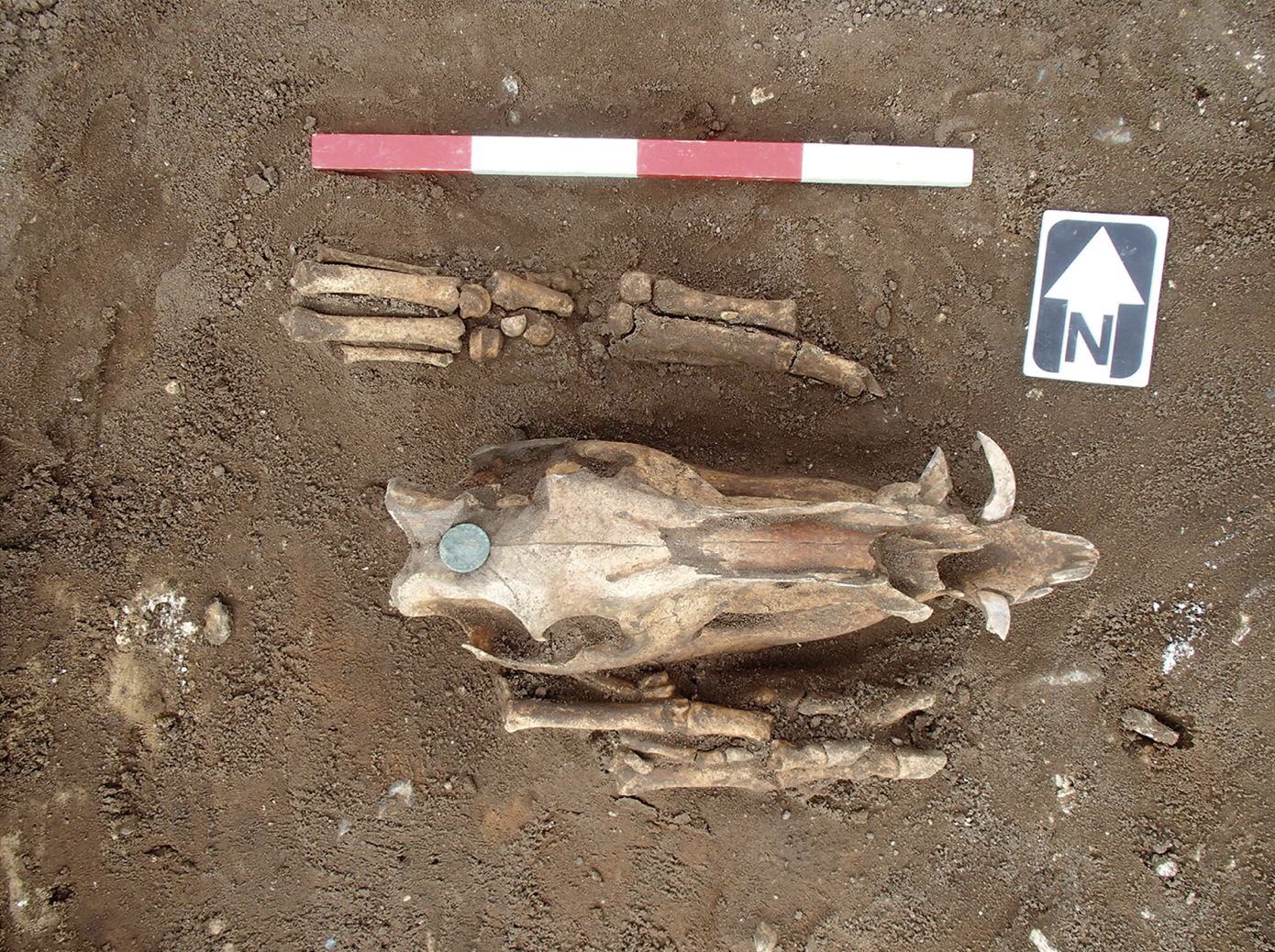
Photo Credit: Forshaw, A. (2026)
Animal deposition at Red Lodge was considerably more varied than the pig skulls alone might suggest.
Close to what appears to have been the entrance to the sanctuary, archaeologists discovered an almost complete dog skeleton alongside a horse shoulder blade. Elsewhere, the remains of a cockerel had been deposited with a cattle scapula and deer antler.
On the other side of the Bronze Age mound, a young cow had been buried almost intact. There was no evidence that it had been butchered or eaten, suggesting that its burial may have had a specifically ritual purpose. Radiocarbon dating places the animal's death sometime between AD 238 and 384.
Taken together, these discoveries make it difficult to identify the sanctuary with confidence as a place dedicated to a single Roman god.
Instead, the evidence may point towards a more locally focused form of worship. Rural sanctuaries could provide spaces where different beliefs and practices overlapped, and Red Lodge may have accommodated a local cult or several different traditions rather than following one clearly defined religious system.
The wider sanctuary also contains clues about the activities that took place there.
A deep shaft located between the entrance and the barrow may have been a well. Its position is particularly interesting because it lay along the route into the sanctuary. If it was indeed used as a water source, it could have played a role in ritual preparation or cleansing.
Nearby, a pit contained roughly two kilograms of oyster shell along with several pig teeth. Oyster consumption was not particularly common across the site, making this concentration noteworthy. It could potentially be connected with communal eating or feasting, although there is not enough evidence to establish that this was definitely a ceremonial meal.
Another feature, consisting of a tile-lined flue to the north of the barrow, may have formed part of an oven. It could have been involved in cooking or perhaps the preparation or burning of offerings, but the archaeological evidence is insufficient to determine its exact function.
The objects found around the shrine provide further evidence of repeated ritual activity.
Of the 52 Roman coins discovered across the site, more than half were concentrated around the shrine or the nearby section of the prehistoric ditch. Twenty-seven were found close to the building itself, while another 11 came from the adjacent part of the Bronze Age ring ditch.
Other small objects were similarly concentrated in this area, including brooches, pins, tweezers and fragments of votive plaques.
Some objects had also been deliberately damaged or transformed before being deposited. A copper-alloy leaf thought to have been a votive object had been folded, while a bracelet appears to have been deliberately broken.
Perhaps even more intriguing are two polished stone axes dating from the Neolithic period. Although thousands of years old by the time they reached the Roman sanctuary, prehistoric objects occasionally appear in Roman contexts in Britain. Their presence may reflect a belief that particularly ancient objects possessed unusual qualities, or they may simply have been regarded as fascinating and potentially powerful curiosities.
The religious complex does not appear to have been destroyed abruptly. Instead, activity seems to have gradually diminished during the fourth century.
The latest evidence indicates that regular use had declined by around the middle of the century, although the location may have continued to hold some significance after its formal religious function had faded.
The site's story did not end there. Several centuries later, a man was buried face down within the upper fill of the former Roman enclosure ditch. Radiocarbon dating places his death between approximately AD 1169 and 1266.
This is particularly interesting because medieval documentary sources refer to a gallows somewhere in the vicinity during the thirteenth century. It raises the possibility that the individual was executed and subsequently buried at or near the site of the gallows.
There is, however, no surviving gallows structure, and the skeleton does not display injuries that could conclusively demonstrate death by hanging. The identification therefore remains speculative.
What makes Red Lodge especially significant is not simply the discovery of a Roman shrine, but the extraordinary continuity of the landscape.
The story begins with Bronze Age communities constructing a substantial funerary monument between roughly 2200 and 1600 BC. More than a thousand years later, Roman worshippers encountered the ancient mound and incorporated it into a new sacred landscape.
They maintained the old ditch, constructed a shrine beside it and repeatedly returned to the area to deposit animals, coins and other objects.
By this point, the original purpose of the barrow had probably been forgotten. Yet its survival as a highly visible and ancient feature may have made it seem inherently significant to the people who encountered it.
Eventually, the Roman sanctuary itself fell out of use. Centuries later, the same landscape may have taken on an entirely different function, potentially becoming associated with medieval executions.
Red Lodge therefore provides a rare glimpse into the way ancient monuments could accumulate new meanings over generations. The Bronze Age builders created a place for the dead; Roman communities transformed it into a setting for worship; and medieval society may have used the same prominent landscape for punishment.
The coins pressed against pig skulls, the carefully arranged animal remains and the fragments of painted plaster offer a small but remarkable window into the beliefs of the people who gathered there. More than two millennia after the barrow was first constructed, its presence was still powerful enough to shape how later communities understood and used the landscape.