Roman Women Used Public Banquets to Gain Status in Ancient Hispania!
Women in the Roman world may have had a far more visible role in civic life than surviving ancient literature suggests. New research examining Latin inscriptions from Roman Hispania has revealed that wealthy women could use public banquets not only to support their communities, but also to establish their own social standing and promote the memory of their families.
The study analysed 36 inscriptions dating from the late first century BCE through to the third century CE. Of these, 20 document banquets paid for by women, compared with 14 associated with male benefactors. Two further inscriptions record contributions involving both men and women.
The findings are particularly significant because public generosity in Roman cities is traditionally associated with wealthy male citizens and the exercise of civic authority. These inscriptions provide evidence for a more complicated picture of who could participate in this form of public benefaction.
Roman public banquets, known as epula, were important occasions within civic and religious life. They could accompany sacrifices, religious ceremonies, public honours and the dedication of monuments or buildings.
For wealthy individuals, however, organising one of these meals was about more than providing food.
A benefactor could use the occasion to demonstrate their generosity in front of the local community. Their contribution could be commemorated in an inscription, creating a permanent public association between the donor and their act of generosity. This gave wealthy women an opportunity to make their own resources and social position visible.
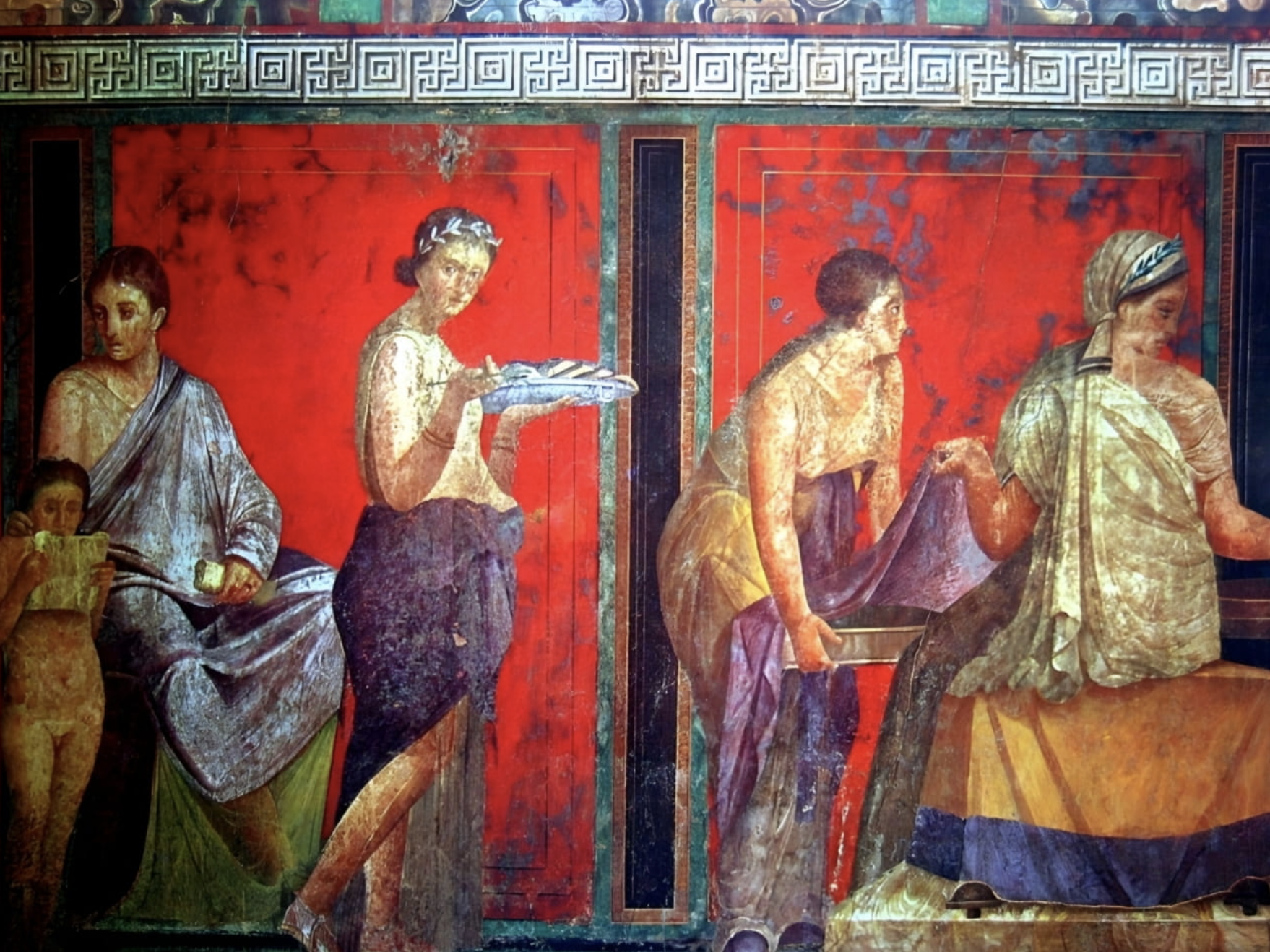
Photo Credit: Public domain (Women depicted in a Roman fresco from the Villa dei Misteri in Pompeii, Italy, c. 60–50 BCE.)
The evidence is particularly strong in Baetica, where 29 of the 36 inscriptions examined by the researchers were discovered. Seventeen of the 20 inscriptions documenting female-funded banquets also came from this province. Several communities, including Munigua, Cartima and Nescania, have produced multiple examples.
Female benefactors frequently connected their generosity with members of their families. Banquets could be used to commemorate husbands, sons, fathers and other relatives, while simultaneously establishing the donor's own presence within the civic community.
Twelve of the 20 inscriptions relating to women-funded meals connect the banquet with another form of public recognition, such as a statue or honour.
This suggests that the feast was often one component of a much broader programme of benefaction. A woman could spend money on a communal meal while also contributing to buildings, religious monuments or statues, creating a lasting public record of her generosity.
One particularly revealing example is Iunia Rustica. Her inscription records an extensive series of benefactions, including work on porticoes, a contribution towards a public tax, land donated for baths and a bronze statue of the god Mars. Alongside these acts, she also financed a banquet and two equestrian statues.
The inscription makes a point of stating that these contributions were made from her own resources.
This distinction appears repeatedly in the evidence. Approximately 70 per cent of the inscriptions relating to female benefactors use the Latin expression sua pecunia, meaning that the donation was made "with her own money". Such wording emphasised the personal nature of the contribution and made it clear whose wealth had funded the public gift.
Religion was another important avenue through which women could become visible within their communities. Six of the female benefactors identified in the study held priestly positions, with several serving as flaminicae associated with the imperial cult. These positions gave women recognised responsibilities within the religious and civic structures of their towns.
One particularly interesting case is Baebia Crinita. In her will, she left funds for a banquet as well as for the construction of a temple dedicated to Apollo and Diana. Her benefaction also included provision for a statue to be erected in her honour.
The amount involved was substantial. The original donation was valued at 200,000 sesterces, although five per cent was deducted in inheritance tax, leaving 179,000 sesterces.
Her example demonstrates how religious activity, wealth and commemoration could overlap. By providing money for a temple and a public feast, she could contribute to the religious life of her community while also ensuring that her own memory was preserved.
The inscriptions also raise an important question: were women simply funding public meals, or were they participating as guests? The answer appears to be both, although the evidence is difficult to interpret.
Some inscriptions only identify particular groups of recipients, such as members of the town council. Their failure to mention women does not necessarily mean that women were excluded from the event.
Other inscriptions are more explicit. Several examples describe meals being provided for both male and female members of the community. An inscription from Naeva, for example, records a banquet for male and female residents, while another from Munigua describes arrangements in which the meal was divided between the two sexes.
Evidence from Italy goes even further. Three inscriptions record banquets where women were the sole recipients. In one case, a donor provided both a meal and two sesterces for every woman attending. Another benefaction provided food for the mothers, sisters and daughters of council members, as well as female citizens from different social backgrounds.
These examples suggest that women could be recognised as legitimate recipients of civic generosity rather than merely appearing in the background of male-centred public events.
It is important not to overstate what this evidence tells us. Roman municipal life remained overwhelmingly structured around male authority. Many public institutions and civic gatherings were dominated by male elites, particularly local councillors.
Women therefore did not have the same access to public life as men. Instead, their participation operated within the social expectations and restrictions of Roman society.
The inscriptions nonetheless demonstrate that wealthy women had several ways of exercising influence. Through their financial resources, religious positions and family connections, they could become highly visible members of their communities.
The study found that around 40 per cent of the female benefactors were married women, while approximately 17 per cent were identified as daughters. Almost half had no stated marital or family status, showing that women's identities in these inscriptions were not always defined through their relationships with male relatives.
Public benefaction was an important part of status and social competition in Roman cities. Wealthy individuals could gain prestige by funding buildings, monuments, religious projects and communal celebrations.
The evidence from Hispania shows that women could participate in this system too. A public banquet offered a particularly effective opportunity. It allowed a woman to provide something tangible for her community while simultaneously creating a public association between herself, her wealth and her generosity.
In many cases, the event also strengthened family memory. A banquet might accompany a statue or honour dedicated to a relative, ensuring that both the family and the benefactor remained part of the town's commemorative landscape.
These inscriptions therefore offer an important counterpoint to the predominantly male perspective found in many literary sources.
They do not show that Roman women possessed the same civic rights or opportunities as men. Instead, they reveal the ways in which some wealthy women were able to negotiate the boundaries of Roman society and establish a public presence within them.
Far from being confined entirely to the private sphere, elite women in Roman Hispania could fund communal meals, hold religious offices, distribute their wealth and receive public recognition.
The evidence suggests that when a Roman community sat down to share a public feast, the person responsible for paying for it was not necessarily a man.
Sometimes, the benefactor was a woman, and she could use that generosity to ensure that her name, wealth and family were remembered long after the meal itself had ended.