Roman Shipwreck Reveals Ancient Engineering Secrets Beneath the Adriatic Sea!
Just off the Croatian coast, a Roman-era shipwreck is quietly rewriting what we know about ancient shipbuilding. Resting beneath the Adriatic for over two millennia, this vessel is offering an unusually detailed glimpse into how ships were protected from the harsh realities of life at sea, and how they were maintained throughout their working lives.
At the centre of this discovery is the Ilovik–Paržine 1 wreck, a merchant ship dating back to around the mid-second century BC. Found in shallow waters near Ilovik Island, it has become the focus of a fascinating study that combines chemistry with palynology, the study of pollen, to uncover not just what the ship was made of, but where it travelled and how it was repaired over time.
Roman ships weren’t simply wooden structures held together by skill alone. To withstand constant exposure to saltwater, shipbuilders coated their hulls with waterproof substances designed to prevent rot and decay. These coatings were typically made from natural materials such as plant resins, tar, bitumen, and wax.
In the case of this ship, researchers found a thick organic coating applied both inside and out. The main ingredient? Pine-derived pitch, a sticky, water-resistant substance created by heating conifer wood in low-oxygen conditions. It’s a material that has been used in shipbuilding for thousands of years, and for good reason.
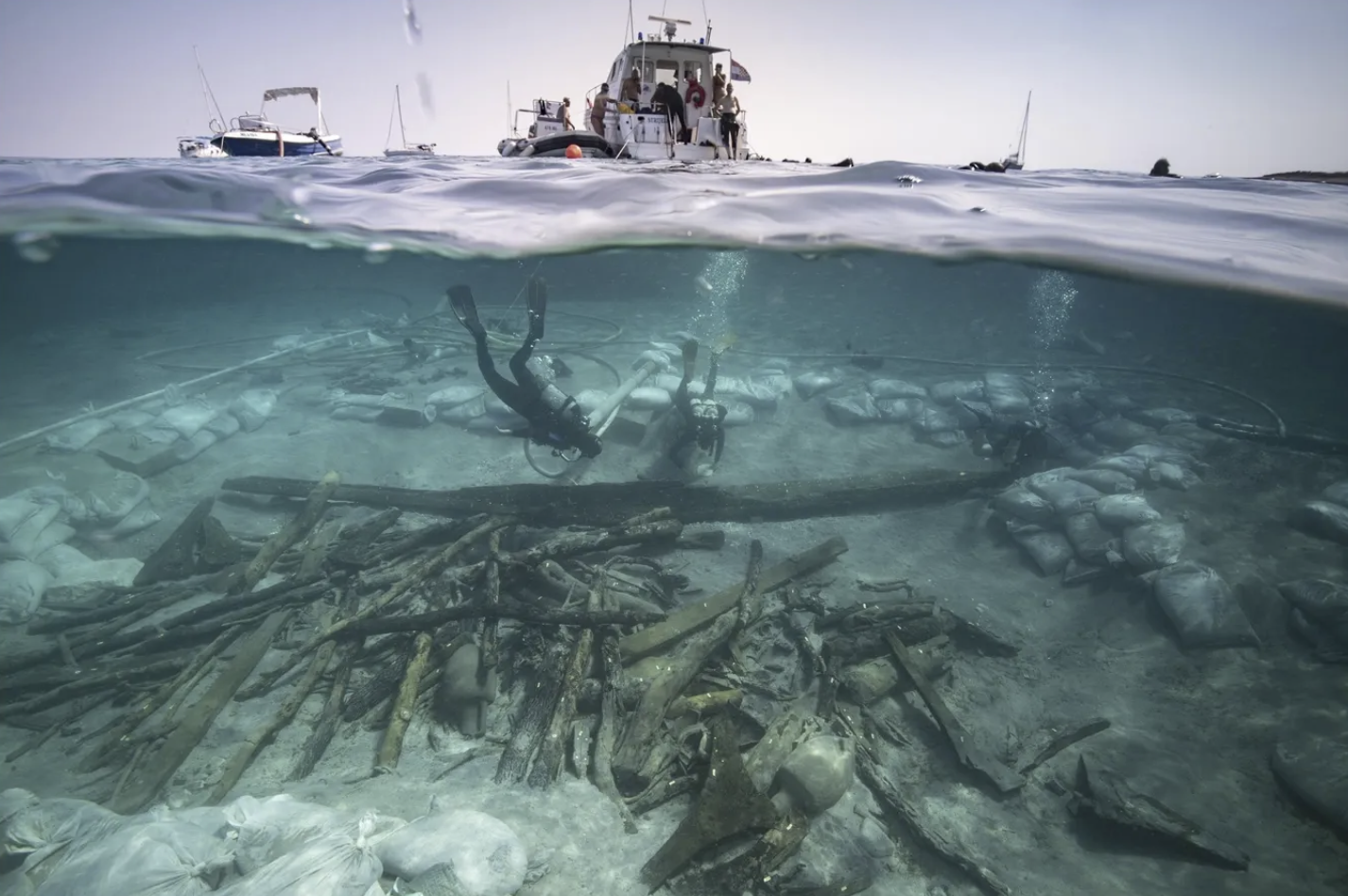
Photo Credit: Adriboats © L. Damelet, CNRS/CCJ). Charrie-Duhaut A, et. al., 2026
What makes this study stand out is how deeply researchers examined the coating itself. Using advanced techniques like gas chromatography–mass spectrometry and infrared spectroscopy, they were able to identify the chemical “fingerprints” within the material.
These fingerprints revealed compounds linked to abietic acid, confirming the use of conifer resin. Even more interestingly, some of the compounds only form when resin is heated to very high temperatures, over 300°C. This suggests Roman shipbuilders weren’t just using raw materials; they were actively refining them to improve performance.
Over time, the coating had naturally degraded, showing signs of exposure to seawater and microbial activity. But one particular finding stood out: traces of beeswax mixed into the pitch. Known in ancient texts as zopissa, this blend would have made the coating more flexible and easier to apply, evidence that Roman builders had a sophisticated understanding of material properties.
While chemistry revealed what the coating was made of, pollen told a different story, where it had been.
Sticky substances like pitch can trap microscopic particles, including pollen grains. By analysing these, researchers were able to reconstruct the environments the ship had encountered during its lifetime.
The results pointed to a mix of Mediterranean landscapes, including oak forests, wetlands, and coastal vegetation. More importantly, the variety of pollen suggested that the ship’s coating wasn’t applied in a single location. Instead, it appears the vessel underwent multiple repairs, using materials sourced from different regions.
Some of the pollen matched areas near Brundisium (modern-day Brindisi in southern Italy), once a major Roman port. Other traces pointed to the eastern Adriatic coast, indicating the ship was likely repaired during its journeys.
Discovered in 2016 and excavated over several years, the wreck lies just four metres below the surface. Alongside parts of the wooden hull, archaeologists found amphorae and ballast stones, helping to confirm its age at around 170 BC, firmly within the Roman Republic period.
What makes this ship so compelling isn’t just its preservation, but the story embedded in its materials. Researchers identified four to five distinct layers of coating, each representing a different phase of maintenance. These layers act almost like a timeline, marking repairs carried out in different places and under different circumstances.
This research highlights a broader shift in archaeology. Rather than focusing solely on visible remains, scientists are now examining microscopic and chemical traces to build a fuller picture of the past.
By combining molecular analysis with environmental data, it becomes possible to map trade routes, understand technological choices, and even trace cultural influences. For instance, the use of beeswax may point to knowledge borrowed from Greek shipbuilding traditions, which were well established in parts of southern Italy at the time.
In that sense, the ship’s coating isn’t just a practical feature; it’s evidence of shared knowledge and interaction across ancient maritime networks.
The Ilovik–Paržine 1 wreck shows how modern science is transforming our understanding of history. Instead of seeing a shipwreck as a static object, we can now view it as something with a life story, built, repaired, adapted, and shaped by the world it moved through.