Roman Villa in Spain May Have Held the Westernmost Library in the Roman Empire!
A seemingly unremarkable room at a Roman villa in southern Spain may have once been a centre of learning, reading and intellectual life.
Archaeologists studying the ancient settlement of Fuente Álamo, near Puente Genil in Córdoba, have proposed that one of its rooms was not, as previously believed, a sanctuary dedicated to the god Mithras. Instead, they argue that the space may have functioned as a private library.
If the interpretation is correct, the discovery would be particularly significant. Researchers suggest that it could represent the oldest known library in the Iberian Peninsula, as well as the westernmost identified library within the Roman Empire.
The study, carried out by researchers from the University of Granada, was published in the Journal of Mediterranean Archaeology.
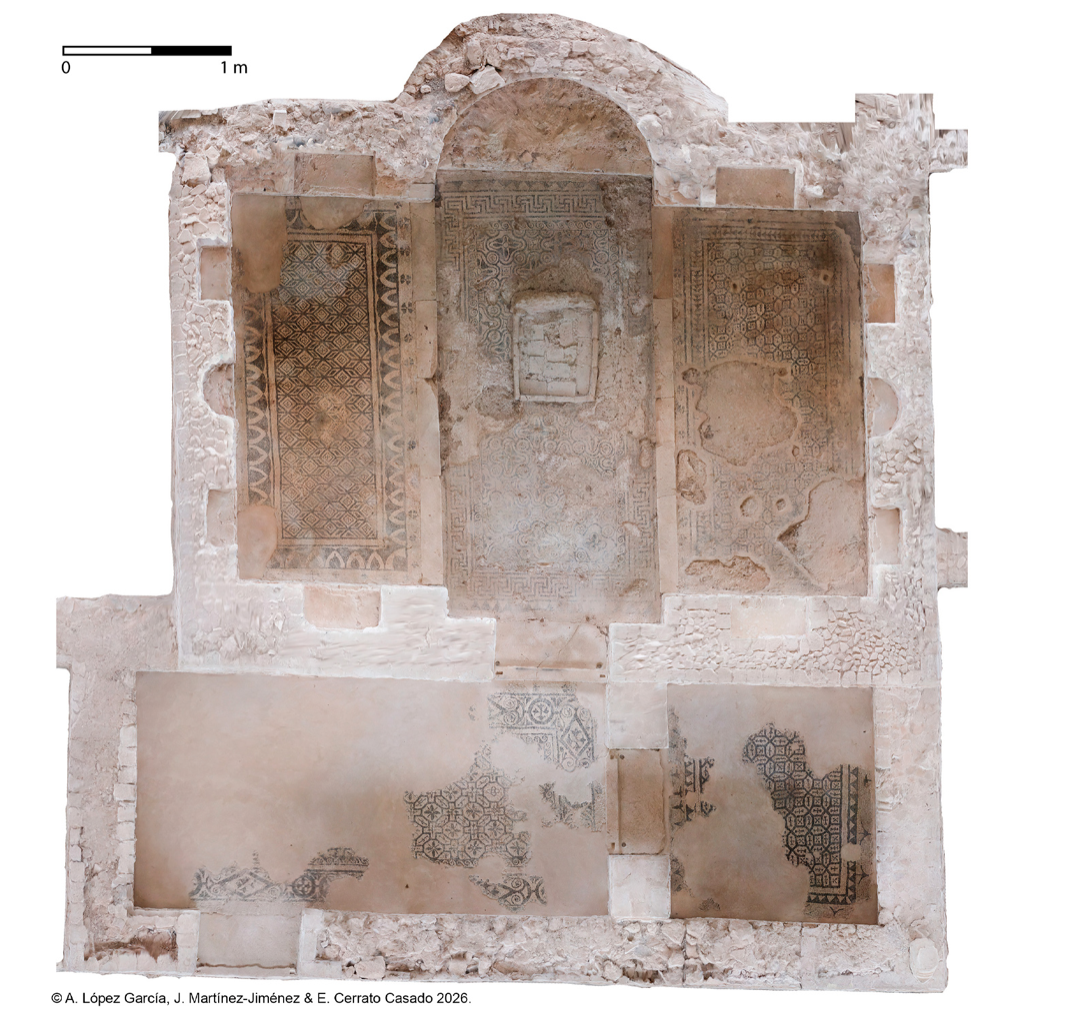
Photo Credit: Antonio López García – University of Granada
One of the difficulties archaeologists face when identifying ancient libraries is that very little of the original contents tends to survive. Roman books were commonly produced using materials such as papyrus and parchment, both of which are vulnerable to decay. Wooden shelving and cupboards have also disappeared from most archaeological sites. As a result, archaeologists are often left trying to reconstruct the purpose of a room from its surviving architectural features alone.
This is precisely the challenge presented by Room 10 at Fuente Álamo. Rather than relying on one particular feature, Antonio López García, Javier Martínez-Jiménez and Eduardo Cerrato Casado examined the room as a complete architectural arrangement. They used an approach known as shape grammar, which considers the relationship between different architectural elements and how their combined arrangement can indicate a building's function.
Their analysis produced an intriguing result. Room 10 contains several unusual features, including an apse, rectangular niches built into the walls, smaller semicircular niches, a raised platform and a series of adjoining spaces.
None of these elements, taken individually, necessarily identifies the room as a library. However, the researchers argue that their combination corresponds closely with architectural patterns found in other Roman spaces associated with books, reading and study.
The reinterpretation is particularly interesting because Room 10 had previously been identified as a possible mithraeum. Mithraea were sanctuaries associated with the cult of Mithras, a religious tradition that spread across large parts of the Roman Empire. These spaces were often relatively enclosed and were used for ceremonies connected with the mystery cult.
The researchers behind the new study argue that the overall arrangement of Room 10 fits the characteristics of a library more convincingly than those of a Mithraic sanctuary. That distinction matters because it changes our understanding of the people who occupied Fuente Álamo.
A library was not simply somewhere to store books. In the Roman world, access to literature and education was closely connected with wealth, status and elite identity. Books were costly to produce, and a substantial collection would have required both financial resources and access to networks through which texts could be acquired.
A dedicated library within a rural villa could therefore have served as both a practical space for reading and an expression of the owner's cultural sophistication.
Fuente Álamo was situated within the territory of Baetica, the prosperous Roman province covering much of modern southern Spain. The villa is particularly famous for its extensive collection of mosaics, which cover hundreds of square metres and include elaborate geometric and figurative designs. Like many elite Roman villas, the site changed over time, becoming an increasingly sophisticated rural residence.
By Late Antiquity, villas could be much more than agricultural estates. Wealthy landowners could use them as places for administration, production, entertainment and social gatherings. The possible library adds another layer to this picture.
It suggests that the intellectual culture associated with Roman urban centres could also be found within wealthy rural households. The inhabitants of Fuente Álamo may have used the villa not only as a place to live, but also as a setting in which education, literary culture and learning could be displayed.
The researchers have also suggested a possible link between the room and a Roman sarcophagus discovered nearby during the nineteenth century.
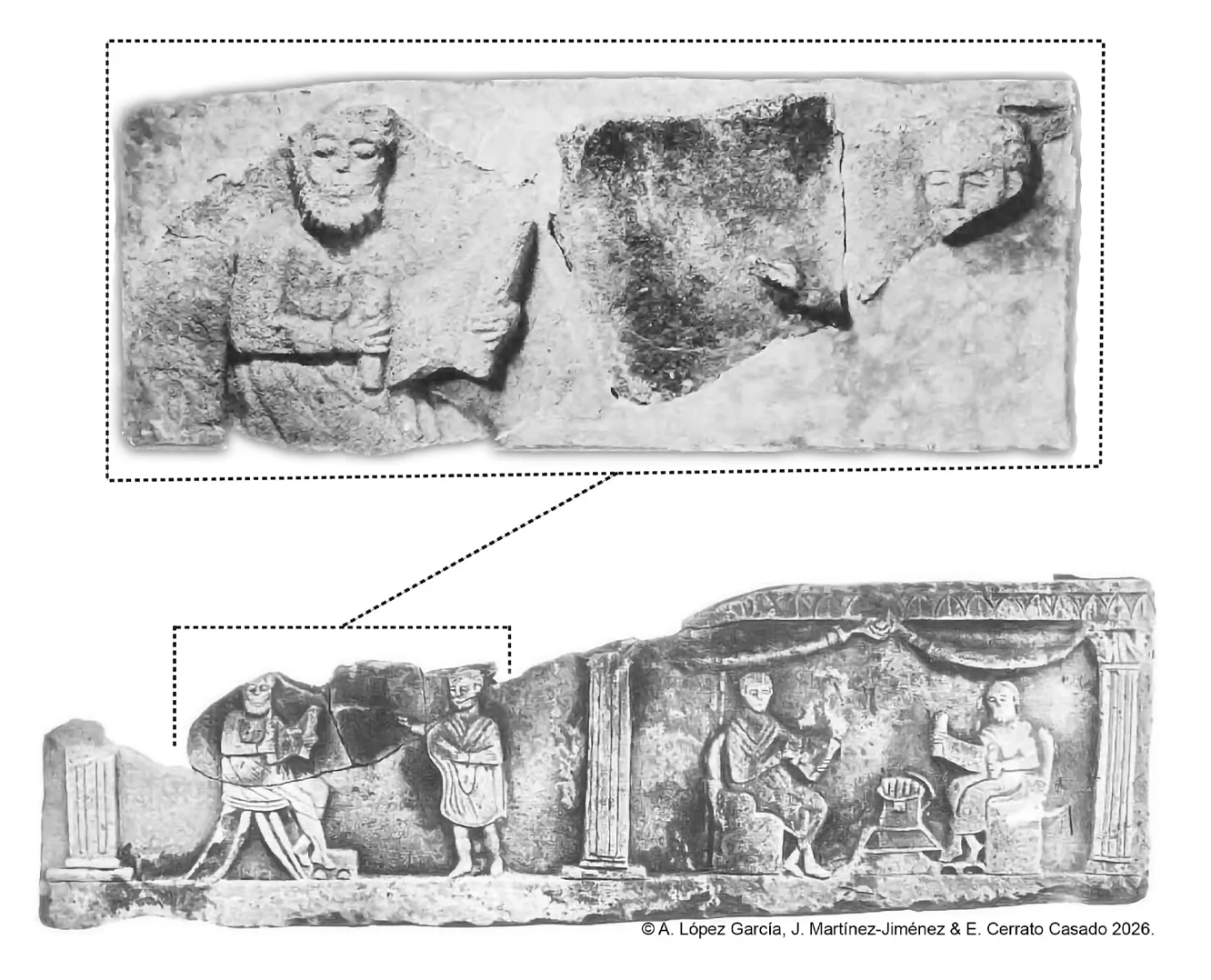
Photo Credit: Sarcophagus photographs reproduced from M. Rodríguez de Berlanga, Catálogo del Museo Loringiano (Málaga: Tipografía Arturo Gilabert, 1903).
Known as the Declamatio Sarcophagus, the object is now preserved in the Museum of Málaga. Its decoration includes imagery associated with education and literary culture. Among its figures is a bearded man carrying both a scroll and a codex, the bound-book format that became increasingly widespread during the later Roman period.
Researchers have noted similarities between this figure and a man depicted in one of the mosaics at Fuente Álamo, who has previously been interpreted as the owner of the villa.
There are also chronological and iconographic similarities between the sarcophagus and the later phases of the villa.
However, this proposed connection remains speculative. There is currently no conclusive evidence that the sarcophagus belonged to the owner of Fuente Álamo, or that the individual depicted on it was associated with the possible library.
Nevertheless, it raises an intriguing possibility. Perhaps the same elite culture that produced luxurious villas and elaborate mosaics also placed considerable value on literacy, education and intellectual identity, both during life and in representations of death.
The significance of the discovery extends beyond a single room in a Spanish villa. Ancient libraries can be exceptionally difficult to recognise archaeologically because their most obvious contents have usually vanished. Without surviving scrolls, manuscripts or furniture, a room can easily be assigned another function.
The researchers therefore argue that looking at combinations of architectural features could provide a more reliable way of identifying libraries and other specialised spaces in the archaeological record.
Fuente Álamo demonstrates why this approach can be valuable. There is no surviving collection of books to tell us what was once read there. We do not know which authors were represented, what subjects were studied, or even how large the collection might have been. Yet the architecture may preserve a trace of the room's original purpose.
If the new interpretation is correct, the walls of Room 10 once surrounded a space dedicated to the preservation and use of knowledge, hidden within a luxurious Roman villa in the far west of the Empire.
The books themselves have disappeared. But nearly two thousand years later, the room built to house them may still be telling their story.